
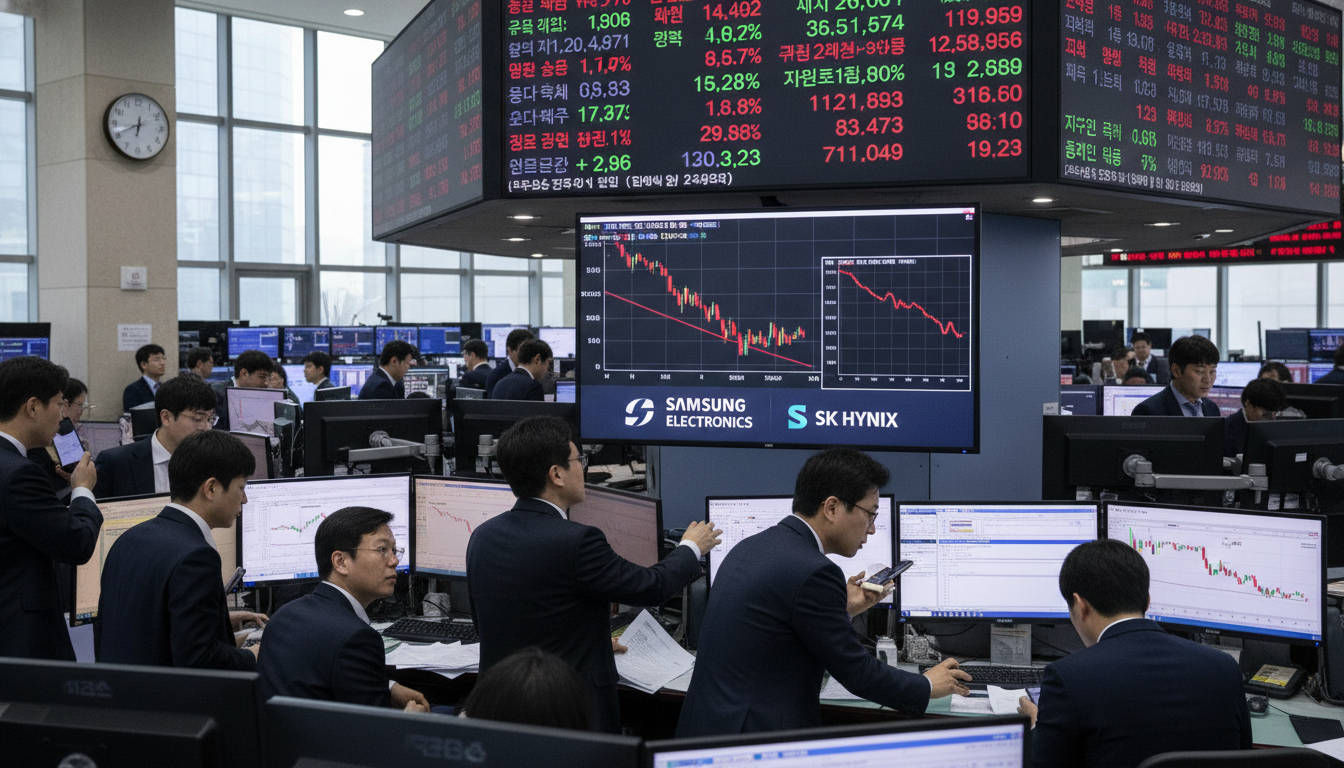
Broadcom Guidance Sparks 5% Sell-Off in Seoul, Dragging Samsung and SK Hynix
Broadcom’s guidance cut sparked a sell-off in Seoul on June 5, 2026, pushing Samsung and SK Hynix down as KOSPI fell over 5%, rattling global chip markets.
South Korean equities plunged sharply on Friday after U.S. chipmaker Broadcom issued weaker-than-expected revenue guidance for its artificial intelligence chip business. The move wiped roughly $285 billion off Broadcom’s market value overnight and triggered heavy selling in semiconductor-linked stocks in Seoul. The rout drove the KOSPI down more than 5%, led by steep declines in the nation’s two largest listed technology firms.
Market Reaction in Seoul
Trading in Seoul opened with substantial losses across technology and export-driven sectors as investors digested Broadcom’s announcement. Chip-related names were the hardest hit, with market breadth skewed heavily to the downside early in the session.
Benchmark KOSPI volatility spiked as institutional and retail traders adjusted positions, amplifying downward pressure. The sell-off was notable for its speed and concentration in semiconductor equities that had previously been buoyed by AI demand narratives.
Broadcom Guidance Sparks Global Sell-Off
Broadcom’s guidance reduced near-term revenue expectations tied to AI accelerators, surprising some investors who had factored robust demand into valuations. The company’s stock lost a significant portion of its market capitalization overnight, prompting reassessments of demand for high-end data-center chips.
Global markets reacted as analysts parsed whether the weakness signaled a broader slowdown in enterprise AI spending or a temporary inventory reset. The episode highlighted the interconnectedness of large chip designers and the supply chain stretching to Asian memory and foundry suppliers.
Impact on Samsung and SK Hynix
Samsung Electronics and SK Hynix, key suppliers in the memory and chip ecosystem, recorded steep declines as traders feared weaker downstream demand. Both firms’ shares fell substantially, contributing the lion’s share of the index’s losses and weighing on market sentiment across sectors.
The sell-off underscored investor sensitivity to demand signals from major customers and systems designers, whose guidance often serves as a near-term barometer for component makers. For Korea’s largest chipmakers, the episode may prompt fresh scrutiny of short-term revenue forecasts and inventory levels.
Investor Sentiment and Fund Flows
Foreign selling accelerated during the day as overseas investors reduced exposure to South Korea’s tech-heavy benchmark amid heightened uncertainty. Exchange-traded funds and active funds with large semiconductor weights saw outflows that intensified price moves in underlying stocks.
Volatility in futures and options markets increased, and implied volatility metrics jumped as market participants sought downside protection. The dynamic raised questions about the speed at which liquidity could return if buyers step in to value the sector on longer-term fundamentals.
Analysts’ Reactions and Earnings Outlook
Brokerage and sell-side analysts moved quickly to update models and guidance assumptions, flagging potential revisions to near-term revenue and margin outlooks for memory vendors. Some analysts emphasized that longer-term structural demand for AI infrastructure remains intact, while others cautioned that deployment schedules and customer ordering patterns could shift.
Earnings calls and investor presentations in the coming weeks are likely to draw heightened attention as market participants look for clarity on sales momentum, inventory digestion, and capital expenditure plans. Companies with diversified product mixes and strong balance sheets may see a different investor response than those more concentrated in volatile product lines.
Potential Ripple Effects for Korea’s Economy
Beyond immediate market moves, the sell-off poses a short-term risk to sentiment-sensitive flows into South Korea’s equity market and could affect capital spending decisions if uncertainty persists. The semiconductor industry is a major contributor to exports and investment, so a sustained slowdown in chip demand would have wider implications.
Policymakers and market participants will monitor developments closely, particularly given the sector’s role in employment, R&D spending, and supplier networks. A rapid correction could present buying opportunities, but it also raises the prospect of delayed projects and tightened liquidity for smaller suppliers.
The episode on June 5, 2026, serves as a reminder of how quickly sentiment can shift in a market dominated by a handful of mega-cap technology names. Market participants will be watching upcoming corporate disclosures and macroeconomic indicators for signals on whether the move reflects a temporary repricing or the start of a more drawn-out adjustment in demand.

