
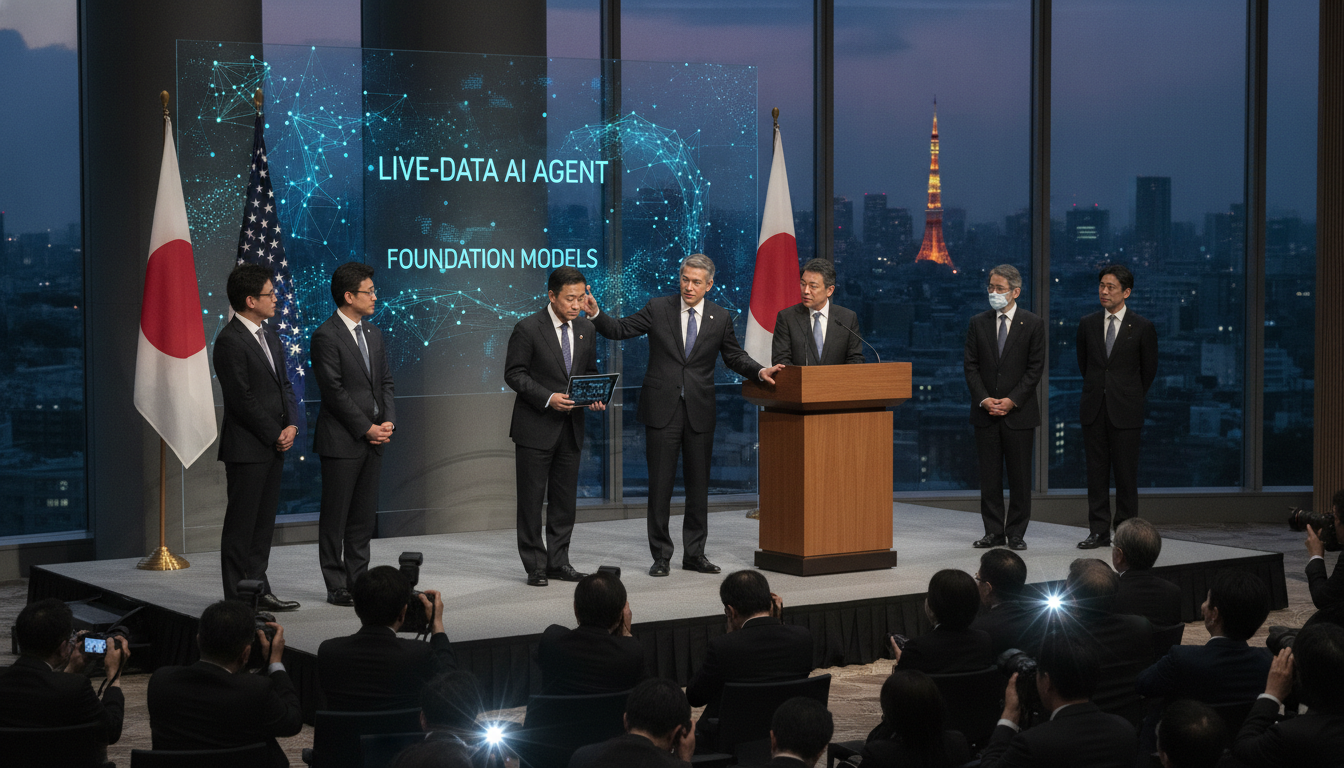
TinyFish expands to Japan with AI agent that ingests live web data
TinyFish expands to Japan with an AI agent that gathers live web information to improve disaster preparedness, manufacturing efficiency and supply-chain resilience across sectors
TOKYO — TinyFish, a U.S.-based artificial intelligence startup, has announced an expansion into Japan centered on an AI agent designed to gather and analyze live information from the internet. TinyFish says the move aims to address a key limitation of many foundation models that rely mainly on historical training data by delivering real-time situational awareness to Japanese organizations.
TinyFish launches AI agent in Japan
TinyFish unveiled its Japan initiative from Tokyo, describing the deployment as the company’s first major push into the country’s commercial and public-sector markets. The startup’s CEO, Sudheesh Nair, said the firm will focus initially on applications where timely data can materially change outcomes, such as disaster response and industrial operations.
The company framed the Japan expansion as part of a broader strategy to pair foundation-model capabilities with continuous access to live sources, enabling organizations to move from retrospective analysis toward proactive decision making. TinyFish emphasized its intent to work with local partners to adapt the technology to Japan’s specific needs and language environment.
How the AI agent captures and analyzes live web data
TinyFish’s agent is described by the company as a system that ingests publicly available web content, news feeds, and other live information streams, then filters and synthesizes data into actionable summaries. The approach aims to augment large language models by feeding them current events, status updates and domain-specific signals that are absent from static training sets.
According to TinyFish, the agent applies relevance filters and context-aware ranking before delivering outputs to clients, reducing noise while highlighting emerging risks and opportunities. The company also says the agent can be integrated with enterprise workflows so that alerts and analyses flow into existing operations dashboards and communication channels.
Disaster preparedness and early warning applications
TinyFish has singled out disaster preparedness as a prioritized use case in Japan, where seismic activity, typhoons and flooding pose recurring risks. The company argues that real-time monitoring of local reports, social media and sensor feeds can provide earlier indicators of disruptions than models trained only on historical events.
In practice, TinyFish envisions its agent aggregating incident reports, transport disruptions and infrastructure status to supply emergency managers and municipal authorities with concise situational briefings. The startup says such rapid summaries can help coordinate relief efforts and inform public advisories when minutes count.
Manufacturing and supply-chain applications targeted at Japanese industry
Manufacturing and supply-chain management are other sectors TinyFish identified as strategic for its Japan expansion. The company pointed to Japan’s dense manufacturing networks and complex supplier relationships as fertile ground for real-time intelligence that flags production bottlenecks and shipping delays.
TinyFish expects its agent to help manufacturers monitor supplier announcements, port conditions and logistics indicators, enabling faster mitigation of disruptions. Executives in procurement and operations roles could use those insights to reroute shipments, adjust production schedules or prioritize components, the company said.
Commercial approach and local partnerships
TinyFish plans to pursue a mix of direct sales to large enterprises and partnerships with Japanese systems integrators to localize deployments. The company indicated it will tailor interfaces and language models to fit Japanese workflows and regulatory norms, while seeking pilot projects that demonstrate measurable operational gains.
The startup did not disclose specific commercial partners or pricing but signaled an openness to collaborate with government agencies, utilities and private-sector firms. TinyFish’s move follows a broader trend of overseas AI vendors adapting offerings for Japan’s market, where language, standards and institutional practices require local customization.
Regulatory and privacy considerations for live-data AI in Japan
Deploying an AI agent that ingests live web content raises legal and ethical questions in any jurisdiction, and TinyFish will need to navigate Japan’s data-protection framework and industry rules. Observers note that operators must be careful about personal data handling, intellectual property and the provenance of sources used to generate outputs.
TinyFish said it will implement controls to filter personally identifiable information and respect takedown or access restrictions when present, while also working to ensure transparency around how conclusions are reached. For prospective clients, the company emphasized the importance of governance, auditing and human oversight in operational use cases.
TinyFish’s Japan expansion spotlights a wider industry effort to overcome a common shortcoming of foundation models: their dependence on static, historical training corpora. By combining continuous access to live signals with model-driven synthesis, the startup aims to deliver time-sensitive intelligence that can influence operational choices in sectors where immediacy matters.
If TinyFish can demonstrate consistent accuracy, regulatory compliance and tangible benefits in early pilots, the company’s agent could become another tool for Japanese enterprises seeking greater resilience and responsiveness in an era of frequent disruptions.

