
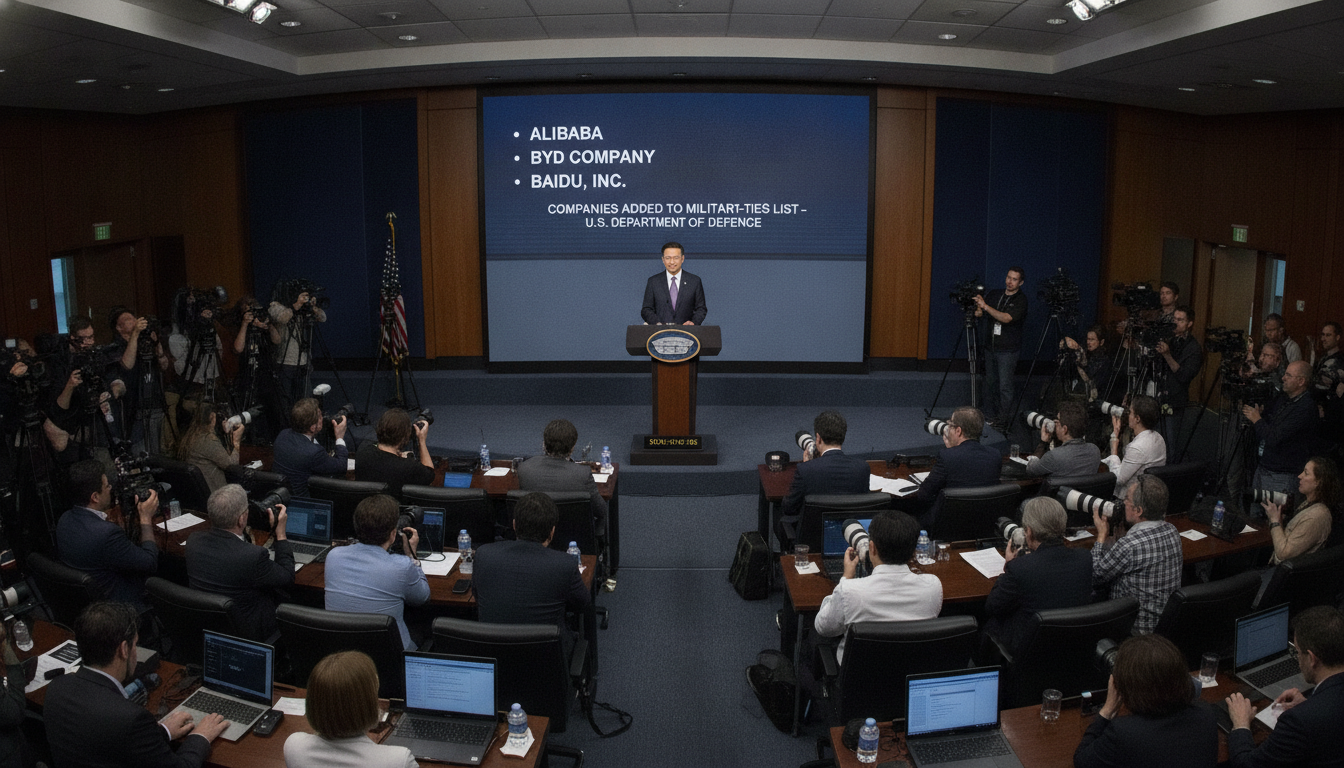
Pentagon adds Chinese companies to military-ties list, including Alibaba and Nio
Pentagon adds Chinese companies to military-ties list; move on June 9, 2026 expands U.S. definition of dual-use technologies and draws corporate vows to contest the designation.
The Pentagon on June 9, 2026 added more than a dozen Chinese firms to a list of entities it says have ties to the Chinese military, a move that officials framed as expanding the U.S. definition of "dual-use technologies" on national security grounds. The announcement, which names companies including Alibaba, BYD, Baidu, Unitree and Nio, comes weeks after a high-profile summit between Chinese president Xi Jinping and U.S. president Donald Trump. The Pentagon said the designations reflect concerns about technology transfers and military modernization, while several companies vowed to fight the action in court and before regulators.
Pentagon expands scope of dual-use technology assessment
The Department of Defense described the latest update as part of an effort to identify civil firms whose technologies could materially support military capabilities. Pentagon officials stated the list targets entities that they assess to have ties to or provide material support for efforts to strengthen and modernize China’s armed forces. The department said the broadened classification emphasizes software, artificial intelligence, robotics and other emerging technologies that can be used in both civilian and military contexts.
Companies named and the range of sectors affected
The list released June 9 covers companies spanning e-commerce, electric vehicles, internet services and robotics. Among those publicly identified were Alibaba, a major cloud and commerce group; BYD, known for electric vehicles and batteries; Baidu, a leading internet and AI firm; Unitree, a robotics maker; and Nio, an electric vehicle manufacturer. The Pentagon’s characterization focused less on consumer products and more on capabilities—such as autonomous systems, advanced semiconductors and AI applications—that it says could advance defense-related programs.
Corporate responses and plans to challenge the designations
Several companies named in the Pentagon notice issued immediate statements rejecting the characterization and pledging to contest the measure. Corporate spokespeople argued their operations are commercial and serve civilian markets, and they called for clarity about the evidentiary basis and legal rationale behind the listing. Some firms also indicated they would seek legal remedies, regulatory review or dialogue with U.S. authorities to clear their names and limit disruption to business activities.
Companies and outside counsel signaled they expected litigation or administrative appeals could follow, and they warned that the designation could unsettle investors and customers while disputes proceed.
U.S. officials cite national security and technology transfer risks
U.S. defense and security officials framed the action as a precaution aimed at curbing the transfer of advanced capabilities that could degrade U.S. or allied military advantages. Officials pointed to risks in supply chains, cloud services and AI-driven systems that, if repurposed, could enhance surveillance, autonomy or weapons development. The Pentagon’s language underscored an evolving view in Washington that commercial technology firms may directly or indirectly contribute to military modernization, prompting new scrutiny beyond traditional defense contractors.
Officials said the update is part of a broader interagency effort to align export controls, investment screening and procurement policy with emerging technological threats.
Market, supply chain and diplomatic repercussions
Analysts warn the redesignation could accelerate adjustments by global investors and suppliers that rely on the affected firms, particularly in semiconductors, cloud infrastructure and automotive components. Trading and capital flows may be disrupted if financial institutions impose restrictions or if partners seek to de-risk exposure to entities on the Pentagon list. Suppliers that provide specialized chips, sensors or software may face secondary pressure to suspend relationships, with potential knock-on effects for production timelines and product roadmaps.
Diplomatically, the move risks complicating U.S.-China economic engagement even as leaders recently met to ease bilateral tensions, and it may prompt reciprocal measures or a hardening of investment screening in Beijing.
Legal and regulatory avenues ahead
Legal experts say the next steps are likely to include administrative appeals, court challenges in U.S. jurisdictions and requests for greater transparency from the Department of Defense and other agencies. Firms could ask courts to compel disclosure of the factual bases for the listings or to review whether the designations exceed statutory authority. Meanwhile, U.S. regulators may coordinate with allies on export controls or investment screening, raising the prospect of parallel actions that would expand the practical reach of the Pentagon’s move.
Companies also face practical compliance decisions as they weigh whether to suspend joint ventures, adjust sourcing or alter product offerings to reduce perceived national security risks.
Timing and geopolitical context after the Xi-Trump summit
The step comes weeks after a summit between President Xi Jinping and President Donald Trump aimed at stabilizing bilateral relations, and it underscores persistent tensions over technology and security. Critics of the listing argue the timing undercuts diplomatic overtures and risks re-escalation of trade and tech frictions, while proponents contend it is a necessary response to long-term strategic competition. The juxtaposition of high-level diplomacy and tougher industrial measures highlights the complex balance governments are trying to strike between engagement and protection.
Market participants and diplomats are now watching for follow-up actions from the U.S. government or from China that could clarify how the designation will be enforced and whether it will trigger reciprocal responses.
The Pentagon’s June 9 announcement marks a notable shift in Washington’s approach to commercial technology firms and national security, and it is likely to prompt legal contests, corporate strategy shifts and further policy moves as both governments and industry adapt to the changing rules of engagement.

