
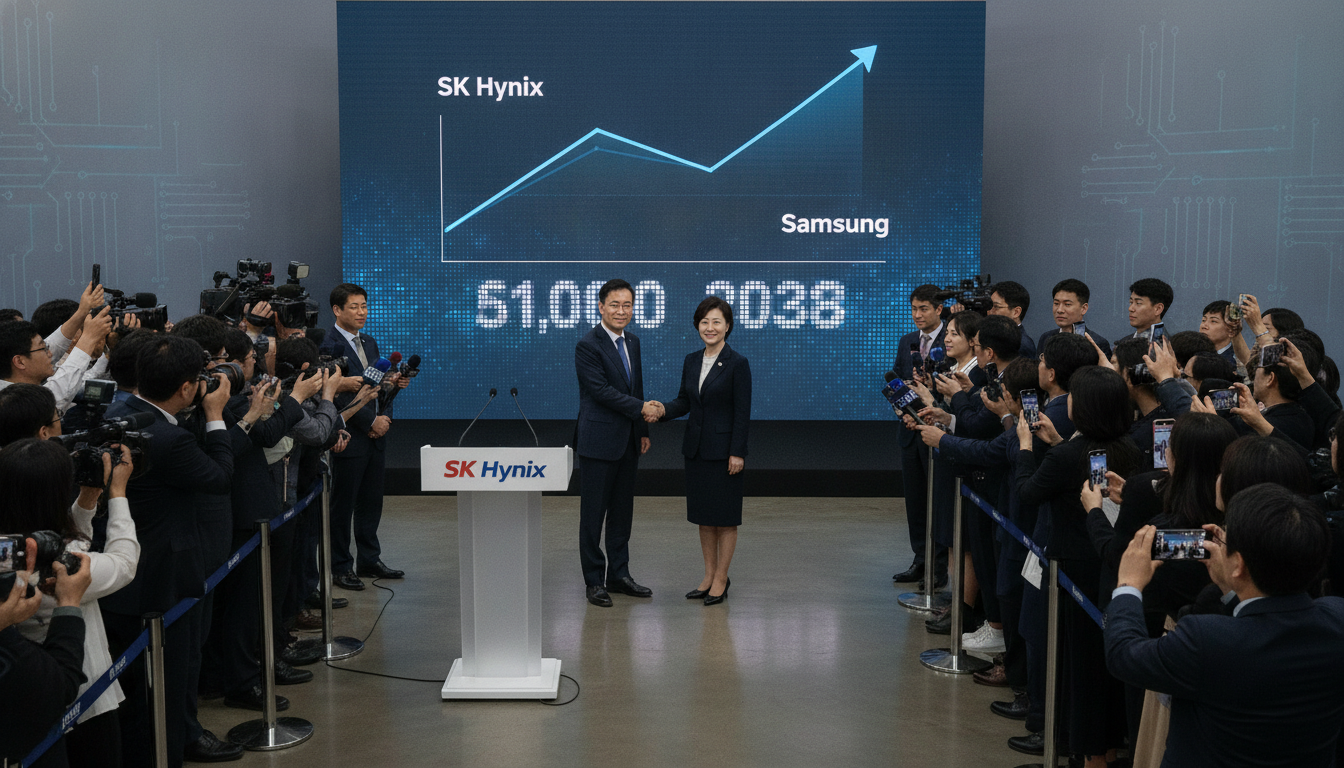
SK Hynix Overtakes Samsung to Become South Korea’s Most Valuable Company
SK Hynix becomes South Korea’s most valuable company as AI-driven demand for high-bandwidth memory pushes its market cap past Samsung on June 22, 2026 trading.
SK Hynix briefly surpassed Samsung Electronics to claim the top market valuation in South Korea during intraday trading on Monday, June 22, 2026. The rise marks the first time in 26 years that Samsung has been displaced from the No. 1 spot, driven largely by surging demand for memory products used in artificial intelligence computing. Investors reacted to fresh earnings estimates and supply dynamics that favored SK Hynix’s advanced memory technologies.
Market Move Breaks Longstanding Ranking
SK Hynix’s intraday market value climb interrupted a quarter-century run during which Samsung held the leadership position in market capitalization. The shift occurred on June 22, 2026, when trading momentum amplified gains in SK Hynix shares. While intraday leadership can be volatile, the event signals how technology cycles and investor sentiment can reshape market hierarchies rapidly.
SK Hynix’s position reflects a reweighting of investor priorities toward companies playing direct roles in AI infrastructure. The company’s stock gains were tied to expectations for continued strength in shipments of high-bandwidth memory and other advanced DRAM products. Market participants noted the move as emblematic of a broader rotation into firms supplying components for large-scale AI systems.
AI Demand Fuels High-Bandwidth Memory Sales
Analysts point to accelerating demand for high-bandwidth memory (HBM) as a core driver behind SK Hynix’s valuation surge. HBM modules, designed to feed massive amounts of data to AI accelerators, have become a key bottleneck in data-center upgrades worldwide. SK Hynix is one of a small number of suppliers able to scale HBM production, giving it leverage as hyperscalers and chip designers expand AI compute capacity.
The AI hardware cycle has raised forecasts for memory pricing and utilization, improving revenue visibility for suppliers. SK Hynix’s reported gains reflect both real demand and investor expectations of sustained pricing power through the near term. Companies specializing in these specialized memory products have attracted fresh interest from institutional and retail investors seeking exposure to the AI supply chain.
Short-Term Volatility and Trading Dynamics
The transition to intraday leadership underscores how quickly market capitalizations can shift in response to news and analyst revisions. Intraday price moves do not necessarily indicate a permanent change in rankings; closing values and subsequent trading sessions will determine whether SK Hynix sustains the top spot. Traders noted increased volumes and implied volatility in both SK Hynix and Samsung shares on June 22, 2026.
Derivatives activity around memory and semiconductor stocks also increased, suggesting hedging and directional bets by funds. Short-term traders seized the momentum while longer-term investors focused on fundamentals such as capacity expansion plans, margin trends, and supply-chain constraints. Market strategists cautioned that earnings reports, export policy decisions, or changes in capital expenditure plans could quickly alter valuations.
Samsung’s Position and Industry Response
Samsung Electronics remains a dominant player across memory, logic chips, and consumer electronics despite the intraday shift. Its diversified business model and leading foundry investments continue to anchor its long-term market position. Company executives and industry observers emphasized that a single trading session does not erase Samsung’s scale or strategic importance to South Korea’s economy.
Nonetheless, the episode highlights how concentrated demand for specific components—like HBM—can temporarily elevate specialist suppliers. Samsung’s own investments in memory and semiconductor capacity mean competition for high-margin, high-demand segments is intensifying. Market analysts said the episode would likely spur further scrutiny of product road maps and capacity timelines across the industry.
Broader Implications for South Korea’s Tech Sector
The valuation episode reflects a wider reappraisal of winners and losers within the global semiconductor ecosystem as AI adoption accelerates. South Korea’s technology sector stands to benefit from increased capital flows and attention, especially for firms that can demonstrate near-term revenue exposure to AI infrastructure. Policymakers and industry associations may cite the development as evidence of the country’s strategic role in global tech supply chains.
At the same time, concentration risk grows when market valuations cluster around a few suppliers of critical components. Investors and corporate boards will watch capacity investment decisions, export controls, and geopolitical developments closely. The interplay between national industrial policy and global demand for AI hardware could shape capital allocation in the sector for years.
Market watchers will monitor whether SK Hynix can hold the top spot at the close of trading and beyond, and whether the AI-driven memory cycle translates into sustained earnings upgrades. For now, the June 22, 2026 intraday milestone underscores the speed with which technological shifts can reorder market leadership in a major economy.

