
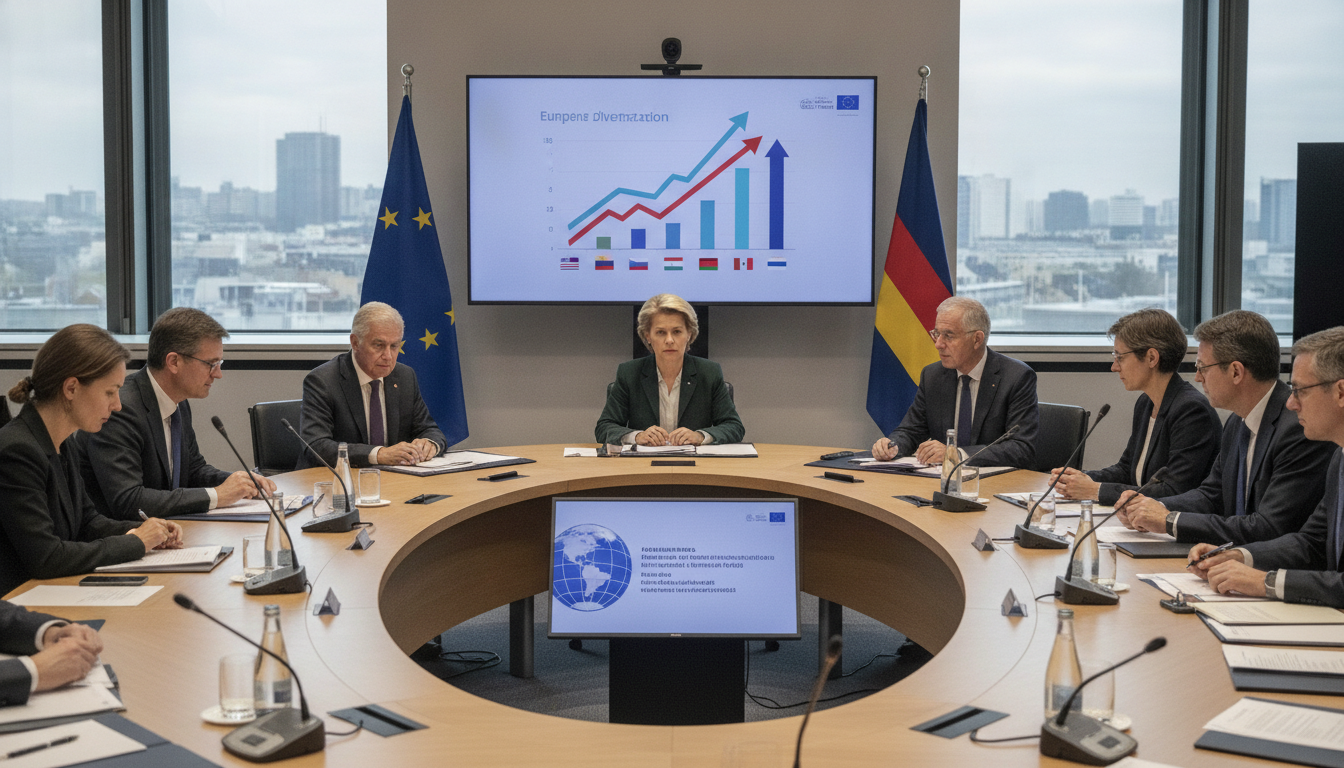
EU-China trade: EU leaders back diversification tool as bloc splits over pressure on Beijing
EU-China trade: EU leaders approved a diversification tool to address a €1bn-per-day trade deficit with China, while remaining divided over how tough to be with Beijing.
European Union leaders agreed this week to give the bloc new means to diversify trade and reduce strategic dependence on China, a move that signals a shift in EU-China trade policy and regulatory posture. The announcement comes as the EU’s trade deficit with China has topped about €1 billion per day, prompting calls within the bloc for stronger measures to rebalance commerce. Chinese companies operating in Europe are preparing for tougher scrutiny, even as member states hedge on how far to push Beijing on investment and market access. The decision reflects both economic concern and political caution as the EU seeks tools to protect key industries without igniting a broader confrontation.
Leaders adopt diversification tool to limit dependencies
EU capitals reached a consensus to deploy a so-called diversification instrument aimed at reducing strategic exposure to single-country supply chains. The tool is intended to encourage member states and private companies to seek alternative suppliers and to better coordinate procurement and investment screening across the bloc.
Officials framed the measure as preventive rather than punitive, emphasizing resilience for critical sectors such as batteries, semiconductors and medical supplies. The aim is to reduce vulnerabilities without immediately resorting to tariffs or wholesale decoupling.
Trade deficit of roughly €1bn per day cited as catalyst
Senior policymakers cited the widening EU-China trade gap as a key driver for the new policy push, noting the imbalance at roughly €1 billion a day as unsustainable for Europe’s industrial base. That figure has intensified debates in Brussels about market access, subsidies and reciprocity in trade rules.
The deficit has become a political touchstone, used by officials to justify stronger tools to counter distortions from state-backed competition and to protect nascent European industries.
Regulatory options under discussion in Brussels
Brussels officials outlined a menu of possible measures that could be tightened if imbalances persist, including stronger investment screening, targeted anti-subsidy investigations and stricter scrutiny of state-owned-enterprise activity. Export controls on sensitive technologies and incentives for reshoring or nearshoring are also on the table.
EU institutions caution that any concrete steps will need legal backing and unanimous or qualified-majority approval depending on the measure. That process ensures procedural checks but also leaves room for political bargaining among member states.
Member states remain divided over how hard to press Beijing
Despite agreement on diversification, member states differ sharply on how aggressively to confront China on trade and investment. Countries with large manufacturing linkages to China and significant Chinese investment, such as Hungary, have urged caution and a pragmatic approach.
Other EU capitals, particularly those with stronger domestic green-tech and semiconductor ambitions, favor more assertive measures to level the playing field. This split complicates efforts to agree on sanctions-like tools or broad restrictions that would directly target Chinese firms.
Chinese investments in Europe come under closer scrutiny
European scrutiny of Chinese acquisitions and greenfield projects has heightened, with particular attention on strategic sectors. Notably, CATL’s battery factory in Debrecen, Hungary, has been cited as a prominent example of ongoing Chinese investment in Europe and has spurred debate over long-term industrial implications.
Regulators and legislators in several member states are now pushing for clearer thresholds and faster procedures to review foreign direct investment that might threaten security or critical supply chains. Investors and companies say they are preparing for a stricter regulatory environment and a longer approval process.
Timetable and next steps for implementation
Officials in Brussels say the diversification tool will be fleshed out through legislative proposals and intergovernmental consultations over the coming months. Legal drafting and impact assessments are expected to precede any formal adoption, with implementation mechanisms calibrated to avoid sudden market disruption.
EU institutions will also seek to align the new measures with existing trade and competition laws to reduce the risk of legal challenge. The timing and scope of any concrete restrictions will likely reflect the balance of political pressures among member states.
The decision to pursue a diversification strategy underscores a strategic shift in EU-China trade relations toward risk management and reciprocity. While the bloc has stopped short of unified hardline measures, the combination of political attention, a rising trade imbalance and targeted regulatory options signals a new era of closer scrutiny for trade and investment ties with China.

