
Khamenei funeral in Tehran draws massive turnout as Iran projects unity during U.S. talks
Iran reports up to 20 million could attend Tehran events for Khamenei funeral; casket displayed at Imam Khomeini Mosalla amid political messaging.
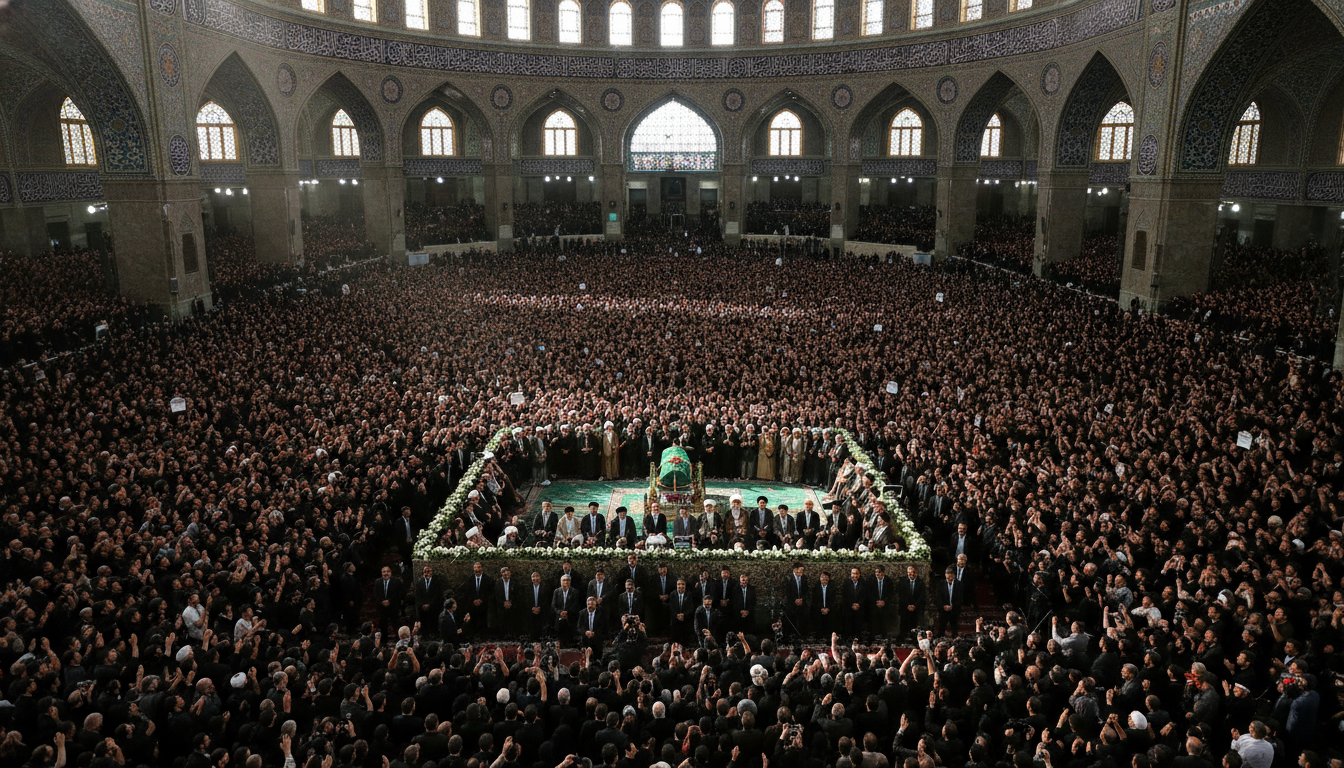
The funeral for the late Supreme Leader Ali Khamenei opened in Tehran on July 4, 2026, with the casket displayed at the Imam Khomeini Mosalla and large crowds gathering in the mosque’s plaza. State-organized events and attendant displays of public mourning for the Khamenei funeral coincided with sensitive negotiations aimed at ending hostilities with the United States. Government statements and the scale of the ceremonies signaled an intention to reinforce national unity and project resolve while talks continue.
Casket displayed at Imam Khomeini Mosalla
The public viewing began at the sprawling Imam Khomeini Mosalla in central Tehran early on July 4, where the mosque compound and its adjacent plaza filled with worshippers and mourners. Eyewitness accounts and state broadcasts described long lines and dense clusters of people who had gathered to file past the casket. Organizers moved to maintain order inside the complex even as the sheer number of attendees tested the facility’s capacity.
Religious rites and traditional funeral observances were held throughout the day, with clerics and protocol officials conducting formal ceremonies at scheduled intervals. The choice of the Mosalla, a prominent venue for national events, underscored the ceremonial importance the state attached to the proceedings. Officials framed the display as both a religious obligation and a moment for public expression of grief.
Government predicts up to 20 million attendees in Tehran
Iranian authorities announced that events in the capital could attract as many as 20 million participants across multiple days, a figure that, if realized, would represent a substantial portion of the national population. Officials described the estimate as reflecting attendance at a range of scheduled gatherings and processions tied to the funeral. State media emphasized widespread participation to convey the depth of public sentiment.
Analysts caution that official crowd and attendance figures at large state events can be difficult to verify independently, but the projection itself functions as a political signal. The government’s calculation—equivalent to roughly one in five citizens attending some part of the capital’s program—was repeatedly highlighted in official reporting and commentary. Logistics for such a turnout prompted visible deployment of municipal services and crowd management resources.
Timing of ceremonies amid U.S. negotiations
The funeral’s scale and timing drew immediate attention because it unfolded while diplomatic channels reportedly remained engaged in negotiations aimed at ending combat with the United States. Officials framed the ceremonies as a unifying national event, but observers noted the added layer of political messaging. Holding mass public rituals during delicate talks can serve both domestic mobilization and international signaling purposes.
Iranian spokespeople and allied voices framed the ceremonies as an assertion of sovereignty and national resolve, language likely intended for both domestic and external audiences. Foreign policy experts suggested the state sought to demonstrate a mandate of popular support that could strengthen its bargaining position. At the same time, diplomats monitoring the situation signaled concern that large-scale mobilization might complicate back-channel efforts to reach a de-escalatory agreement.
Military and officials pledge unity before ceremonies
In the days leading up to the public viewing, senior government figures and military commanders issued statements emphasizing unity and commitment to preserving national security. State coverage highlighted coordinated messages from political and security institutions, presenting a consolidated leadership front during the funeral events. The sequence of public pledges underscored the ceremonial moment’s overlap with high-stakes policy considerations.
Military processions and formal appearances by senior officers at memorial gatherings reinforced the impression of institutional cohesion. Observers noted that such displays are often designed to reassure supporters and deter adversaries by showcasing organizational discipline. Officials stressed that the funeral program would remain orderly and respectful, while also invoking themes of national endurance.
Crowd management and urban impact in Tehran
Managing the expected influx of mourners placed pressure on Tehran’s transport and public services, with authorities implementing measures to facilitate movement and safety. Roads leading to the Mosalla and major arteries in the city experienced disruptions as large numbers of people converged on ceremonial sites. Local authorities coordinated emergency services, sanitation teams and volunteer networks to cope with the crowds.
Public messaging urged participants to follow instructions from organizers and to observe public health and safety guidance. Despite measures, long waits and congestion were reported in several districts, and residents noted an unusually visible security presence. City officials said contingency plans were in place to handle any emergencies that might arise during the multi-day program.
The funeral’s progression and the government’s framing of attendance figures will be watched closely in Tehran and beyond as indicators of domestic cohesion and regime resilience. What follows in coming days—burial arrangements, national mourning episodes and official commemorations—may offer further clues about internal dynamics and the interplay between ceremony and politics.
The Khamenei funeral thus functioned as a major national event with both religious and political dimensions, unfolding in a context where diplomatic efforts to end hostilities with the United States remain active and fragile. The ceremonies demonstrated the Iranian leadership’s capacity to stage mass public rituals and to marshal institutional support, even as the country navigates sensitive negotiations and the practical challenges of managing vast crowds in an urban capital.

