
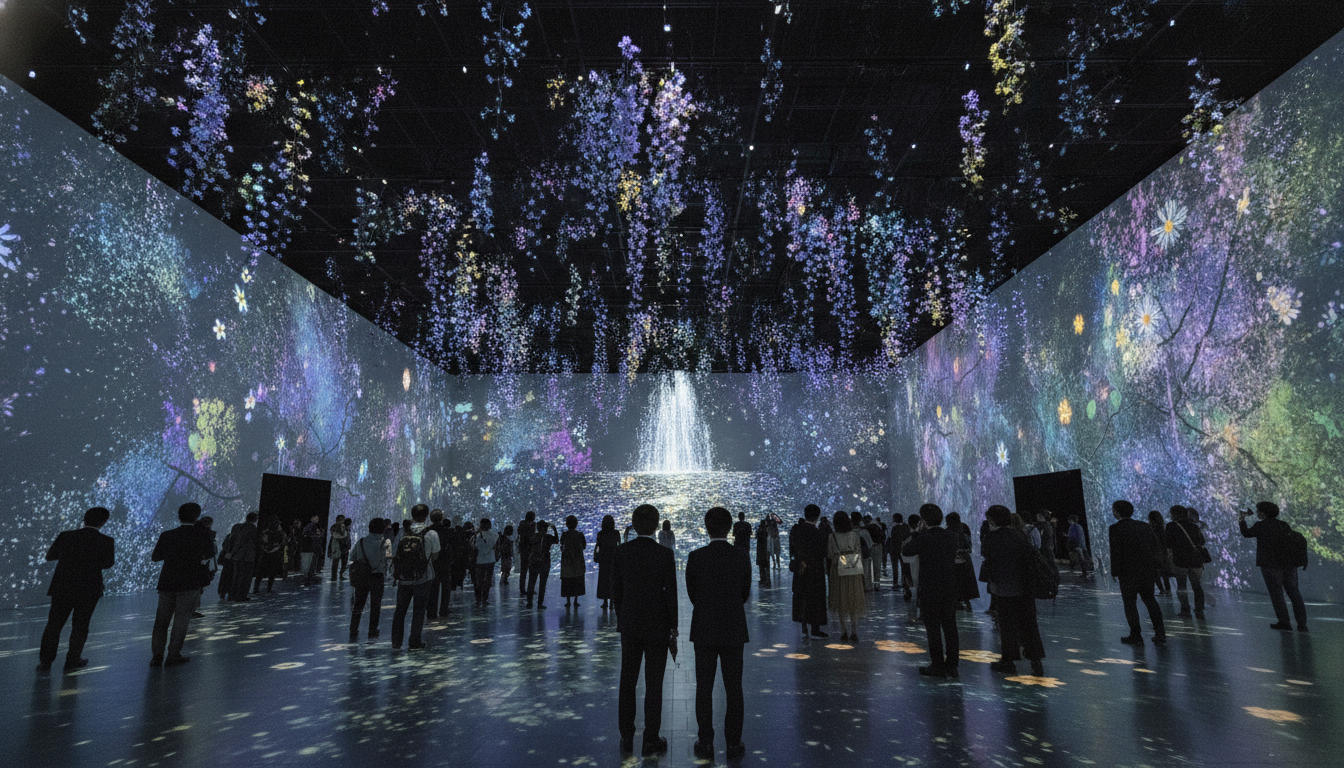
teamLab Borderless reopens at Azabudai Hills with new “On the Asymmetry of the Universe” installations
teamLab Borderless reopens at Azabudai Hills with new “On the Asymmetry of the Universe” installations through Oct 8, 2026; tickets, hours and visitor tips.
teamLab Borderless reopened on July 8, 2026 at Azabudai Hills, introducing a fresh set of works under the title “On the Asymmetry of the Universe.”
The Mori Building Digital Art Museum’s relaunch brings classic attractions and newly commissioned pieces to a redesigned, permanent home near Roppongi.
This report outlines the new installations, practical visitor information, and what the reopening means for Tokyo’s cultural landscape.
Reopening date and headline installation details
teamLab Borderless officially reopened its doors at Azabudai Hills on July 8, 2026, marking the return of the institution to central Tokyo.
The museum’s Light Sculpture – Flow room reopened with two new series — “Asymmetric Existence” and “Chromatic Existence” — running through October 8, 2026.
Both new works are included in the standard museum route and require no additional ticket; they are intended to expand the museum’s long-running exploration of perception, light and spatial illusion.
Why the move from Odaiba and how the new site differs
The original teamLab Borderless in Odaiba closed in 2022 as part of redevelopment at Odaiba Palette Town, ending a run that had made the venue a global draw.
Azabudai Hills, located in Minato Ward near Roppongi, offers a more central location and deeper integration with a mixed-use urban complex, providing visitors with expanded dining and shopping options before or after a museum visit.
Museum programming at the new site pairs restored favorites from the Odaiba collection with site-specific commissions designed for the Azabudai Hills architecture and circulation patterns.
New works in the Light Sculpture – Flow room and what to expect
“Asymmetric Existence” experiments with reflection and absence, presenting light sculptures that challenge visual coherence by disconnecting object and mirror image.
One piece appears in the physical space with no mirror reflection, while another exists only within a reflective surface, forcing viewers to reconcile two halves of a single perceived form.
“Chromatic Existence” abandons hard edges and surfaces, using fields of color that settle into ordered patterns to create sculptures with no defined boundaries, inviting visitors to experience form through light and color alone.
Signature rooms and interactive highlights returning to the museum
Visitors will find long-favored installations such as the Bubble Universe — a mirrored chamber of glowing spheres — and Infinite Crystal World, a suspended forest of lights that visitors can walk among.
The Sketch Ocean and the celebrated waterfall-like projection are on the route as well, combining participatory digital drawing, motion-reactive projection and large-scale environmental pieces.
Several projections throughout the museum respond to touch or movement, emphasizing teamLab’s mission of erasing boundaries between artwork and audience.
Tickets, opening hours and special passes
Standard adult admission ranges depending on the date, with typical prices reported between ¥3,600 and ¥5,600; youth and child pricing, reduced and disability-rate tickets are available.
The museum generally operates from 8:30 a.m. to 9:00 p.m., with last entry typically one hour before closing, though hours and occasional full closures change on specified dates, so visitors should confirm the official calendar before travel.
A limited-time Student Summer Pass is available for university and vocational students between July 18 and September 18, 2026, offering reduced pricing for eligible cardholders.
How to buy tickets and best timing for a visit
Tickets are sold in advance through the museum’s official ticketing channels and authorized vendors; the museum recommends purchasing at least two to three weeks ahead for preferred dates and timeslots.
To avoid peak crowds, plan for the earliest weekday slot available and allow around two hours to move through the main route at a relaxed pace, although visitors may remain inside for longer if they wish.
Download the museum app before visiting to access artwork descriptions and to obtain numbered entry for particularly popular spaces, including Infinite Crystal World.
Visitor experience, practical tips and accessibility notes
Some exhibit spaces include floor mirrors or low-reflective surfaces; visitors are advised to wear clothing that provides comfortable coverage and to be mindful of slippery areas in wetter tactile displays.
Photography and video are generally permitted in most areas for personal use, but the museum encourages guests to balance documentation with direct engagement to fully appreciate time-based and interactive works.
Accessibility provisions include discounted tickets for those with disability certificates and facilities designed for wheelchair access in many areas, though certain immersive spaces may have physical constraints; visitors with specific needs should check with the museum prior to arrival.
On-site amenities: En Tea House and Azabudai Hills surroundings
The museum’s En Tea House offers a sensory pause mid-visit, serving tea experiences in which digital projections interact directly with the cup, extending the exhibition’s themes into refreshment and ritual.
Azabudai Hills itself provides a range of restaurants, cafés and retail outlets, making it practical to combine a museum trip with a longer visit to the neighborhood.
Public transportation access is convenient: the site sits roughly a 15-minute walk from Roppongi and Azabujūban stations, providing multiple transit options for domestic and international visitors.
teamLab the collective and the broader network of exhibitions
teamLab began as a multidisciplinary collective of artists, programmers and researchers and has grown into an internationally recognized producer of large-scale digital exhibitions.
Beyond the Borderless flagship in Tokyo, teamLab operates other long-term and temporary sites across Japan and abroad, offering variations on immersive, interactive installations that pair technology with natural and cultural themes.
The group’s practice emphasizes collective authorship and transdisciplinary collaboration, which is reflected in the museum’s rotating program and large-scale commissions.
Comparing Borderless and Planets for visitors choosing between locations
teamLab Borderless emphasizes a “museum without a map,” offering open circulation and works that migrate across spaces, whereas teamLab Planets presents a more structured route with highly tactile elements.
Visitors seeking exploratory, photo-friendly environments may prefer Borderless for its sprawling, shifting displays; those who want to physically interact with installations, including wading and climbing in controlled settings, may find Planets more aligned with their interests.
Both institutions share conceptual DNA and overlapping works, but each delivers a distinct balance of movement, touch and spatial storytelling.
Practical considerations for families and groups
Children three and under typically enter free, while child and youth ticket categories cover ages four through 17, with pricing tiers in place for different age groups.
The museum’s combination of dim lighting, mirrored floors and dense visual stimuli means families should plan for calm transitions and allow time for younger visitors to acclimate.
Groups can benefit from staggered entry times and pre-arranged meeting points both inside and outside the museum to avoid congestion at popular installations.
What the reopening means for Tokyo’s cultural calendar
The return of teamLab Borderless to central Tokyo strengthens the city’s roster of immersive digital art and reinforces Azabudai Hills as a new cultural hub.
The museum’s schedule of temporary commissions and rotating works through the autumn creates an incentive for repeat visits and for tourists to time their travel around specific installations.
This reopening is likely to sustain tourism footfall in Minato Ward and to encourage collaboration between private developers, cultural institutions and international visitors.
teamLab Borderless’ return to Azabudai Hills offers a renewed opportunity to experience immersive digital art in the heart of Tokyo, combining new experimental works with established crowd-pleasers.
Visitors are advised to secure tickets in advance, confirm opening hours for their chosen date, and allocate sufficient time to move through the exhibitions at leisure.
With installations running through October 8, 2026 and special student passes available during the summer window, the reopened museum is positioned as a must-see attraction for both first-time and returning visitors.

