
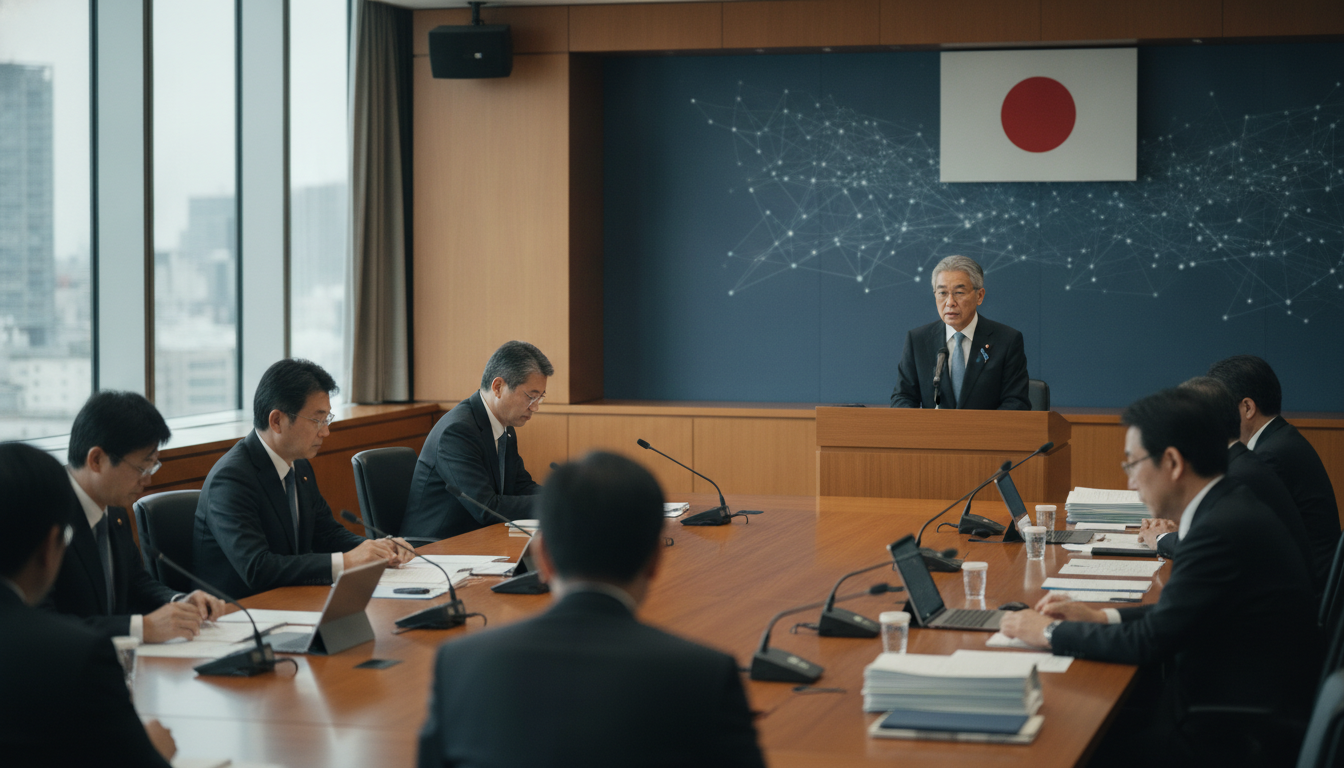
Cabinet Approves Revised AI Basic Plan to Strengthen Cybersecurity and Pursue AI Sovereignty
Japan approves revised AI basic plan July 14, 2026, tightening cybersecurity, seeking AI sovereignty and prioritizing vertical and physical AI and jobs.
The cabinet on July 14, 2026, approved a revised AI basic plan that tightens Japan’s response to cyber and national security risks posed by high‑performance artificial intelligence. The updated AI basic plan emphasizes strengthened defenses against cyberattacks, reviews of regulatory frameworks including the AI law, and closer coordination with foreign government agencies. Officials said the changes were prompted by rapid technological shifts and recent incidents demonstrating new vulnerabilities in large AI systems.
Cabinet Decision and Immediate Drivers
The cabinet decision moves quickly to adapt policy to a changing technological landscape, coming only months after the previous plan. Government sources cited the emergence of high‑capacity AI models abroad, notably Anthropic’s recently deployed model, which exposed systemic weaknesses and raised the prospect of more accessible attack vectors. That development prompted an expedited reassessment of risk in critical sectors and immediate steps to protect government systems and essential infrastructure.
Expanded Cybersecurity Measures and System Inspections
Under the revised plan, the government will require more frequent inspections of core government systems and critical infrastructure to identify and patch vulnerabilities that could be exploited through AI‑assisted attacks. The measures include stepped‑up monitoring, accelerated incident response protocols and updated guidelines for public and private operators in finance, energy and transportation. Officials stressed the need for closer information‑sharing between ministries and private sector operators to reduce response times when threats emerge.
Review of Legal Frameworks and International Cooperation
The plan tasks relevant ministries with reviewing existing statutes, including the AI law, to ensure legal tools are effective against evolving risks from high‑performance models. At the same time, Tokyo will deepen collaboration with allied governments and international agencies to harmonize standards and pursue joint countermeasures. The government said that enhanced diplomatic and technical cooperation will be essential to address cross‑border threats and to coordinate supply‑chain controls where necessary.
Pursuit of AI Sovereignty to Reduce External Dependence
A central aim of the revised AI basic plan is to bolster what officials call “AI sovereignty,” enabling Japan to carry out critical research, development and operational deployments domestically. The strategy seeks to reduce overreliance on any single foreign supplier or nation, thereby strengthening Japan’s negotiating position and operational autonomy. Policymakers argue that building domestic capacity will also protect sensitive datasets and infrastructure from strategic exposure.
Targeting Vertical AI and Physical AI as Competitive Strengths
The government singled out two priority areas where Japan can compete globally: sector‑specific “vertical AI” such as medical diagnostics and industrial automation, and “physical AI” embodied in robotics and autonomous vehicles. Tokyo intends to focus public‑private investment and regulatory support on these domains to create exportable technologies that leverage Japan’s industrial strengths. The plan projects large, long‑term investments in these areas through fiscal 2040, with public and private funding targets set to scale up capacity and commercialization.
AI Transformation (AX) and Workforce Development
The revised AI basic plan encourages broad adoption of AI‑driven work practices through an “AI transformation” (AX) agenda that updates decision‑making and operational processes across government and industry. Measures include new training programs, certification pathways and incentives for firms to upskill employees and redesign workflows around AI capabilities. Observers note a gap between Japan’s current private investment levels in AI and those of other leading economies; a recent Stanford University analysis showed Japan’s private AI investment in 2025 lagging far behind the United States, underscoring the need for intensified domestic funding and talent development.
The government said implementation will proceed on multiple fronts, beginning with regulatory reviews and targeted cybersecurity upgrades, while launching programs to accelerate domestic research and industrial adoption. Officials plan to publish implementation schedules and performance indicators as agencies begin work under the revised AI basic plan. The government also indicated it will maintain close dialogue with industry and academic partners to adjust policy as technologies evolve and new risks become evident.

