
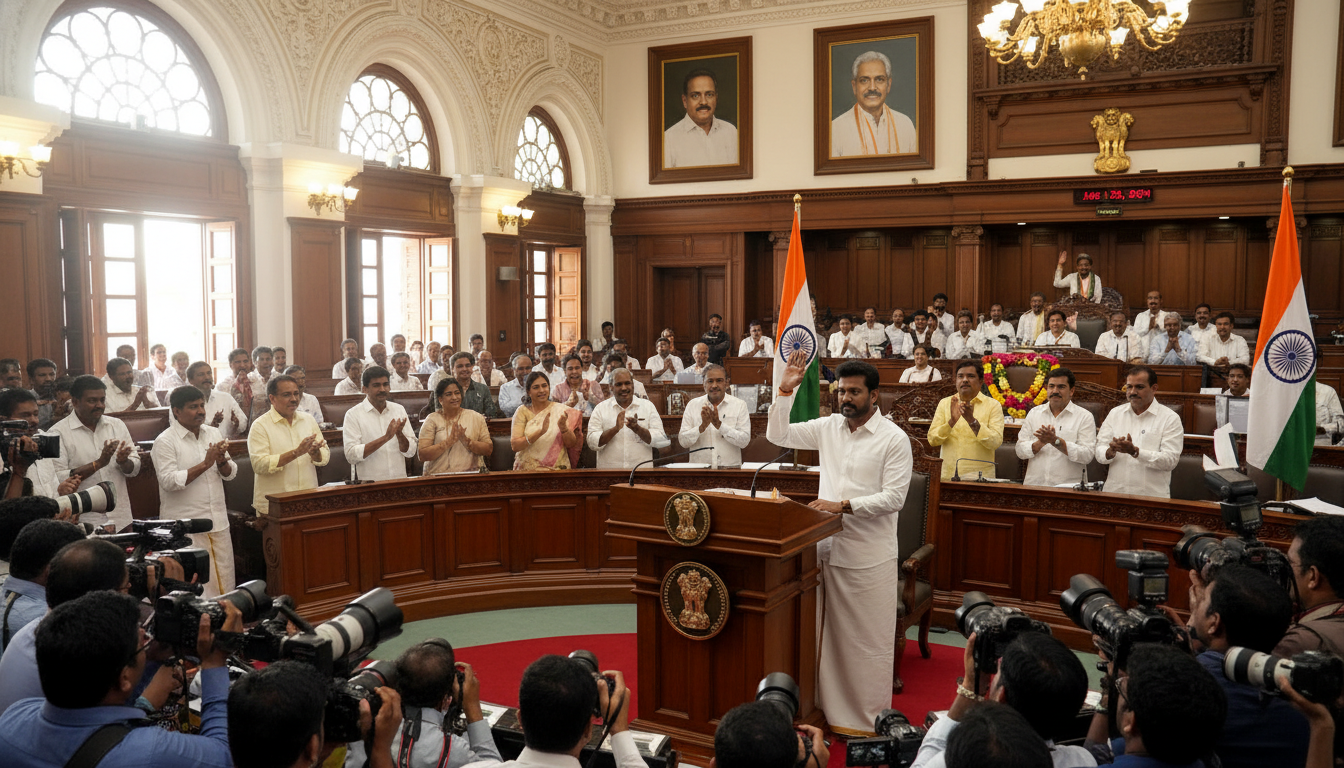
C. Joseph Vijay sworn in as Tamil Nadu chief minister after TVK victory
C. Joseph Vijay took office as Tamil Nadu’s chief minister on May 10, 2026, after his new party’s breakthrough in the state election, promising a “new beginning” as coalition partners pledged support. (Meta keyword: C. Joseph Vijay)
C. Joseph Vijay, the film star-turned-politician, was formally sworn in as chief minister of Tamil Nadu on May 10, 2026, in a large ceremony at Chennai’s Jawaharlal Nehru Stadium that drew thousands of supporters. The event followed a shock election result in which his fledgling Tamilaga Vettri Kazhagam (TVK) emerged as the single-largest party in the assembly contest, altering six decades of Dravidian party dominance. (hindustantimes.com)
Swearing-in ceremony and immediate mandate
Vijay took the oath of office before Governor Rajendra Vishwanath Arlekar and addressed the crowd with a call for “a new beginning” for the state, blending populist rhetoric with assurances of coalition governance. Thousands of supporters, fan-club activists and political colleagues filled the stadium as senior national and regional politicians attended the ceremony. The swearing-in capped a week of intense negotiations after vote counting and formalised the TVK-led administration’s transition from campaign triumph to government. (hindustantimes.com)
Election result and TVK’s rise
The 2026 assembly election produced a dramatic upset when the two-year-old TVK won a plurality of seats, emerging as the single-largest party and breaking the long-running alternation between the DMK and AIADMK. TVK’s performance in its debut contest rewrote political assumptions in Tamil Nadu and reflected a surge of younger and urban voters who gravitated to a celebrity-led campaign. The unexpected result has triggered debates in regional and national circles about the changing mechanics of state politics and voter alignment. (indiatoday.in)
Coalition-building and parliamentary arithmetic
Although TVK led the poll tally, it fell short of an outright majority and moved quickly to secure allies to meet the 118-seat threshold in the 234-member assembly. Congress, the Communist parties, VCK and IUML signalled or formalised backing for the new government, and additional support from dissident MLAs helped the coalition pass a confidence vote in the days following the swearing-in. Vijay was asked to prove his majority in the assembly within a short timeframe, a test his administration subsequently cleared amid negotiations that highlighted the fragility of post-poll alliances. (moneycontrol.com)
Economic priorities and industry reaction
Business and manufacturing leaders in Tamil Nadu greeted the new government with cautious optimism, underlining that the state’s role as a manufacturing hub for electronics and automotive supply chains demands steady policy and administrative continuity. Analysts warned that investor confidence will depend on how quickly the new cabinet outlines fiscal priorities, labour policies and infrastructure commitments for ports, power and logistics. Corporates emphasised that while the personality of the chief minister matters politically, large-scale employers will watch concrete policy signals before adjusting investment plans. (ca.marketscreener.com)
Cross-border expectations from Sri Lanka
Leaders and civil society figures in Sri Lanka responded with a mixture of hope and reservation to Vijay’s accession, reflecting deep cultural and political ties across the Palk Strait. Sri Lankan Tamil politicians and trade-union representatives publicly congratulated the new chief minister and expressed expectations that Tamil Nadu would press for refugee welfare, plantation-worker rights and fishermen’s concerns linked to maritime boundaries. Commentators in Colombo noted that sympathy among Sri Lankan Tamils for a Tamil Nadu leader with mass popular appeal could translate into diplomatic pressure, but they also cautioned that national foreign-policy constraints will shape what a state government can realistically deliver. (ceylontoday.lk)
Implications for regional politics and the Dravidian era
Vijay’s victory and the success of TVK pose an immediate challenge to the established Dravidian parties, forcing both DMK and AIADMK to reassess messaging, organisation and youth outreach. Political strategists say the TVK model—melding celebrity charisma with grassroots mobilising—may inspire imitation elsewhere, but they also emphasise governance competence and coalition management as the true tests of staying power. In the short term, the new administration must translate campaign promises into deliverable programs while maintaining the fragile coalition that put it in power. (indiatoday.in)
Vijay’s first weeks in office will be closely watched across India and in neighbouring Sri Lanka for indications of policy direction, administrative appointments and the handling of high-profile local issues such as fisherfolk disputes and refugee welfare. The outcome of early decisions will shape whether the TVK’s debut is remembered as a transformative political reset or a fleeting populist surge.
Tamil Nadu’s new government has signalled an intent to move quickly on welfare pledges and to present a collaborative face to partners and investors, but it must do so while managing high public expectations shaped by the actor’s public persona. The balancing act between theatrical style and the day-to-day demands of governance will define C. Joseph Vijay’s tenure in the weeks and months ahead. (hindustantimes.com)

