
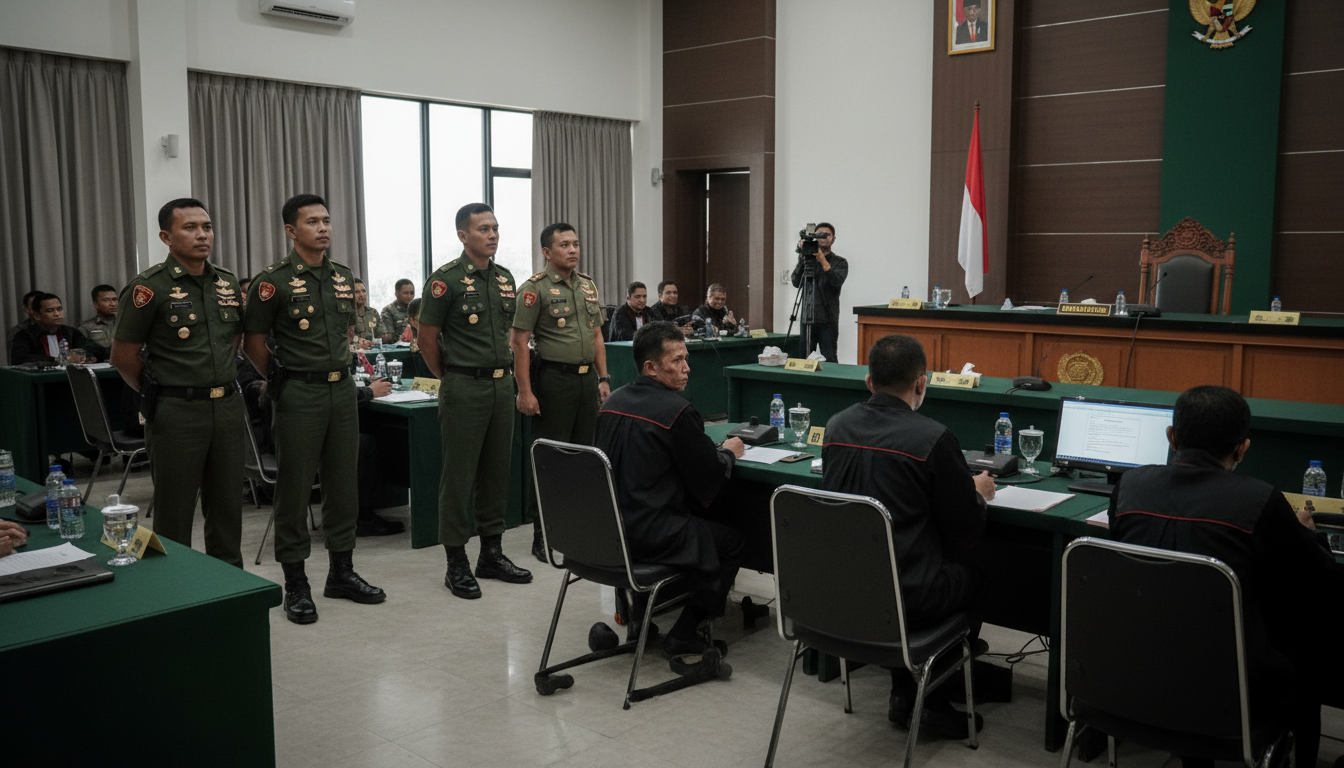
Acid attack on Andrie Yunus prompts trial of four military intelligence officers in Jakarta
Acid attack on Andrie Yunus in Jakarta led to a military court trial for four officers, raising calls from human rights groups for a fuller investigation and civilian oversight.
Attack and immediate aftermath
An acid attack on Andrie Yunus last month in Jakarta left the activist with burns to roughly 24 percent of his body and severe damage to his right eye. The assault, carried out while Yunus rode a motorbike, was captured on nearby street surveillance cameras and quickly drew public attention. Authorities moved rapidly to detain four members of a military intelligence unit — a captain, two lieutenants and a sergeant — on suspicion of involvement in the ambush.
Surveillance footage and scene evidence
Security camera footage shows two men on another motorcycle approach Yunus and throw a corrosive liquid toward his face, then speed away from the scene. Forensic teams reportedly examined the site and collected physical evidence, but details of the material recovered have not been released publicly. Family members and several eyewitnesses have described the attack as sudden and targeted, contributing to questions about motive and coordination.
Charges and military court proceedings
The four suspects were brought before a military court this week, marking a swift move by the armed forces to prosecute those accused. Military prosecutors have not publicly detailed the charges beyond involvement in the assault, and court sessions so far have been closed to the wider public. The decision to try the suspects in a military tribunal rather than a civilian court has reignited debate over jurisdiction in crimes involving service personnel.
Human rights groups demand broader probe
Human rights organizations say the four arrests are likely only a fragment of a larger conspiracy and have urged an independent, transparent investigation that reaches beyond the defendants now on trial. Activists contend that the speed of the military response may be intended to contain fallout and protect higher-ranking individuals who could have ordered the attack. Several groups have called for civilian prosecutors to take up the case or for an independent commission to examine possible links between military intelligence and the operation.
Questions over chain of command and accountability
Legal experts and rights advocates note that prosecuting low- and mid-level officers without concurrently probing the chain of command risks leaving the alleged mastermind untouched. They point to past instances where politically sensitive incidents were contained within military justice systems, limiting public scrutiny and restricting access to evidence. Observers warn that narrow prosecutions could hinder accountability if systemic directives or orders were involved.
Government response and institutional statements
Government officials have publicly emphasized a commitment to due process while expressing concern over the attack’s implications for public safety and civil-military relations. Military spokespeople confirmed the arrests and said the institution will cooperate with judicial procedures, but they also characterized the action as the work of a few individuals rather than indicative of broader policy. The differing tones from civilian authorities and the military have done little to ease calls from activists for an open inquiry.
Public reaction and political context
The attack has revived broader debate about the military’s expanding role in public life and politics, a sensitive subject in Indonesia’s post-dictatorship era. Civil society groups and opposition figures have used the case to underscore risks when security forces gain greater latitude without parallel oversight mechanisms. Street protests and social media campaigns have demanded clarity on who ordered the operation and whether there are institutional incentives for targeting critics.
The trial of the four military intelligence officers is unfolding amid heightened scrutiny, and observers say its outcome could influence public trust in both the armed forces and the country’s justice institutions. Continued calls for an independent investigation, expanded jurisdictional review and full disclosure of evidence are likely to shape the next phase of proceedings and public debate.

