
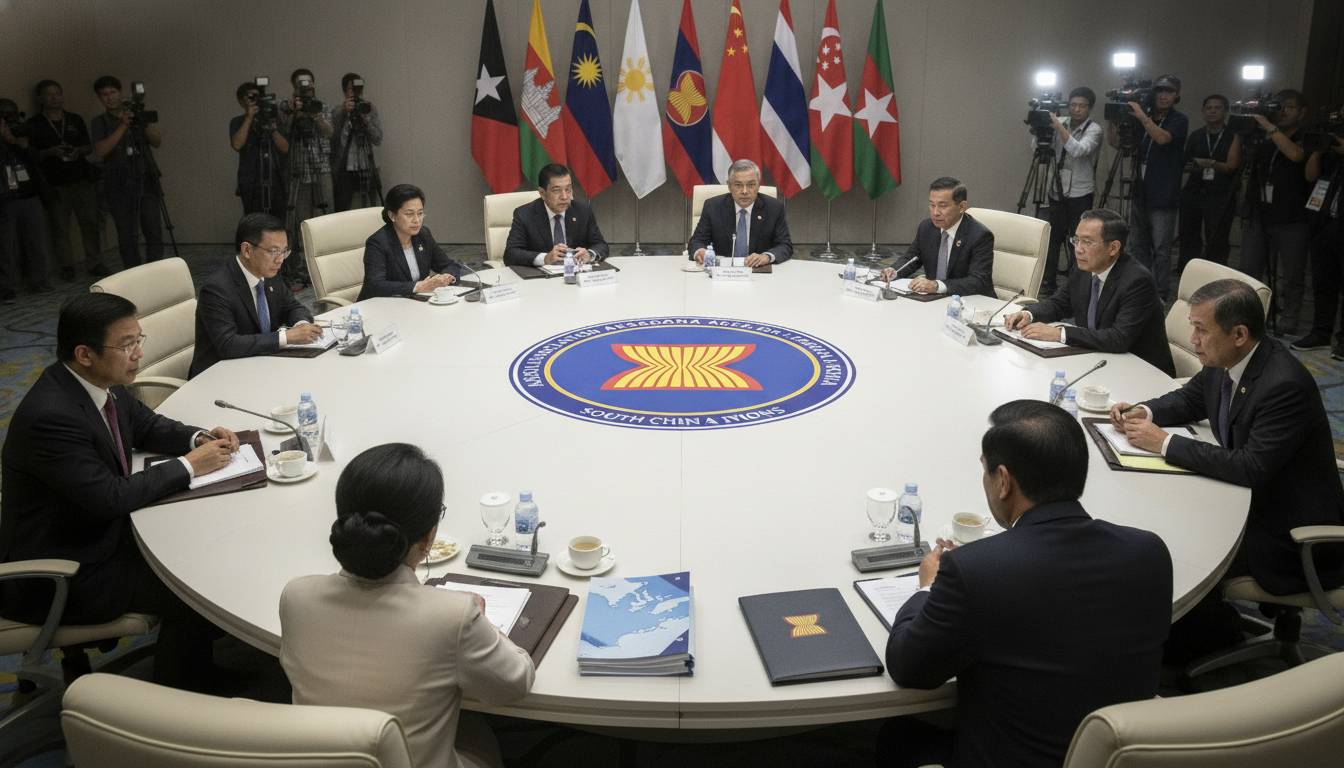
ASEAN foreign ministers meet in Manila as unity faces tests over Myanmar, border clashes and South China Sea
ASEAN foreign ministers meeting in Manila this week will confront a series of unresolved crises, centering on the Myanmar crisis, renewed Thailand–Cambodia border clashes and growing tensions in the South China Sea. The talks are widely seen as a barometer of the bloc’s ability to maintain consensus amid deep divisions among member states.
Ministers arrive in Manila with tight agenda
Foreign ministers from the ten-member Association of Southeast Asian Nations arrived in the Philippine capital for a packed schedule of bilateral and multilateral sessions. Diplomats said the agenda was dominated by security flashpoints and persistent humanitarian concerns that have eluded lasting regional solutions.
Manila has framed the meeting as an opportunity to recalibrate ASEAN’s crisis response mechanisms, but several delegates privately acknowledged the difficulty of finding common ground. The gathering is expected to include informal consultations as well as plenary discussions aimed at preventing further deterioration in regional stability.
Myanmar remains the most divisive issue
Myanmar’s political and humanitarian situation is set to be the most contentious topic, with member states divided over engagement and pressure strategies. ASEAN has previously struggled to enforce its five-point consensus, and officials say little progress has been made toward meaningful implementation.
Representatives of the Myanmar junta and opposition-aligned groups are unlikely to appear together in Manila, increasing the challenge for ministers seeking a unified course of action. Humanitarian needs, cross-border displacement and the impediments to dialogue were listed by delegates as immediate priorities requiring urgent attention.
Thailand–Cambodia border clashes escalate diplomatic concern
Skirmishes along the Thailand–Cambodia border have reintroduced a bilateral security dilemma that could spill across the region if left unchecked. ASEAN ministers are expected to urge calm and reiterate calls for direct dialogue between Bangkok and Phnom Penh to de‑escalate tensions.
Military movements and local civilian impacts have prompted concern among neighboring capitals, which are monitoring refugee flows and potential disruptions to trade. Analysts say ASEAN’s role in mediating such disputes is constrained when member states prefer bilateral channels or domestic responses over collective intervention.
South China Sea disputes to dominate maritime discussions
The South China Sea’s maritime disputes feature prominently on the Manila agenda, with ministers set to discuss freedom of navigation, resource competition and the prospects for a stronger code of conduct. Several ASEAN members have differing threat perceptions and strategic calculations, complicating efforts to adopt a single unified position.
China’s role and recent activities in contested waters were cited by diplomats as an underlying factor shaping the talks, though ministers are expected to frame their deliberations in terms of regional stability and adherence to international law. Calls for enhanced confidence‑building measures and clearer communication channels are likely to resurface during the sessions.
Consensus under strain as divergent national interests surface
ASEAN’s hallmark principle of consensus decision‑making is under scrutiny as domestic priorities and external partnerships pull member states in different directions. Observers note that economic ties, security partnerships and domestic political constraints limit the scope for decisive, collective action on sensitive issues.
The Manila meeting will test whether diplomatic pragmatism can outweigh competing national interests, particularly on matters requiring follow‑up mechanisms or enforcement. Some diplomats are reported to favor incremental steps and confidence‑building over sweeping resolutions that may prove unimplementable.
International partners and expectations for regional leadership
External actors, including major powers with stakes in Southeast Asia, are watching the meeting for signals on ASEAN’s cohesiveness and its capacity to lead regional responses. Several ministers are expected to meet counterparts from outside the region on the sidelines to discuss cooperation on maritime security, humanitarian assistance and economic resilience.
ASEAN’s ability to present a coordinated front could influence the calculus of outside partners seeking to engage on security and development initiatives. At the same time, ministers must balance international expectations with sensitivity to sovereignty and non‑interference principles that underpin the bloc.
The Manila meeting will therefore serve as a clear indicator of ASEAN’s current diplomatic bandwidth: whether it can reconcile disparate member priorities and translate rhetoric into concrete steps on Myanmar, border security and maritime disputes. Outcomes from these talks will shape the bloc’s agenda for the coming year and test the resilience of regional diplomacy at a moment of heightened geopolitical uncertainty.

