
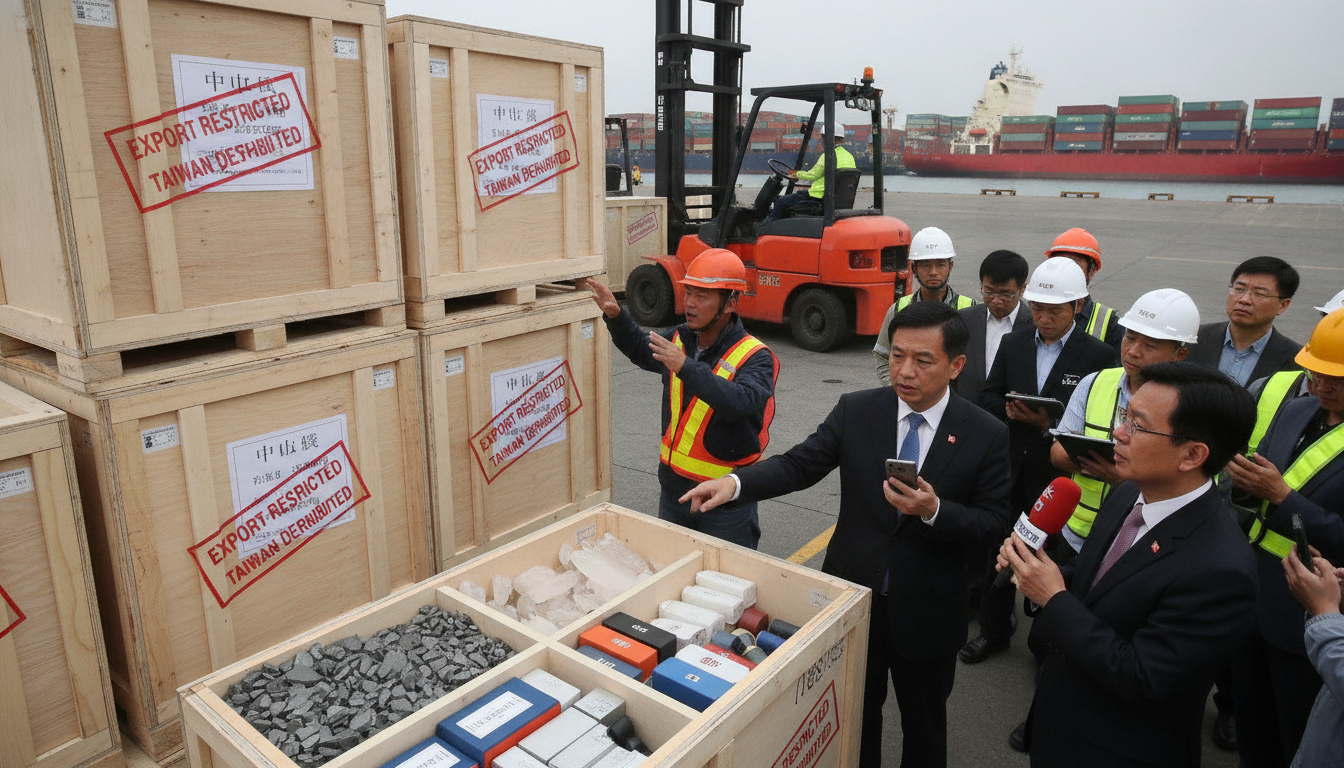
China restricts exports to Taiwan of germanium, quartz and certain magnets
China restricts exports to Taiwan of germanium, quartz and some magnets, disrupting aerospace and optics supply chains and prompting industry and policy concerns.
A fresh set of export controls and delays imposed by Chinese authorities on materials bound for Taiwan has begun to squeeze critical manufacturing lines as of Aug. 20, 2026. China restricts exports to Taiwan of germanium, quartz and certain magnets, sources in Taiwan’s tech and aerospace sectors said, creating immediate bottlenecks for firms that rely on those inputs. Companies involved in optics, aerospace components and precision instruments report shipment holds and increased lead times that are already affecting production schedules.
Scope of the Export Measures
The curbs appear to target a narrow but strategically important group of inputs used in high-precision industries. Industry contacts identified germanium, specialised quartz glass and specific types of permanent magnets as being delayed or subject to new licensing checks at Chinese export points. Those materials serve roles in infrared optics, satellite components, and guidance systems, underscoring why the bottlenecks have attracted attention beyond commercial circles.
Shipping notices and customs delays reported by Taiwanese suppliers indicate the measures are being carried out through routine inspections and additional documentation requirements rather than a blanket embargo. The result, however, is similar: unpredictable delivery dates and higher compliance costs that ripple down complex supply chains. Firms say several consignments have been held for days to weeks while paperwork is examined.
Impact on Taiwan’s Aerospace and Optics Firms
Taiwan’s aerospace subcontractors and optical component manufacturers are among the first to feel the effects, executives and procurement managers said. Germanium is used in infrared sensors and lenses, while high-purity quartz is critical for optical windows and resonators; shortages force companies either to slow assembly or to seek substitutes that can compromise performance.
Smaller suppliers with limited inventories are most exposed and some have initiated contingency measures, including re-routing older stock to mission-critical projects and scaling back production runs. Larger firms with diversified sourcing are also evaluating longer-term responses such as redesigns to reduce dependence on single-source materials.
Specific Materials Under Scrutiny
Germanium is a small-volume, high-value metalloid used in thermal imaging and fiber-optic applications; China is a dominant source of refined germanium and related downstream materials. Quartz of the type used in precision optics and specialized magnets for certain motors and sensors were singled out by procurement staff as particularly affected. The combined impact of constraints on these items is amplifying pressure on tightly sequenced manufacturing timelines.
Market participants say the measures are not uniform across all categories: commodity-grade quartz and off-the-shelf magnets continue to move, while high-purity, defense- and aerospace-grade variants face stricter checks. This segmentation complicates substitution, because industrial specifications for aerospace and advanced optics leave limited room for replacement.
Industry and Government Responses in Taiwan
Taiwanese companies have accelerated talks with alternative suppliers in Japan, Europe and the United States, and some are exploring inventory pooling among domestic firms to smooth short-term shortages. Procurement heads are also revisiting contracts and invoking force majeure clauses where deliveries fail to meet agreed terms.
Government agencies in Taiwan say they are monitoring the situation and coordinating with industry groups, though officials have stopped short of announcing emergency import waivers or stockpiling programs. Analysts expect Taipei to weigh diplomatic and trade tools alongside industrial policy measures to reduce strategic vulnerabilities.
Wider Supply-Chain and Geopolitical Implications
The disruptions highlight how concentrated production of a handful of critical materials can translate into leverage over complex global supply chains. Companies outside Taiwan that use the same inputs—such as satellite manufacturers and defense contractors in other economies—are also tracking the situation for potential knock-on effects. The episode may prompt multinational buyers to accelerate diversification of suppliers and to invest in domestic refining or recycling capabilities.
Trade analysts warn the developments could feed into broader strategic competition, as nations reassess dependencies for materials tied to dual-use technologies. For industries where performance margins are tight, the costs of redesign or stockpiling are likely to be significant and long-lasting.
Market Outlook and Next Steps for Firms
In the near term, expect tighter lead times and price volatility for the affected materials as buyers compete for limited supplies. Some firms have already begun to approve alternative component designs that use more readily available materials, though technical validation and regulatory certification will extend timelines. Procurement teams project several months of elevated risk unless normal flows resume.
Longer term, corporate strategies will likely include expanded supplier audits, investment in alternative material research, and closer collaboration with allied governments to secure critical inputs. For Taiwan’s high-tech and aerospace clusters, those shifts could reshape sourcing patterns and industrial policy priorities for years to come.
The export measures have underscored a practical vulnerability for technology supply chains that depend on a narrow set of suppliers for specialist materials, prompting both immediate contingency actions and longer-term strategic planning across industry and government.

