
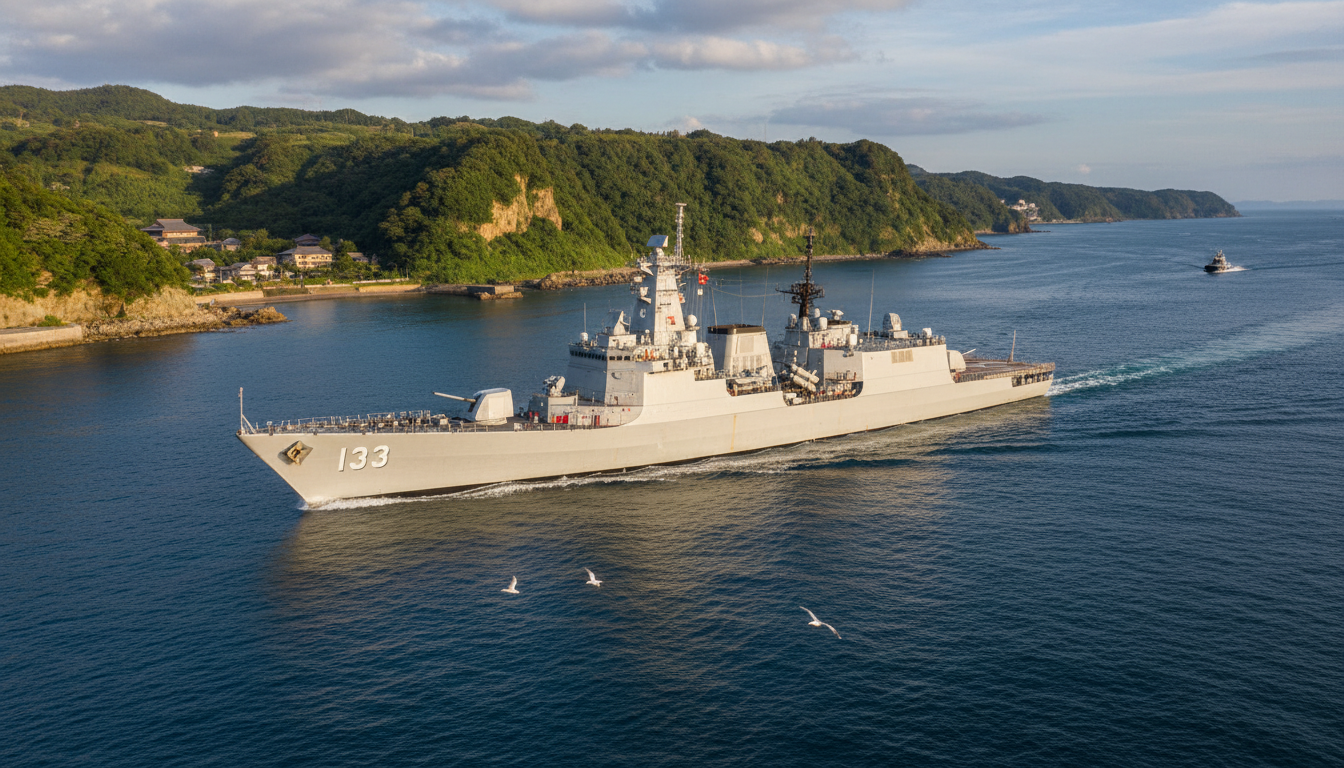
China warships near Amami Oshima as Type 052D destroyer Baotou and frigate Huanggang transit strategic waterway
Chinese naval vessels led by the Type 052D destroyer Baotou transited the waterway near Amami Oshima on April 19, 2026, in what Japan called a training passage in the western Pacific. The movement of China warships near Amami Oshima was confirmed by the Japanese Defense Ministry’s Joint Staff Office the following day, and it came amid heightened regional tensions after a Japan Maritime Self-Defense Force transit of the Taiwan Strait on April 17, 2026.
Ships and route reported
The Joint Staff Office said on April 20 that two Chinese naval vessels — the Type 052D destroyer Baotou and the Type 054A frigate Huanggang — sailed between Amami Oshima and Yokoate Island on April 19. The passage took place in a waterway off Kagoshima Prefecture inside the western Pacific approach, a corridor frequently used by commercial and military traffic. Japanese maritime patrols monitored the vessels as they moved through the area and recorded their route and timing.
Rare public announcement by Chinese military
Chinese authorities do not commonly publicize individual training transits, making the disclosure notable to regional observers. The announcement was widely interpreted as an atypical public posture by Beijing, and analysts suggested it may have been intended as a signaling move. The decision to highlight the exercise contrasts with China’s usual practice of keeping routine naval movements unpublicized.
Timing tied to Japan’s Taiwan Strait transit
Tokyo’s reporting framed the transit as occurring days after the Japan Maritime Self-Defense Force destroyer Ikazuchi conducted a rare transit of the Taiwan Strait on April 17. Beijing criticized that earlier passage, saying the move was an attempt by Tokyo to “deliberately provoke trouble,” according to Chinese statements. Japan has described its movements in regional waters as routine operations underscoring freedom of navigation and the right to operate in international seas.
Capabilities of vessels involved
The Type 052D destroyer Baotou is regarded as among China’s most advanced surface combatants, equipped with modern air defence and anti-ship missile systems. The Type 054A frigate Huanggang is a medium-sized escort ship designed for versatile roles including anti-submarine and air-defence missions. The presence of both platforms together in the same transit underscores Beijing’s capacity to deploy multi-mission warships in near-Japanese waters.
Regional security implications
The passage of China warships near Amami Oshima adds to a pattern of increasingly visible naval activity in waters close to Japan and Taiwan. Such movements can complicate regional security calculations and raise pressure on maritime surveillance and response systems. Officials in Tokyo have emphasized their commitment to monitoring maritime activity closely while coordinating with partners to maintain stability in the Indo-Pacific.
Japan’s monitoring and diplomatic posture
Japan’s Self-Defense Forces stepped up observation following the transit and issued a public notice through the Joint Staff Office to inform domestic and international audiences. Tokyo typically balances defensive readiness with diplomatic channels when addressing sensitive naval encounters, and public statements aim to document incidents while avoiding immediate escalation. The Defense Ministry continues to collect and analyze data from the operation to inform future posture and planning.
The transit by Baotou and Huanggang near Amami Oshima is the latest development in a series of maritime movements that reflect broader strategic rivalries in the region, and it is likely to shape Tokyo’s operational and diplomatic responses in the coming days.

