
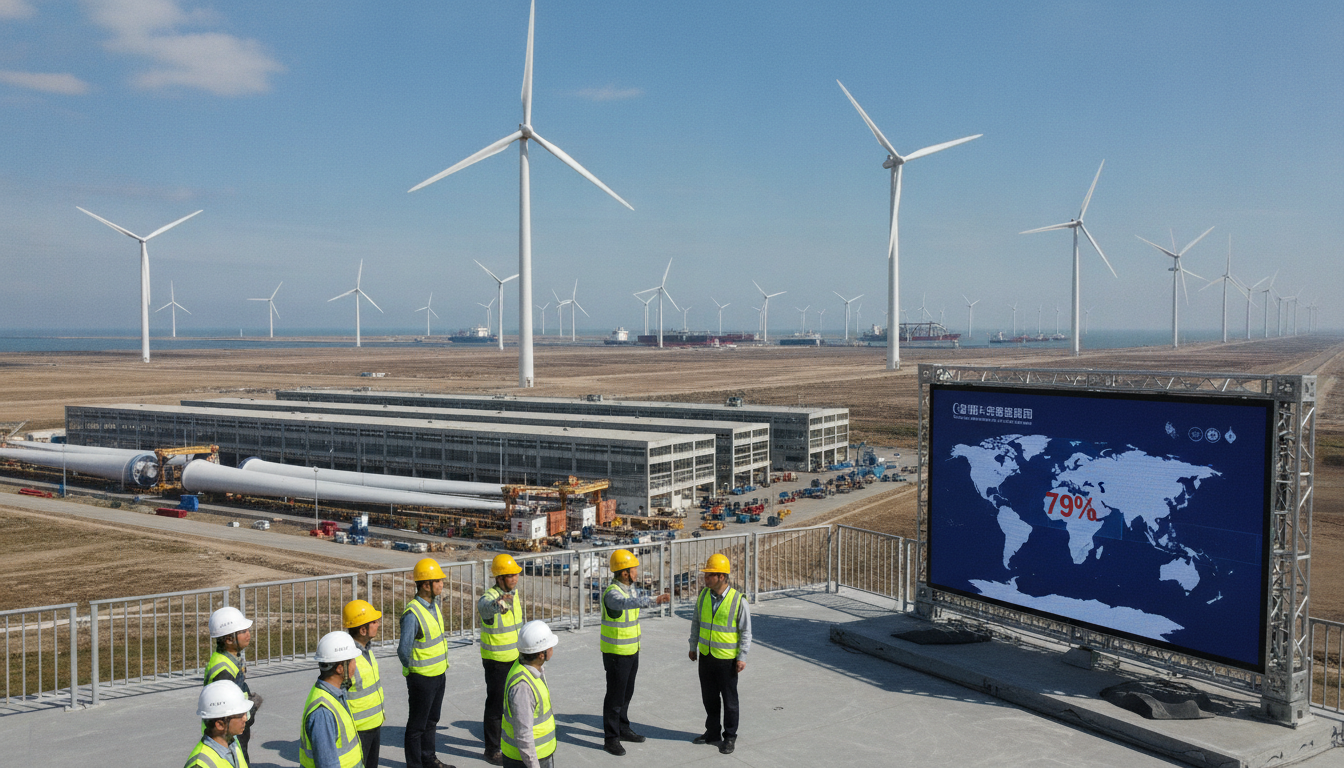
Chinese wind turbine manufacturers capture 79% of global installations in 2025
Chinese wind turbine manufacturers captured 79% of global installations in 2025, aided by competitive pricing, large domestic projects and expansion into Africa and Southeast Asia.
The market for wind power saw a striking concentration last year as Chinese wind turbine manufacturers accounted for 79% of turbines installed worldwide in 2025, up six percentage points from 2024. Industry sources and installation tallies point to a combination of heavy domestic deployment, aggressive overseas bidding and targeted financing that pushed Chinese firms to the forefront. The rapid expansion across Asia and Africa is reshaping procurement patterns and prompting fresh debate over supply chains and energy security.
Chinese Firms Dominate Global Installations
Chinese manufacturers increased their share of global wind-turbine installations to 79% in 2025, a rise of six percentage points from the previous year. That market concentration reflects both the scale of production capacity in China and a surge in new-build projects at home. Analysts say the share gain underlines how quickly manufacturing scale can translate into outsized installation figures when paired with export ambitions.
Chinese firms also benefited from lower per-unit costs as well as streamlined logistics within a mature domestic supply chain. Large-scale factory output allowed competitors to undercut bids in price-sensitive markets, making Chinese turbines the default choice for many developers. This combination of cost and scale has narrowed opportunities for legacy manufacturers in Europe and North America.
Surging Domestic Demand Drives Output
China’s domestic build-out has been a primary engine for higher installations, with government targets and grid connections spurring large orders. Provincial and national procurement programs accelerated deployment across coastal and inland regions, giving manufacturers predictable long-term demand. That steady pipeline allowed firms to optimize production schedules and reduce per-unit delivery times.
Domestic demand also encouraged investment in larger nacelles and taller towers to capture higher-altitude winds, raising average turbine output per unit. Those technological steps, achieved at scale, improved the price-performance balance of Chinese-made turbines and strengthened their appeal on export tenders.
Growth in Africa and Southeast Asia
Outside China, projects in Africa and Southeast Asia accounted for a substantial portion of export growth, where developers prioritized cost and speed of delivery. Governments and utilities in these regions often favor turnkey offers that combine equipment supply, installation and financing, packages that many Chinese suppliers are positioned to provide. The result has been a steady flow of orders for onshore turbines across diverse climates and grid contexts.
Local partners and contractors in recipient countries have increasingly cooperated with Chinese firms on logistics and commissioning, shortening project timelines. That collaboration, alongside concessional financing structures in some cases, has made Chinese equipment a pragmatic choice for countries expanding renewable capacity rapidly and on limited budgets.
Impact on Western Manufacturers and Markets
The rapid rise of Chinese market share has intensified pressure on manufacturers in Europe and North America, which face higher production costs and more complex regulatory environments. Some incumbent firms have responded by seeking niche specialties, such as offshore technology, service contracts or hybrid systems that combine different renewable sources. Consolidation and strategic partnerships are also emerging as common industry responses.
Buyers in developed markets have shown greater interest in ensuring technological differentiation and supply resilience, prompting discussions about domestic content requirements and long-term service agreements. Those measures aim to protect industrial bases but may also raise project costs and slow deployment timelines if applied too broadly.
Technology, Cost and Supply-Chain Dynamics
Advances in turbine design and manufacturing processes have narrowed the technology gap between suppliers, while mass production drove down component costs. Scale manufacturing enabled modular production techniques and centralized suppliers for blades, generators and gearboxes, reducing procurement complexity. However, the concentration of manufacturing capacity has also created chokepoints for certain inputs and transport routes.
Logistics remain a critical factor for large offshore components and for supplying remote sites in emerging markets. Firms that can combine efficient factory output with reliable shipping, local installation expertise and after-sales service have gained a competitive edge. That integrated capability has become as important as per-unit price in many tenders.
Policy, Finance and Geopolitical Considerations
The expansion of Chinese turbine exports has prompted closer scrutiny from policymakers concerned about energy security and strategic dependence. Export credit, tied financing and state-backed insurance have been cited as enablers of rapid overseas growth, drawing attention from competing governments and financiers. As a result, some importing countries and multilateral lenders are reviewing procurement rules and debt exposure related to large-scale renewable projects.
At the same time, the affordability and speed of Chinese offers have helped accelerate renewable deployment where it is most needed, supporting emissions reduction goals and expanding electrification. Policymakers now face a balancing act between fostering local industry and meeting urgent climate and development targets.
Looking ahead, the global wind market is likely to remain highly competitive, with Chinese wind turbine manufacturers poised to retain a leading position while other suppliers pursue technological niches and service-led strategies to stay relevant. The coming years will test how governments and developers reconcile industrial policy with the imperative to scale renewables quickly and affordably.

