
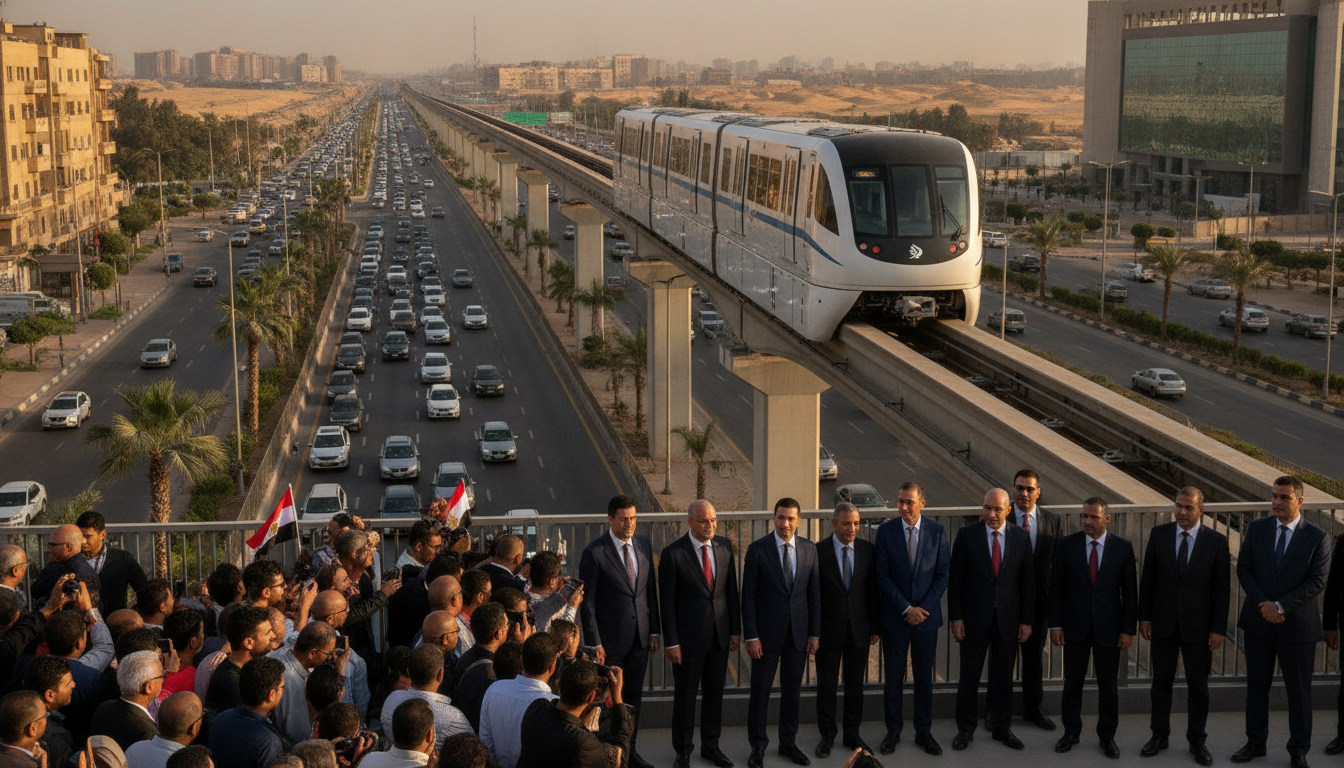
Cairo Monorail Begins Partial Service, Linking City to New Administrative Capital
Cairo Monorail begins partial service on a 57 km elevated line linking Cairo with the new administrative capital, cutting travel times and easing congestion.
Egypt has begun operating a segment of the Cairo Monorail, a project that will form nearly 57 kilometers of single-route elevated track connecting the capital with the country’s new administrative centre in the desert. The partial opening marks a milestone in what is intended to become one of the world’s longest single-route monorail lines, and officials say it will speed commutes and support the development of the new capital.
Early passengers described reduced journey times on the new elevated service, which is designed to carry daily commuters as well as visitors traveling between the two cities. Authorities say the route will also relieve pressure on Cairo’s congested road network as the full system is completed.
Partial Cairo Monorail Service Begins
The first operational stretch of the Cairo Monorail entered service following final testing and phased commissioning by transport authorities. Trains are currently running on a portion of the line while further sections complete construction and safety certification.
Service frequency and timetable adjustments will be rolled out as ridership patterns become clearer during the initial weeks of operation. Officials have indicated a staged approach to opening additional segments until the full route becomes operational.
Route Links Cairo to New Administrative Capital
The monorail runs on an elevated alignment designed to connect central Cairo with the new administrative capital under construction in the desert east of the city. The new capital development includes government buildings, residences and commercial districts, and the rail link is a core element of its transport plan.
By providing a direct rapid transit corridor, the Cairo Monorail is intended to allow workers and residents to move between the two centres without relying on congested highways. Planners also expect the line to facilitate tourism flows to cultural and civic sites along the route.
Engineering and Design Features
Engineers built the system as an elevated single-route monorail to reduce land-take and to provide an uninterrupted corridor across urban and desert terrain. Elevated guides and stations are intended to limit interference with surface traffic and to offer consistent travel speeds.
The design incorporates heat- and dust-resilient systems suited to Egypt’s climate, with elevated stations located to serve existing and planned urban neighbourhoods. The monorail’s profile and stations also aim to integrate with broader plans for pedestrian access and feeder transport networks.
Capacity, Accessibility and Passenger Experience
The Cairo Monorail has been designed to accommodate high volumes of daily commuters while offering accessible boarding and step-free station access. Interior layouts focus on standing space and circulation to handle peak-period flows typical of metropolitan transit systems.
Authorities are monitoring user experience during the early operational phase to refine station operations, signage, and connections with buses and other local transport. Ticketing arrangements and fare structures are being finalised to balance affordability and operational costs.
Construction Partners and Financing
The project has been delivered through a mix of public sector oversight and contracts with major construction and railway suppliers, drawing on both domestic and international expertise. The scale of the work — including elevated structures, guideway systems and stations — required coordinated logistics across multiple construction zones.
Financing combines state investment and contracted procurement aimed at accelerating completion of the new capital’s infrastructure. Officials have said that continued budgetary oversight and partner coordination will be essential as remaining segments proceed to completion.
Challenges and Integration with Cairo’s Transport Network
Operational expansion will face several practical challenges, including integration with Cairo’s dense existing transport systems and the need to manage peak flows at interchange points. Seamless transfers between the monorail and surface buses, metro lines and road-based services will be critical to achieving the scheme’s congestion-relief goals.
Maintaining reliability under desert conditions and ensuring robust safety and maintenance regimes for elevated structures will also be priorities for operators. Authorities have emphasised ongoing testing, staff training and emergency planning as part of the commissioning process.
The partial opening of the Cairo Monorail represents a major step in Egypt’s wider effort to modernise urban mobility and support the new administrative capital’s development. As additional sections are completed and joined to the current stretch, the project will be tested on its ability to reshape commuting patterns, reduce road congestion and support the growth of a planned urban centre outside Cairo.

