
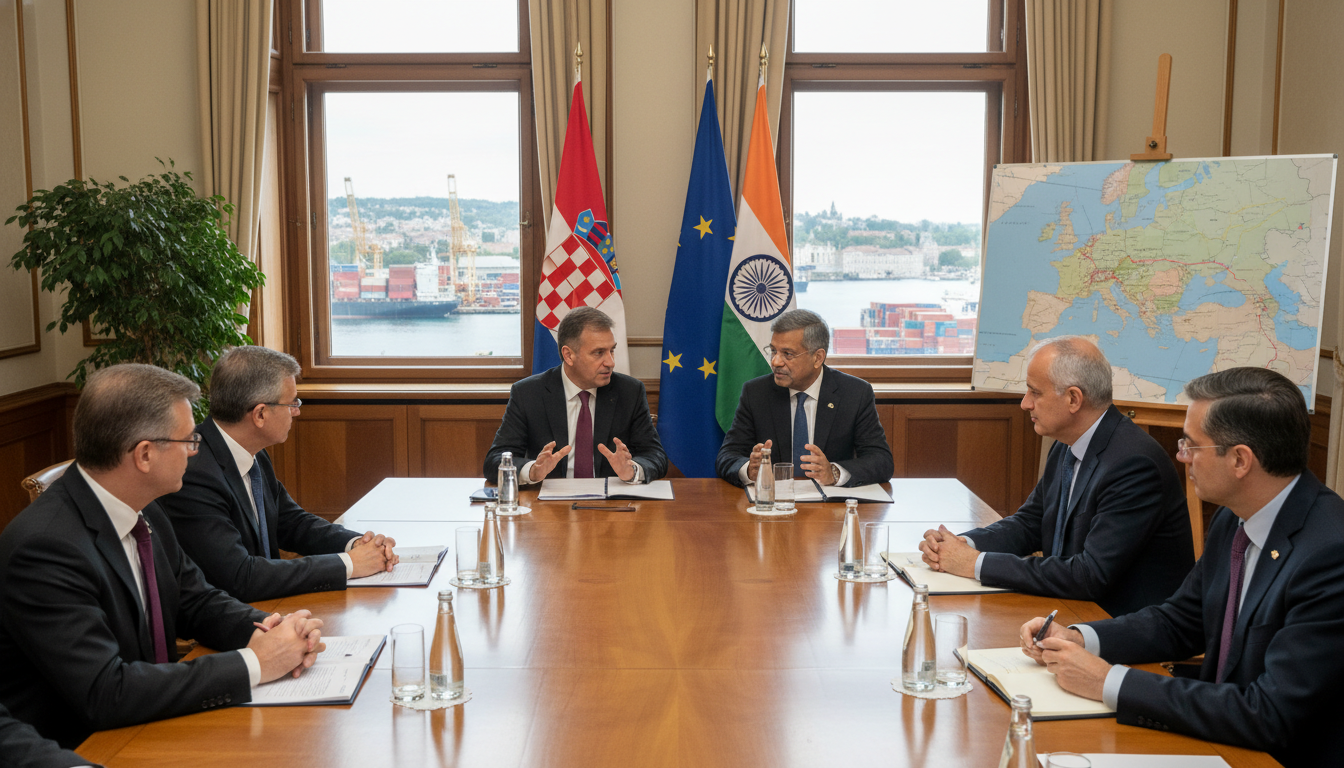
Croatia says its ports should serve as EU gateway for the India-Middle East-Europe economic corridor
Croatia positions its Adriatic ports as EU gateways for goods from the Pacific, joining calls to link the India-Middle East-Europe economic corridor with European logistics and trade.
Croatia pushes to join India-Middle East-Europe economic corridor
Croatia’s prime minister told Nikkei Asia in Dubrovnik that Zagreb seeks to participate in the India-Middle East-Europe economic corridor and offer its ports as entry points for goods bound for the European Union. The government is framing the country’s Adriatic terminals as strategic hubs for cargo routed from the Pacific through the Middle East to Europe. Prime Minister Andrej Plenkovic emphasized the diplomatic and trade importance of such links while underscoring Croatia’s existing maritime infrastructure.
Plenkovic also reiterated a wider foreign policy line by calling transatlantic ties “the backbone of the modern world,” signaling that Croatia intends to balance expanding trade links with continued engagement with traditional partners. His comments reflect a drive to attract new transit flows and investment into Croatia’s port and rail networks. Officials see participation in the corridor as a way to deepen economic ties and improve connectivity between Asia, the Middle East and Europe.
Ports as European entry points for Pacific trade
Croatia is promoting its major Adriatic ports as practical entry points for goods arriving from Asia via Middle Eastern transshipment hubs. The government argues that shorter sea distances across the Adriatic and road and rail connections through Central Europe give Croatian ports a competitive advantage for certain cargoes. Investments in terminal capacity, hinterland links and customs processing are being presented as levers to speed up throughput and reduce costs for shippers.
State and regional authorities are already discussing targeted upgrades to container terminals and intermodal connections to ensure faster transfers to freight corridors heading north and west. Port operators in Rijeka, Split and Ploče have highlighted plans to expand handling capacity and digitalize logistics processes. These changes are intended to make Croatia a viable alternative to long-established Northern European gateways for some Asia–Europe trade lanes.
Infrastructure and logistics planning under review
Government officials say they are assessing where public investment and private partnerships can most quickly improve linkages between seaports and inland routes. Proposed measures under consideration include rail upgrades to increase freight speeds, improved road access to port facilities, expanded warehousing and streamlined customs operations for faster clearance. Officials also point to the potential of free zones and freight villages near port areas to attract value-added services such as light manufacturing and redistribution.
Private-sector stakeholders have signaled interest but caution that practical bottlenecks must be solved before a major shift of volumes takes place. Shippers and carriers will look for predictable transit times, competitive handling charges and reliable hinterland connections. Croatia’s pitch to the corridor will therefore depend on demonstrating measurable improvements in speed, cost and regulatory ease compared with existing alternatives.
Economic and strategic rationale for participation
Croatia frames participation in the India-Middle East-Europe economic corridor as both economic opportunity and strategic diversification. By positioning its ports as EU entry points for transcontinental flows, Zagreb hopes to capture jobs, investment and ancillary services tied to higher cargo volumes. Officials argue that new transit business could also help balance seasonal tourism-driven pressures on coastal infrastructure by creating year-round freight activity.
Strategically, deepening links with Asia and the Middle East fits a broader regional impulse to diversify trading partners and logistics routes. For smaller EU members, enhancing transit competitiveness can bring geopolitical leverage and increased foreign direct investment. Plenkovic’s comments reflect a calculation that engagement with the corridor would complement, not replace, Croatia’s long-standing alliances with transatlantic partners.
Potential challenges and diplomatic next steps
Analysts and industry sources warn that converting political interest into sustained trade flows will require coordination across multiple countries and commercial players. Competing gateway ports in the EU already enjoy scale advantages, established rail corridors and deep-pocketed logistics ecosystems. Croatia will need to prove that its ports can handle increased container volumes without congestion and provide reliable onward connections across borders.
Diplomatic steps will likely include talks with corridor proponents and regional partners to align regulatory, customs and investment incentives. Public-private partnerships and EU cohesion funds could play roles in financing infrastructure upgrades, while bilateral dialogues with shipping lines and freight forwarders will be necessary to secure routings. Zagreb’s approach will have to balance national ambitions with realistic timelines for capacity building.
Final paragraph
If Croatia can translate political intent into concrete upgrades and streamlined processes, its Adriatic ports could become meaningful entry points for goods moving along the India-Middle East-Europe economic corridor, offering shippers a southern gateway into the EU and diversifying Europe’s access to transcontinental trade.

