
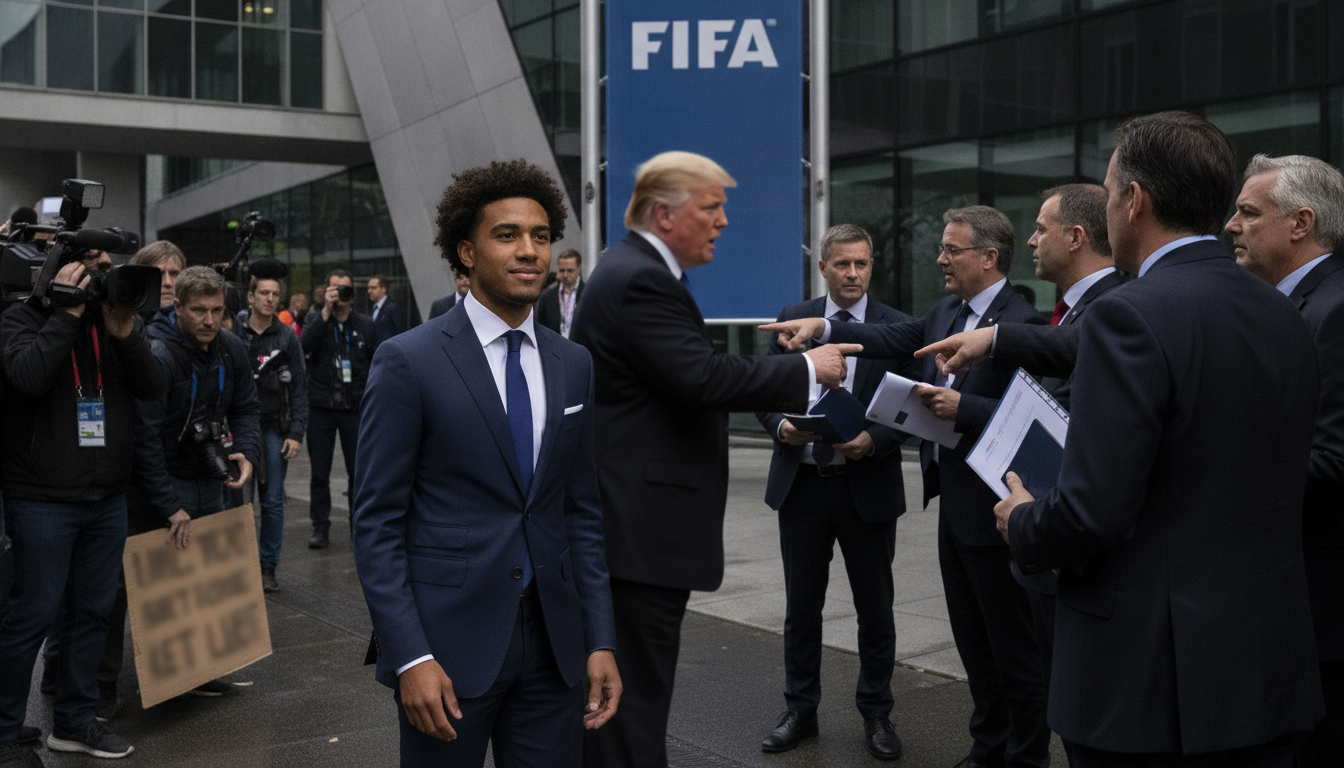
FIFA Defers Balogun Suspension After Reported Trump Intervention, Raising Fairness Questions
FIFA announced a deferred ruling on the Balogun suspension, holding a one-match ban in abeyance for one year after the U.S. forward’s red card, a decision that has provoked scrutiny and allegations of political interference.
The governing body of world football on July 5 deferred the enforcement of the Balogun suspension, meaning the U.S. forward will not serve an immediate ban following a red card in the July 1 knockout match against Bosnia and Herzegovina.
The ruling, announced days before the United States’ next match against Belgium scheduled for July 6–7 (local and Japan time differences noted), has prompted questions about equal treatment and transparency in disciplinary procedures.
Red card during knockout match
Balogun was sent off in the second half of the July 1 first-round knockout match after an incident in which he stepped on an opponent’s ankle, a foul the referee judged to be violent conduct.
Under FIFA disciplinary regulations, such an offense typically carries at least a one-match suspension and, by automatic enforcement rules, would have prevented Balogun from participating in the subsequent fixture.
The U.S. team and its supporters had expected the automatic ban to apply, and team preparations were adjusted accordingly in the immediate aftermath of the red card.
Match officials and tournament disciplinary panels recorded the dismissal as a straight red for unsporting behavior, and the initial expectation was that the suspension would be enforced without delay.
FIFA cites disciplinary clause but gives no rationale
In its brief statement, FIFA said the disciplinary committee had decided to defer the immediate execution of the suspension for one year, invoking a clause in its code that permits a sanction to be stayed in whole or in part.
The federation referenced the relevant articles of its disciplinary code but did not disclose the committee’s factual or legal reasoning for applying the deferment in this specific case.
Those omissions have drawn criticism from observers and rival teams who note that FIFA’s disciplinary code normally requires at least a clear explanation when a customary sanction is altered.
Tournament statistics show that 13 players had received red cards through July 5, yet Balogun’s case alone appears to have been singled out for review and change, fueling further demands for clarity.
Reports of high-level U.S. intervention
Media reports have said that high-level U.S. political figures, including President Donald Trump, communicated directly with FIFA President Gianni Infantino to request a reassessment of the punishment.
Sources cited by The Athletic and other outlets indicate that U.S. government advisers and the player’s legal team also lobbied FIFA and that a coordinated effort sought to overturn or delay the suspension.
FIFA has not publicly confirmed that political pressure affected the committee’s decision, and the federation’s statement did not mention any external communications.
The involvement of a sitting head of state in a disciplinary matter regarding an ongoing tournament, if confirmed, would mark a rare and contentious intrusion of politics into sport governance.
Historical parallels and reaction from the football community
Observers have pointed to a long-ago precedent: in 1962, Brazil’s Garrincha had an exclusion reversed after intervention from powerful national figures, a case often cited when politics and sport collide.
Those interested in tournament integrity warn that exceptions to standard disciplinary processes—especially when unexplained—can erode public confidence in fair play and equal application of rules.
Rival coaches and national associations have publicly expressed frustration and, in some instances, sarcasm about the timing and uniqueness of the decision.
Player unions and refereeing organizations have urged FIFA to release the committee’s reasoning so that disciplinary standards remain consistent and transparent for all teams.
Potential impact on the tournament and governance questions
Practically, the deferment cleared the way for Balogun to be available for the United States’ next knockout match, altering team selection and tactical planning on short notice.
But beyond immediate sporting consequences, the episode has intensified calls for clearer separation between political influence and sporting adjudication at international tournaments.
FIFA officials now face pressure to explain how the deferment was reached and to indicate whether procedures will be reviewed to prevent perceptions of unequal treatment in future cases.
Legal experts in sporting law say that while the rules may permit discretionary stays, the federation’s credibility depends on consistent application and on publicly documented reasoning when exceptions are made.
The Balogun suspension ruling has put a spotlight on the intersection of high-profile politics and global sport, prompting demands for fuller disclosure from FIFA and renewed debate about how international football should protect the impartiality of its disciplinary system.

