
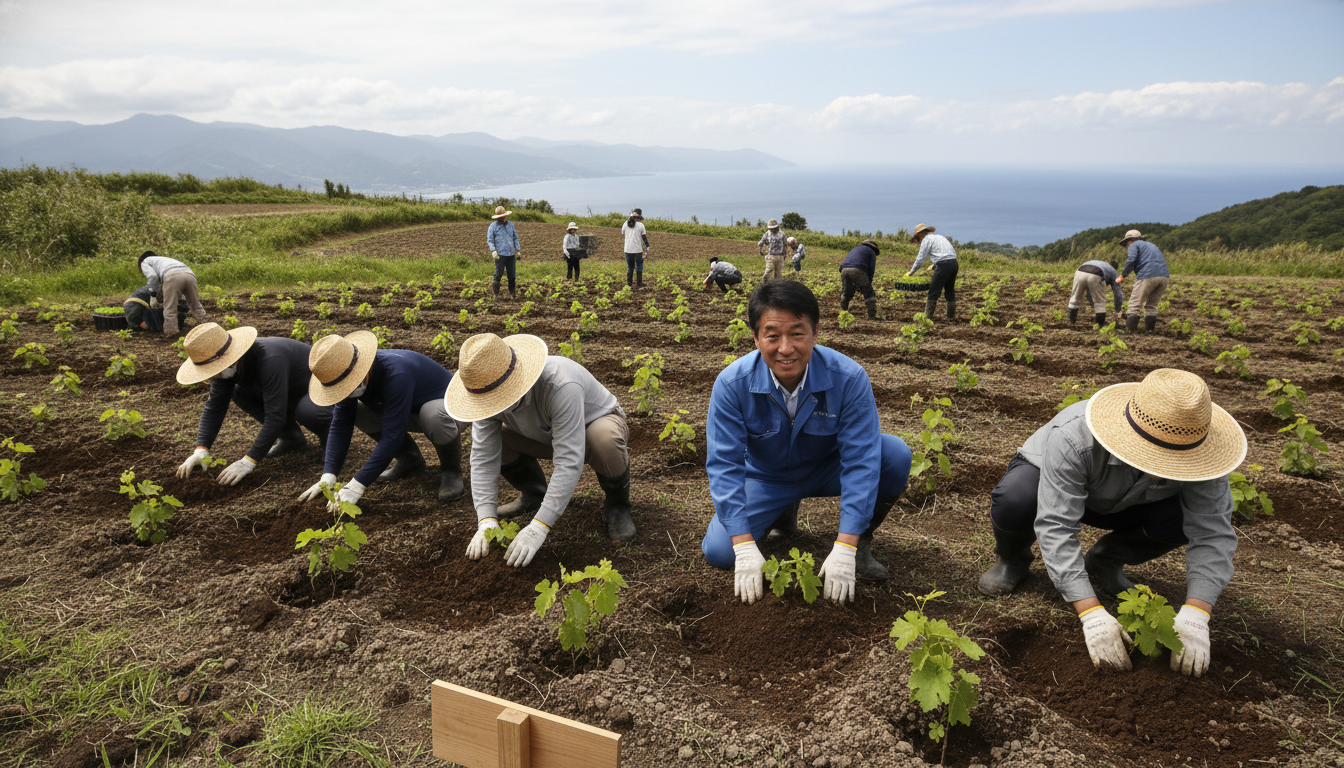
Hirosaki Residents Plant 140 Vines in Push to Build Tsugaru Wine Region
Hirosaki community planted 140 Sauvignon Blanc seedlings on May 2 as part of a wider Tsugaru wine initiative with Suntory and JA to develop local winemaking.
A community planting event in Hirosaki, Aomori Prefecture, saw 12 residents and local volunteers place 140 Sauvignon Blanc seedlings in a 1,000-square-meter field on May 2, advancing the city’s Tsugaru wine ambitions.
The effort is part of a multi-year campaign to raise awareness and expand grape cultivation in the Tsugaru area, which city officials and partner organizations say could develop into a recognized wine-producing region.
Community Planting in Hirosaki
The hands-on planting day brought together local residents and members of a community revitalization group to prepare the gently sloping field for the new vines.
Participants worked under guidance from experienced growers, digging, positioning and orienting each seedling to optimize sun exposure and drainage.
Organizers said the event was the first of its kind in Hirosaki aimed specifically at public engagement with viticulture and attracting broader interest in Tsugaru wine.
Attendance was intentionally small to allow practical training and to establish a model plot that can be scaled up in coming seasons.
Partners and Long-Term Plan
The planting builds on an agreement signed in 2020 between the city, Suntory Holdings and JA Tsugaru Hirosaki to expand wine-grape production across the region.
Officials described the pact as a framework for technical support, variety selection and eventual processing and marketing of locally produced wines.
Suntory’s involvement is intended to bring technical expertise and potential market pathways, while JA Tsugaru Hirosaki will support growers with cooperative services and distribution.
City representatives emphasized that public events and demonstration plots are part of a long-term strategy to encourage farmers to diversify from apples into wine grapes.
Suitability of Mt. Iwaki’s Southeastern Slopes
Agricultural specialists cited the southeastern slopes of Mt. Iwaki as especially promising for viticulture because of significant diurnal temperature variation and well-drained soils.
Those conditions help vines develop balanced acidity and flavor compounds, characteristics sought after in cool-climate white varieties such as Sauvignon Blanc.
Local revitalization leader Takahiro Yamada, 57, told participants that the same climatic traits that produce high-quality apples in the area could support fine wine grape production.
Yamada framed the initiative as a value-added agriculture project that builds on longstanding fruit-growing expertise in Tsugaru.
Planting Details and Varietal Choice
The demonstration planting consisted of roughly 140 Sauvignon Blanc vines set in a gently sloping, well-prepared 1,000-square-meter parcel overlooking the Mt. Iwaki foothills.
Fruit farmer Taishi Kimura, 45, instructed volunteers on planting technique and orientation, emphasizing row direction and spacing to improve air flow and sunlight exposure.
Organizers selected Sauvignon Blanc for the initial plot because of its suitability to cooler climates and its ability to show terroir differences in early trial plantings.
The plot will serve as a practical training site for local growers and a testing ground for cultivation methods adapted to Tsugaru’s microclimates.
Timeline to First Harvest
Project coordinators expect the vines to establish over the next two to three years, with the first meaningful fruit set anticipated in about three years from planting.
Initial harvests will likely be small and focused on studying sugar accumulation, acidity, and disease resistance rather than large-scale production.
Data gathered from the demonstration plot will inform decisions on pruning, canopy management and whether to expand plantings or introduce additional varieties.
Officials stressed that patient, methodical cultivation and careful monitoring will be essential to produce wine-quality fruit in this new regional effort.
Economic and Tourism Prospects
City planners and local stakeholders see Tsugaru wine development as a way to diversify agriculture incomes and create new tourism opportunities in Hirosaki and surrounding towns.
Over time, they aim to pair vineyard growth with tasting events, winery tours and collaboration with hospitality businesses to attract domestic and international visitors.
Local leaders pointed to the dual benefits of sustaining rural communities and enhancing the region’s culinary profile by linking fruit crops and emerging viticulture.
If successful, a recognizable Tsugaru wine label could complement Aomori’s existing reputation for apples and broaden the prefecture’s agricultural brand.
The May 2 planting was described by organizers as a symbolic and practical first step in a multi-year program to establish Tsugaru wine as a distinctive regional product.

