
Diet leaders approve Imperial Household Law amendment outline; detailed guidelines deferred to June 25 meeting
Diet leaders accepted the Imperial Household Law amendment outline on June 22, 2026; detailed guidelines were deferred and will be discussed on June 25.
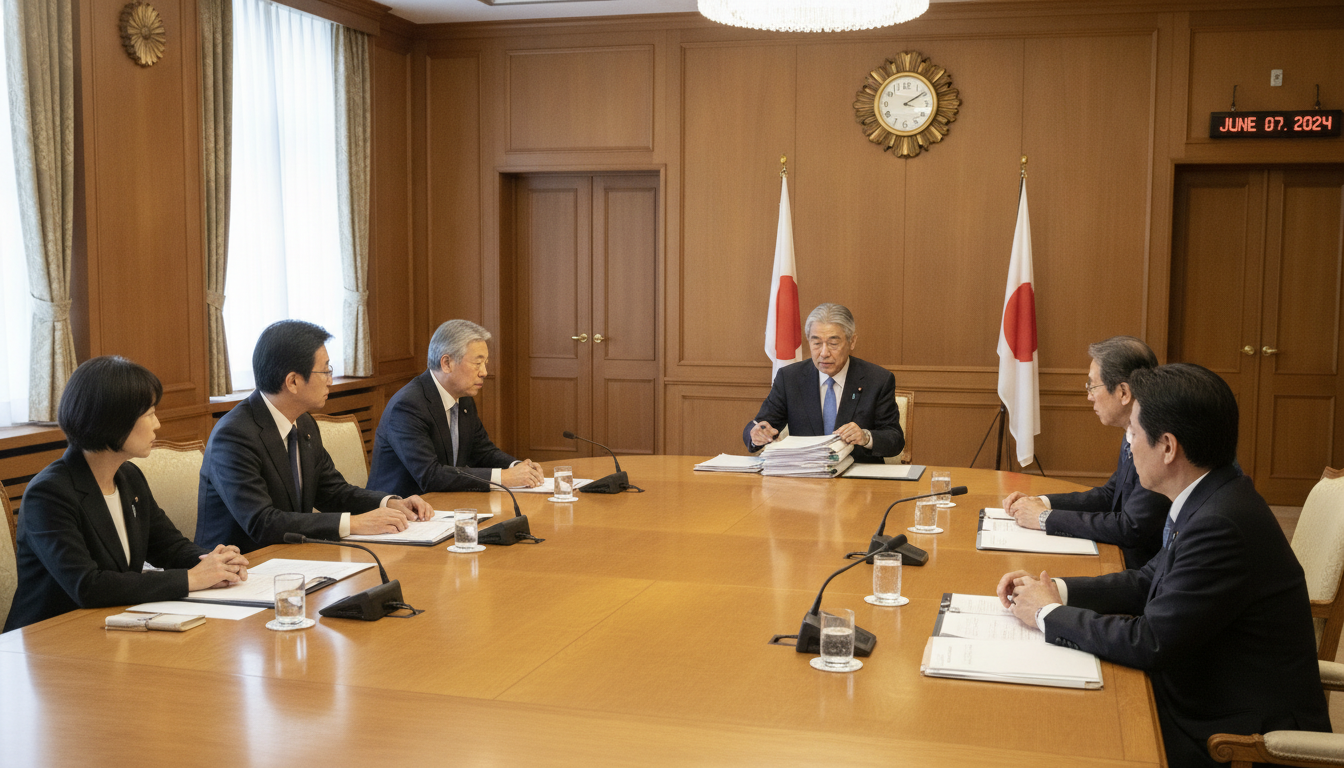
The presiding officers and their deputies of both Diet chambers on June 22 approved the outline of a government-drafted amendment to the Imperial Household Law aimed at securing the number of imperial family members. The keyword Imperial Household Law amendment was central to discussions during a briefing at the House Speaker’s official residence where Chief Cabinet Secretary Minoru Kihara presented the proposal. A more detailed set of implementation guidelines was shown to the leaders but was not approved; they postponed that decision pending wider party consultations.
Approval of the amendment outline
The hosts of the meeting—the Speaker of the House of Representatives and the equivalent officers of the House of Councillors together with their vice-chairs—met at the House Speaker’s official residence for roughly one hour. Chief Cabinet Secretary Minoru Kihara outlined the government’s draft amendment and an accompanying set of guidelines intended to operationalize the changes. Afterwards, House Speaker Eisuke Mori told reporters that the presiding officers had agreed to endorse the outline itself while deferring judgment on the fuller guidelines.
The leaders’ acceptance of the outline formalizes a shared recognition by the legislature of the need for legal change to address the shrinking pool of imperial family members. The move does not yet bind individual parties to a legislative position, but it sets the framework for negotiations that lawmakers have signaled they intend to pursue at the end of the week.
Two measures the draft aims to enable
The draft amendment is constructed to allow two measures long discussed by government panels and lawmakers to shore up the imperial household’s ranks. The first measure would permit female members of the imperial family to retain their imperial status after marriage, reversing the current rule that removes women from the imperial household upon marrying a commoner. The second would provide a legal pathway to bring male-line descendants of former princely households into the imperial family, typically by adoption or other legal recognition.
Both proposals trace back to recommendations from a government expert panel in 2021 and have been central to parliamentary debates since then. The presiding officers earlier this month compiled what they described as a “legislative consensus” endorsing both options, and the government’s draft is explicitly written to make those options implementable through statutory change.
Why the detailed guidelines were postponed
While the outline received approval, the accompanying “guidelines” presented by the government include operational details that presiding officers said require further refinement. Speaker Mori and other leaders noted that provisions on timing, conditions for adoption, and transitional arrangements need more technical and political vetting. For that reason, they decided not to take a final position on the detailed text at the June 22 meeting.
Officials indicated that specific items remain unsettled, including how changes would affect current imperial statusholders and whether special procedures or safeguards will be necessary to align the amendment with existing constitutional and administrative frameworks. The decision to delay reflects both legal caution and an intent to build broader parliamentary agreement before advancing draft legislation.
Planned party meeting on June 25
The presiding officers announced they will convene a full meeting of party representatives on June 25, 2026, to discuss a revised version of the guidelines and to seek input from all major parties. That session is expected to focus on narrow technical fixes and on resolving divergent party views in advance of any formal bill submission to the Diet. Leaders said the June 25 meeting will be the first pan-party opportunity to debate the revised text since the outline was accepted.
Lawmakers from ruling and opposition parties are likely to probe the guidelines’ provisions on succession mechanics, the status of women who marry outside the imperial household, and the legal route for incorporating male-line descendants from former princely houses. The outcome of the party-level talks will shape whether the government proceeds to draft formal amendment bills and the timeline for their introduction to Diet committees.
Legislative consensus and the path to enactment
Presiding officers emphasized that the acceptance of an outline should not be read as final legislative endorsement but rather as a procedural step toward harmonizing views across the Diet. The “legislative consensus” compiled earlier this month provided momentum for the government to present concrete text, yet translating that consensus into law will require detailed policy choices and negotiation among parties. Parliamentary committees will need to examine constitutional compatibility, administrative processes, and potential public reactions as they consider any bill.
Observers note that each of the two measures raises distinct legal and cultural questions—retaining female imperial status after marriage alters longstanding practice, while bringing in male-line members from former princely houses involves tracing genealogical and legal ties. Lawmakers have signaled an interest in resolving those issues through measured debate rather than rushing to a vote.
The presiding officers’ move to approve the outline while deferring the guidelines reflects a deliberate, stage‑driven approach to a sensitive institutional reform that could shape the imperial household’s future. Debates set for June 25 and subsequent committee work will determine how quickly the Diet can convert the outline into a bill and whether lawmakers can build the cross-party support required for enactment.

