
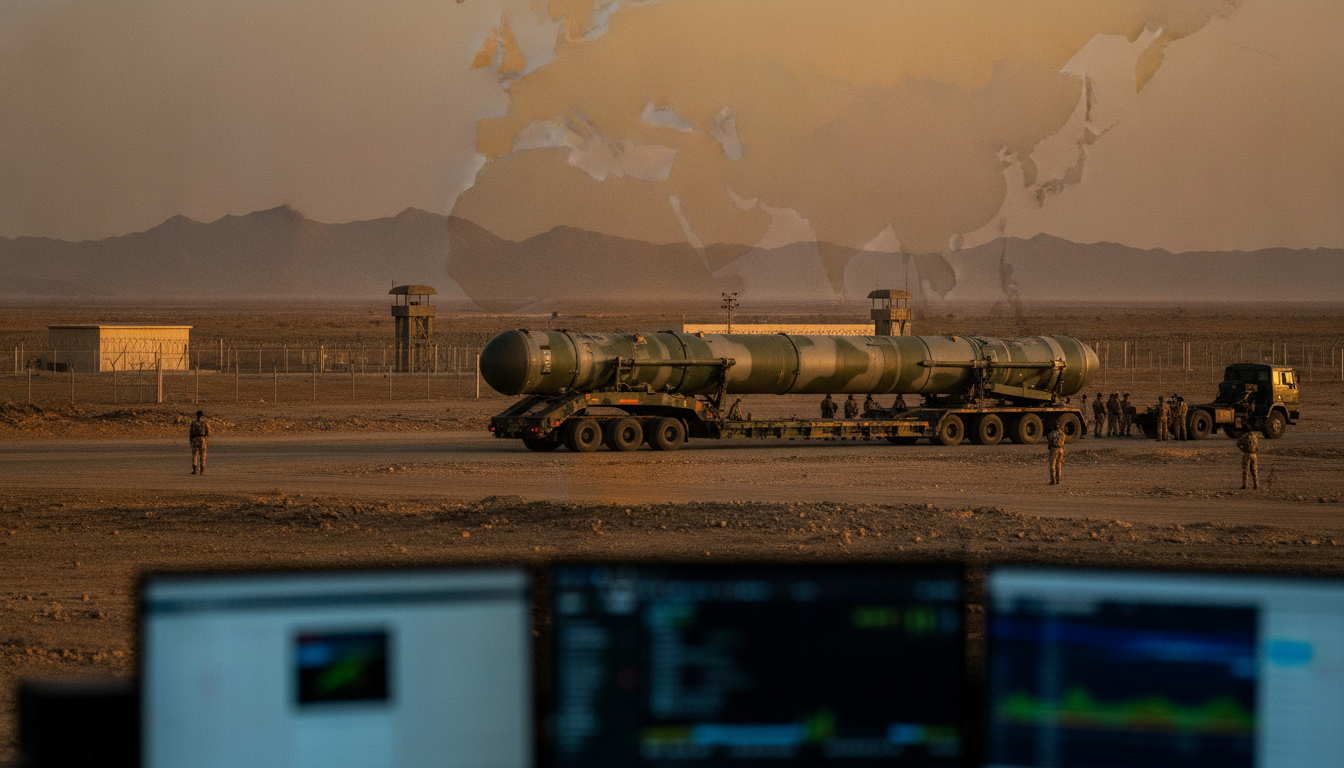
India military modernization centers on Agni-V ICBMs, SIPRI says
SIPRI says India’s military modernization emphasizes Agni-V ICBMs with a claimed 5,000 km range, signaling a strategic shift toward China and regional risk.
SIPRI report identifies Agni-V stockpile and range
India military modernization is increasingly centred on longer-range missile capabilities, the Stockholm International Peace Research Institute (SIPRI) reported, citing a January count of 24 Agni‑V intercontinental ballistic missiles.
SIPRI described the Agni‑V as nuclear-capable and noted the Indian government’s public claim that the system can reach targets up to about 5,000 kilometres.
The institute’s assessment highlights a measurable expansion of India’s strategic missile force in recent years.
SIPRI’s findings, which track inventories and capabilities, underline a shift in procurement and deployment priorities within India’s defence planning.
Missile capabilities and operational reach
The Agni‑V is presented by Indian authorities as a long‑range delivery system intended to extend the country’s strategic reach.
With the reported 5,000 km range, the missile family extends India’s ability to target areas well beyond South Asia, reaching across large parts of East and Southeast Asia.
Indian officials have framed the development as an element of deterrence and strategic stability for New Delhi.
Analysts say range, accuracy, survivability and deployment posture together determine any missile system’s strategic impact.
Planning focus shifts toward China while Pakistan remains a factor
SIPRI’s report indicates that India’s planning now gives increasing attention to capabilities for reaching targets throughout China, even as the country continues to account for its longstanding rivalry with Pakistan.
That dual focus reflects New Delhi’s intent to prepare for a broader set of contingencies across different theatres and potential adversaries.
Defence planners face the challenge of balancing investments between short‑ and long‑range systems while maintaining readiness against multiple threats.
The result has been a more diversified force posture that retains Pakistan as a central concern but also prepares for high‑end competition with a major regional power.
Deployment patterns and command arrangements
Publicly available material suggests India has moved to place longer‑range missiles within its strategic force structure, though details of basing and command arrangements remain limited.
The expansion of Agni‑V inventories, as flagged by SIPRI, implies increased operationalisation rather than purely experimental testing.
Officials typically emphasise secure command-and-control and a declared policy of deterrence.
Observers note that deployment tempo and alert levels—rather than raw numbers alone—are key to understanding the practical implications of any growth in missile stockpiles.
Regional responses and security dynamics
India’s growing long‑range missile capability is likely to reverberate across the region, prompting recalculations in Beijing, Islamabad and other capitals.
Such shifts can produce strategic countermeasures, from doctrinal adjustments to accelerated procurement programmes by neighbouring states.
Analysts caution that a perceived capability gap or arms accumulation can raise the risk of misperception and escalation.
Diplomatic channels and confidence‑building measures have not kept pace with hardware developments, increasing the fragility of regional security dynamics.
Implications for arms control and diplomacy
The increase in India’s strategic missile holdings adds pressure to efforts aimed at regional arms control and risk reduction.
There is no comprehensive arms control framework in South Asia that addresses longer‑range systems and their deployment in a way that mirrors the treaties elsewhere.
Some experts urge renewed dialogue between regional powers to reduce crisis risks and clarify doctrines and thresholds.
Others argue that competitive dynamics, national security doctrines and geopolitical mistrust make formal constraints difficult to negotiate.
India’s public messaging presents the Agni‑V and similar developments as stabilising elements of deterrence, while critics warn that rapid capability growth without reciprocal transparency can fuel insecurity.
The Stockholm institute’s recent tally provides a concrete data point in an evolving picture: New Delhi now fields a measurable number of long‑range ballistic systems that reshape the strategic map of South and East Asia.

