
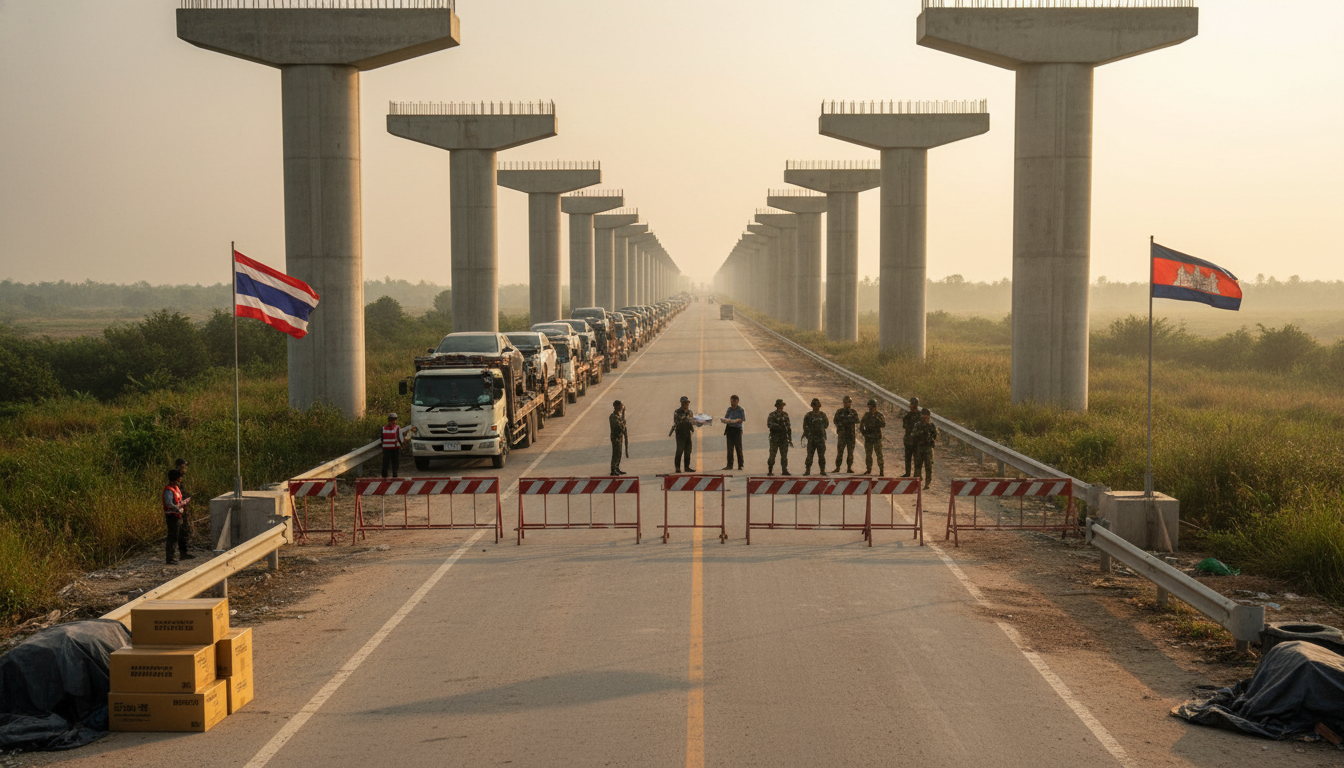
Japan-backed economic corridor remains severed a year after Thailand–Cambodia clashes
One year after the outbreak of a border conflict between Thailand and Cambodia, the Japan-backed economic corridor linking the two countries remains severed, disrupting regional trade and raising costs for Japanese automakers. The closure has forced cargo rerouting, extended transit times and intensified logistics spending for manufacturers that rely on the corridor for parts and finished vehicles.
Border Road Remains Blocked After Year of Clashes
Containers and barriers placed by the Thai army continue to block a key border road near Nong Chan in Sa Kaeo province, a visible sign of the prolonged stand-off. Photographs from May show military matériel sealing routes that were once used for daily cross-border commerce.
The military presence has hardened patrols and checkpoint procedures, complicating movement even where roads remain technically open. Local traders and freight operators report unpredictable closures that add hours or days to journey times and increase the risk of missed factory schedules.
Japan-backed Economic Corridor Severed, Trade Routes Disrupted
The Japan-backed economic corridor was conceived to streamline trade and investment flows between Thailand and Cambodia, underpinning manufacturing clusters that include Japanese suppliers and assemblers. With the corridor effectively closed, planned efficiencies have been lost and supply chains have fragmented.
Cargo that previously moved overland now faces longer, costlier options such as detours through alternative border crossings or additional transshipment via ports. The disruption undermines the corridor’s objective to reduce logistics costs and facilitate integrated production across both countries.
Cost Pressures on Japanese Automakers
Japanese automakers operating in the region are reporting higher freight bills and inventory expenses as they seek to maintain production continuity. Longer routes increase fuel consumption and driver hours, while last-minute rerouting triggers premium surcharges from carriers and higher insurance premiums.
Manufacturers are also holding larger buffers of components to avoid line stoppages, elevating working capital tied up in inventory. Executives in the auto supply chain say those cumulative costs are beginning to erode margins and could influence sourcing decisions if the situation persists.
Supply Chain Rerouting and Transit Delays
Logistics companies have shifted freight onto longer land corridors, secondary border crossings and maritime legs to bypass the sealed route, adding days to transit times. Those alternatives increase handling, raise the risk of damage or loss, and complicate customs clearance procedures for time-sensitive automotive components.
Truck operators face higher operating costs and idle time at checkpoints, while port operators report increased demand for roll-on/roll-off and feeder services. Small and medium-sized suppliers, with less bargaining power and thinner margins, are particularly exposed to the added logistical burden.
Local Communities and Cross-border Commerce Suffer
Border towns that depended on cross-border trade and daily commuters have seen incomes fall and markets thin as movement across the frontier has dropped sharply. Informal traders, transport owners and service workers have fewer customers, and local supply chains for food and parts are experiencing interruptions.
Farmers and small manufacturers on both sides of the border are reporting lost orders and higher transport costs for inputs and finished goods. Community leaders warn that prolonged disruption risks longer-term economic damage that will be harder to reverse than a temporary slowdown.
Diplomatic Talks Falter as Military Presence Grows
Efforts at bilateral talks and mediated discussions have continued intermittently, but progress toward reopening the corridor has been slow against the backdrop of increased military control. Observers say political and security considerations are complicating practical solutions for restoring trade links.
Regional and international stakeholders have urged de-escalation and a return to negotiated border management, noting the broader economic fallout of a sealed corridor. However, without concrete confidence-building measures and technical arrangements for safe transit, commercial traffic is likely to remain constrained.
The severing of the Japan-backed economic corridor a year after the clashes underscores how quickly local security incidents can ripple into wider economic costs for manufacturers and communities. Restoring the corridor will require both political agreement and operational steps to guarantee safe, regular passage for goods so that Japanese automakers and regional economies can regain the efficiency they had built around the route.

