
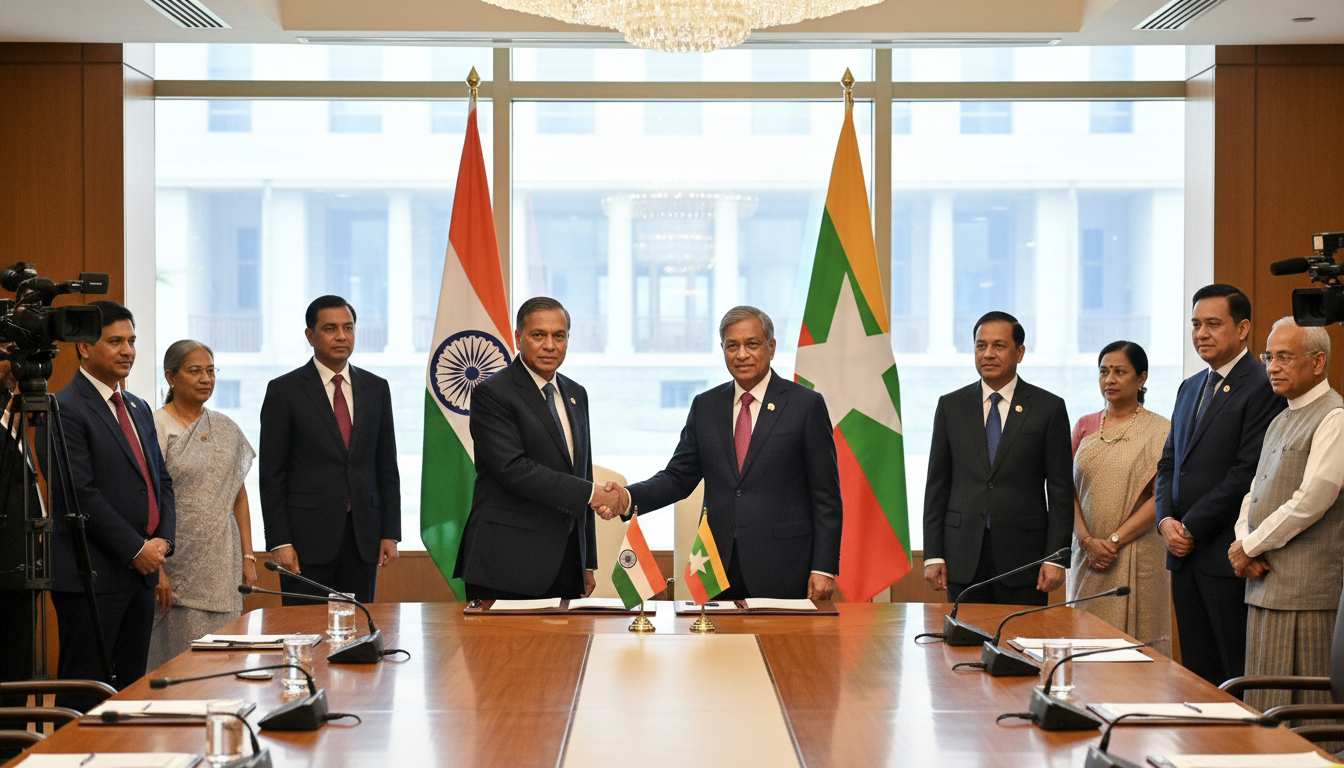
Min Aung Hlaing India visit opens with Myanmar president seeking diplomatic recognition
Myanmar president Min Aung Hlaing begins a five-day India visit on May 30, 2026, to seek diplomatic recognition as New Delhi balances ties amid tensions.
Min Aung Hlaing India visit began on May 30, 2026, when the Myanmar president and former junta chief arrived in New Delhi for his first foreign trip since assuming the presidency. The trip is being framed by Yangon as an opportunity to restore bilateral engagement and secure international legitimacy after his elevation from military leadership. New Delhi has agreed to host a series of meetings that will test how far India is prepared to engage with a leader whose rule remains controversial internationally.
Myanmar leader lands in New Delhi
Min Aung Hlaing touched down in the Indian capital on May 30 and was scheduled for talks with senior ministers and Prime Minister Narendra Modi during a five-day stay. Indian officials said the agenda would include development cooperation, border management and broader strategic cooperation. The visit marks a calibrated opening by New Delhi toward closer official engagement with Myanmar’s new administration.
Diplomatic aims and quest for legitimacy
Myanmar’s government says the visit aims to solidify diplomatic ties and attract investment after years of isolation and conflict. President Min Aung Hlaing is using the trip to seek explicit recognition from a major regional power and to demonstrate that his administration retains state-to-state relationships. Diplomats familiar with the planning described the schedule as carefully managed to give the appearance of normalisation while avoiding highly publicised displays that could provoke international criticism.
India’s hosting of the visit also provides Min Aung Hlaing a platform to argue that bilateral relations can proceed independently of wider international censure. Officials in Yangon hope business and development pledges will help offset the political costs of continuing tensions with Western governments and rights groups.
India’s strategic balancing act
New Delhi’s decision to receive the Myanmar president reflects a long-standing calculus about its immediate neighbourhood and strategic competition in Asia. India has prioritised infrastructure and connectivity projects in Myanmar as part of a broader effort to maintain influence across the Bay of Bengal. Engagement with Naypyidaw is therefore seen in New Delhi as a pragmatic necessity to secure supply routes, energy cooperation and border stability.
At the same time, Indian policymakers face domestic and international scrutiny for dealing with a leader implicated in past human rights abuses. New Delhi has signalled its intent to pursue narrow, interest-driven cooperation while avoiding public endorsements that could be construed as full political legitimisation. This delicate posture underscores the limits of India’s outreach even as it seeks to counterbalance other regional powers.
Regional security and China’s role
The Min Aung Hlaing India visit is taking place against the backdrop of intensified great-power competition in Southeast Asia, particularly China’s expanding influence in Myanmar. Analysts say the trip offers India an opportunity to assert a presence and to remind regional partners of alternative partnerships. New Delhi is expected to press for cooperation on maritime and border security, while remaining cautious about any commitments that would be viewed as military alignment.
China’s deep economic and political ties with Myanmar complicate the picture, and both New Delhi and Yangon are likely to frame discussions in ways that avoid direct confrontation. The outreach to India therefore serves multiple strategic objectives for Myanmar’s leadership, from diversifying external partners to leveraging competition between capitals.
Human rights concerns and international response
Human rights organisations and several Western capitals have criticised engagements that confer prestige on Myanmar’s military-backed leadership. Rights groups reiterated their objections as the visit began, urging states to condition any cooperation on tangible improvements in civilian protection and political reconciliation. The ongoing conflict inside Myanmar, and continued reports of abuses, remain a central source of international unease.
Some foreign ministries have sought to distance themselves from full recognition while keeping channels open for humanitarian and development assistance. This mixed international response constrains the diplomatic gains Min Aung Hlaing can secure and highlights the broader dilemma facing countries that must weigh strategic interests against human rights imperatives.
Economic, infrastructure and security items on the agenda
The official itinerary includes discussions on cross-border connectivity, energy projects and trade facilitation aimed at reviving stalled initiatives. India has invested in road and port links that are vital to its “Act East” strategy, and officials expect the visit to produce incremental commitments rather than sweeping new accords. Security cooperation, including efforts to manage insurgent activity along the shared border, is also likely to figure prominently in talks.
Business delegations accompanying the president are seeking clarity on investment protections and operational access, yet many private firms remain cautious given the uncertain legal and political environment in Myanmar. Any memoranda or joint statements are expected to be narrowly framed to allow both governments room to manage domestic sensitivities.
Observers say the immediate outcomes of the trip will be pragmatic and measured, with both sides prioritising concrete, low-profile cooperation over politically charged declarations.
The Min Aung Hlaing India visit will test New Delhi’s ability to juggle strategic interests with international norms, and it will shape perceptions of Myanmar’s regional reintegration in the months ahead.

