
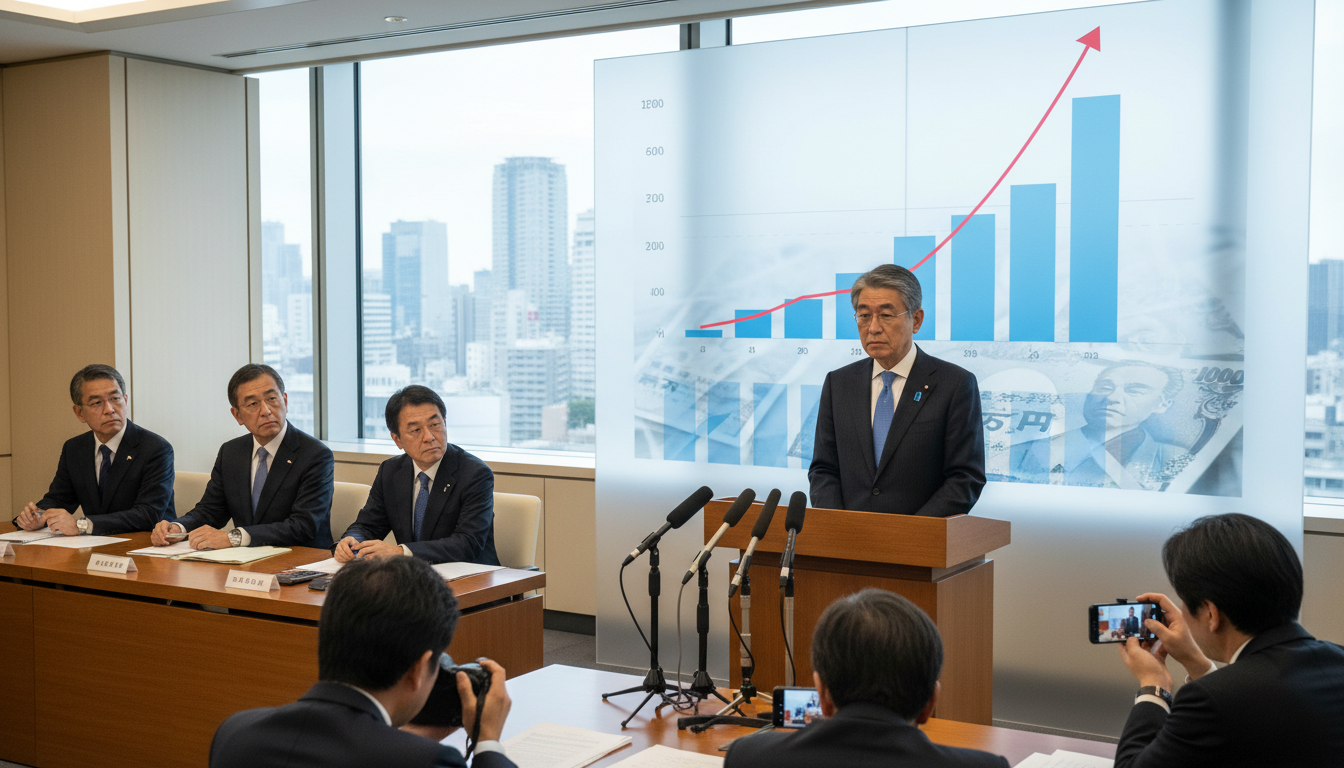
Japan interest rates risk outpacing growth as 10-year JGB yield nears 29-year high
Japan interest rates could top economic growth as 10-year JGB yields near 29-year highs, complicating national debt management and economic policy agenda.
Japan interest rates are edging toward a point where borrowing costs could exceed the country’s economic growth, raising fresh concerns about Tokyo’s ability to manage a large national debt and to finance ambitious economic plans. The Organisation for Economic Co-operation and Development estimates Japan’s GDP growth at roughly 0.5% per year over the past decade and puts 2025 growth at about 1.3%. At the same time the Bank of Japan’s policy rate stands at 0.75% and the 10-year Japanese government bond yield is trading near 2.4%, a level not seen in nearly three decades.
Market Moves Push 10-Year JGB to Multi-Decade High
The 10-year Japanese government bond yield has climbed to about 2.4%, reflecting a sustained move higher in long-term borrowing costs. Market participants point to global rate normalization and changing expectations for monetary policy as drivers of the upward pressure. The current yield level is the highest in close to 29 years, intensifying scrutiny of Japan’s long-standing low-yield environment.
Economic Growth Remains Muted
Japan’s underlying growth has remained modest, averaging around 0.5% annually over the past decade, according to international estimates. While OECD figures indicate a pickup to about 1.3% in 2025, that rate still leaves growth well below historical averages in many advanced economies. The persistent gap between low growth and rising yields raises the prospect that interest expenses could grow faster than the economy itself.
Bank of Japan Policy and Market Expectations
The Bank of Japan’s policy rate is currently set at 0.75%, reflecting a shift from the ultra-low-rate stance maintained for many years. Market forecasts and institutional analysts increasingly expect further normalization, with some economists suggesting yields could move significantly higher over the next year or two. Saisuke Sakai, a senior economist at Mizuho Research Institute, said it “wouldn’t be surprising if interest rates naturally rise to around 3% by fiscal 2027,” underscoring the market’s reassessment of future rate trajectories.
Debt Burden and Fiscal Pressures
Rising interest rates relative to GDP growth can make debt servicing more burdensome and narrow the fiscal space for public investment and social spending. Japan’s public debt is among the largest in the world in ratio terms, and higher borrowing costs would raise interest outlays even if the principal stock remained unchanged. Policymakers may face difficult trade-offs between fiscal consolidation, tax adjustments, and cutting expenditures if market rates continue to climb.
Political Stakes for Prime Minister Sanae Takaichi
The prospect of Japan interest rates exceeding growth carries direct implications for Prime Minister Sanae Takaichi’s economic agenda, which includes ambitious spending and reform objectives. Higher debt servicing costs could constrain the government’s ability to pursue large-scale fiscal initiatives without jeopardizing bond-market confidence. Political pressures may intensify if voters respond to any tightening in services or benefits implemented to stabilize public finances.
Forecasts Indicate a Path Toward 2027 Rate Levels
Analysts are drawing a clearer line between current market pricing and medium-term scenarios in which yields approach the low-to-mid single digits. If yields trend toward the roughly 3% level some forecasters expect by fiscal 2027, the ratio of interest payments to government revenue would rise markedly. That outcome would make fiscal planning more complex and increase reliance on policy coordination between the ministry of finance and the central bank.
Market participants and officials have several tools to manage the transition, but each carries trade-offs. The Bank of Japan can influence short-term rates and intervene in bond markets, but persistent inflationary or global rate pressures could limit its room to maneuver. The government can adjust issuance strategies, such as extending maturities or shifting demand toward domestic investors, though such moves may only partially offset higher yields. Structural reforms to boost potential growth would reduce the long-term risk, but those gains tend to materialize slowly.
Reserve buffers, debt-management rotations, and careful communication will be essential if Japan seeks to avoid a sharp rise in debt-service burdens while allowing a controlled normalization of interest rates. Policymakers must weigh the immediate costs of tighter fiscal stances against the medium-term risks of unchecked borrowing costs.
If Japan interest rates do surpass growth, the country will confront a period requiring close coordination among the Bank of Japan, the finance ministry, and political leaders to preserve market confidence and protect fiscal sustainability. The window for action remains, but the choices will shape Japan’s economic and political landscape into and beyond fiscal 2027.

