
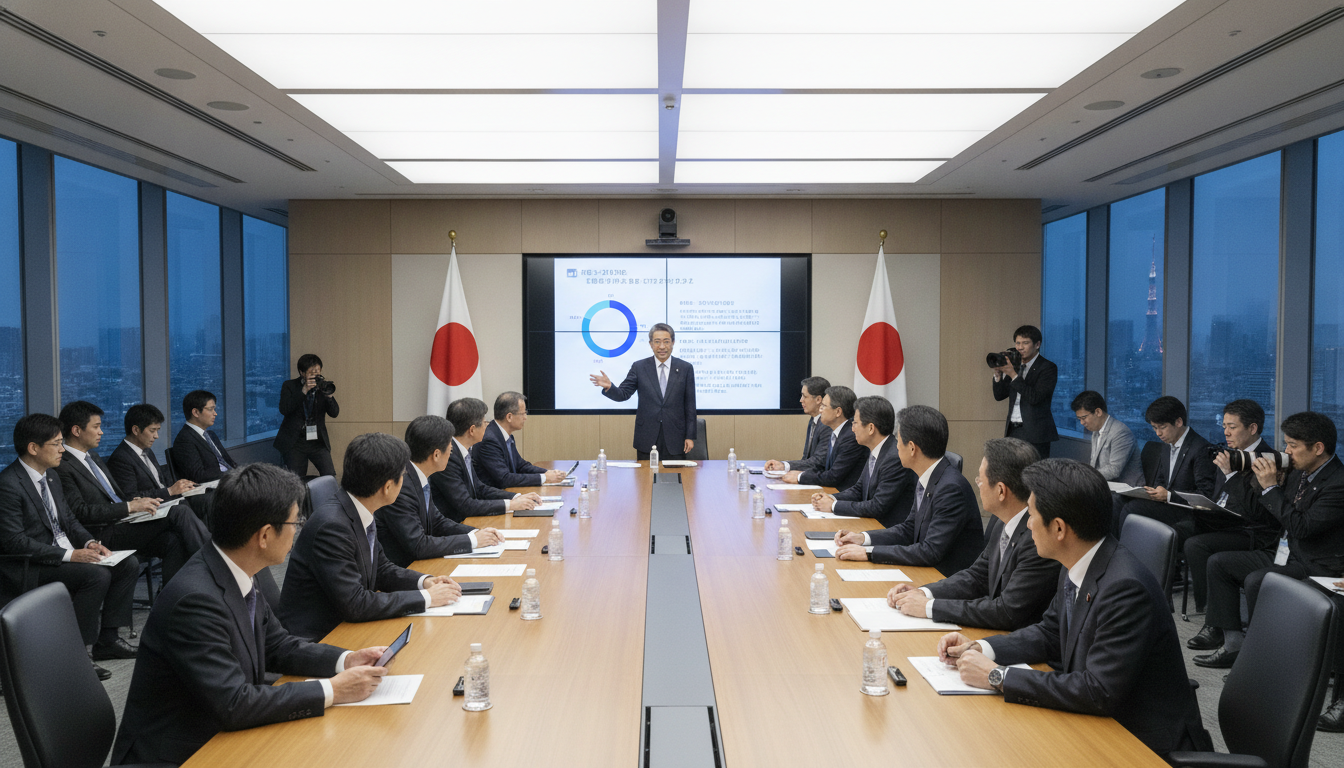
Japan unveils 370 trillion yen investment plan to revive growth and global standing
Japan launches a 370 trillion yen investment plan to spur innovation, restore business confidence and strengthen the country’s global competitiveness through targeted public and private spending.
Japan’s government announced a landmark 370 trillion yen investment plan aimed at jump-starting economic growth and bolstering the country’s position on the world stage. The package, described by the minister in charge of the growth strategy as the largest-ever, is intended to rekindle business confidence and accelerate innovation-led expansion. Officials say the scale and ambition of the plan are designed to attract private capital and modernize key sectors of the economy.
Largest-ever investment package announced
The cabinet approved a framework for a 370 trillion yen investment plan that officials call the most substantial fiscal and strategic push in recent memory. The figure, which officials convert to roughly $2.3 trillion for international comparison, reflects a mix of public spending, incentives and measures to leverage private investment.
Government sources emphasize the symbolic weight of the package as much as its monetary value, arguing policymakers hope the announcement itself will revive risk-taking and long-term corporate investment. The plan is being presented as a turning point after years of subdued growth and weak private-sector momentum.
Minister outlines goals for restoring ‘animal spirits’
Minoru Kiuchi, the minister charged with the growth strategy, framed the package as a deliberate effort to restore "animal spirits" among businesses and investors. He said the government wants to create an environment in which firms are confident to invest in research, factories and high-value services.
Kiuchi emphasized innovation-driven growth as the central objective, linking public measures to enhancements in productivity and international competitiveness. He argued that targeted investments in new technologies and skills would help Japan reclaim momentum in global markets.
Funding priorities and strategic sectors
Officials indicated the investment plan will prioritize areas seen as vital to long-term competitiveness, including digital transformation, green technologies, advanced manufacturing and human capital development. The package is expected to combine direct spending, tax incentives and regulatory reforms aimed at hastening corporate digitalisation and decarbonisation.
While detailed line items are still being finalized, government briefings point to increased support for research and development, pilot projects for next-generation manufacturing, and incentives to attract strategic private investment. Authorities say the approach is intended to mobilize private capital rather than rely solely on government outlays.
Business community and market reaction
Market participants and corporate leaders offered cautious welcome to the announcement, with many praising the scale but urging clarity on implementation and financing. Analysts noted that while headline numbers are significant, the plan’s effectiveness will depend on concrete project pipelines and measurable outcomes.
Some economists warned of potential fiscal pressures and the need to avoid inflationary excess in an economy still recovering from demographic headwinds. Business associations called for streamlined approval processes and clearer tax incentives to ensure funds translate quickly into productive investment.
Implementation timeline and accountability measures
The government plans a phased rollout with short-, medium- and long-term initiatives, aiming to deliver visible results while building capacity for sustained investment. Officials have proposed oversight mechanisms and performance metrics to monitor projects and ensure funds achieve intended productivity gains.
Authorities stress partnerships with local governments and the private sector will be essential to implementation, with pilot programs used to refine approaches before national scaling. Transparency and regular progress reports are expected to be central to maintaining parliamentary and public support.
Implications for Japan’s international competitiveness
Policymakers argue the investment plan is designed not only to boost domestic growth but also to enhance Japan’s global standing in strategic industries. By accelerating innovation and fortifying supply chains, the government aims to make the country a more attractive destination for technology partnerships and foreign capital.
Observers say success could shift perceptions of Japan as a market willing to invest decisively in future industries, potentially altering trade and investment flows in Asia and beyond. Conversely, failure to deliver measurable improvements could deepen concerns about long-term productivity and demographic challenges.
The 370 trillion yen investment plan marks a high-stakes effort by Tokyo to reshape the economic outlook and rebuild confidence among investors and businesses. Delivering on the pledge will require precise execution, rapid mobilization of capital, and sustained political will to translate ambitious targets into tangible growth.

