
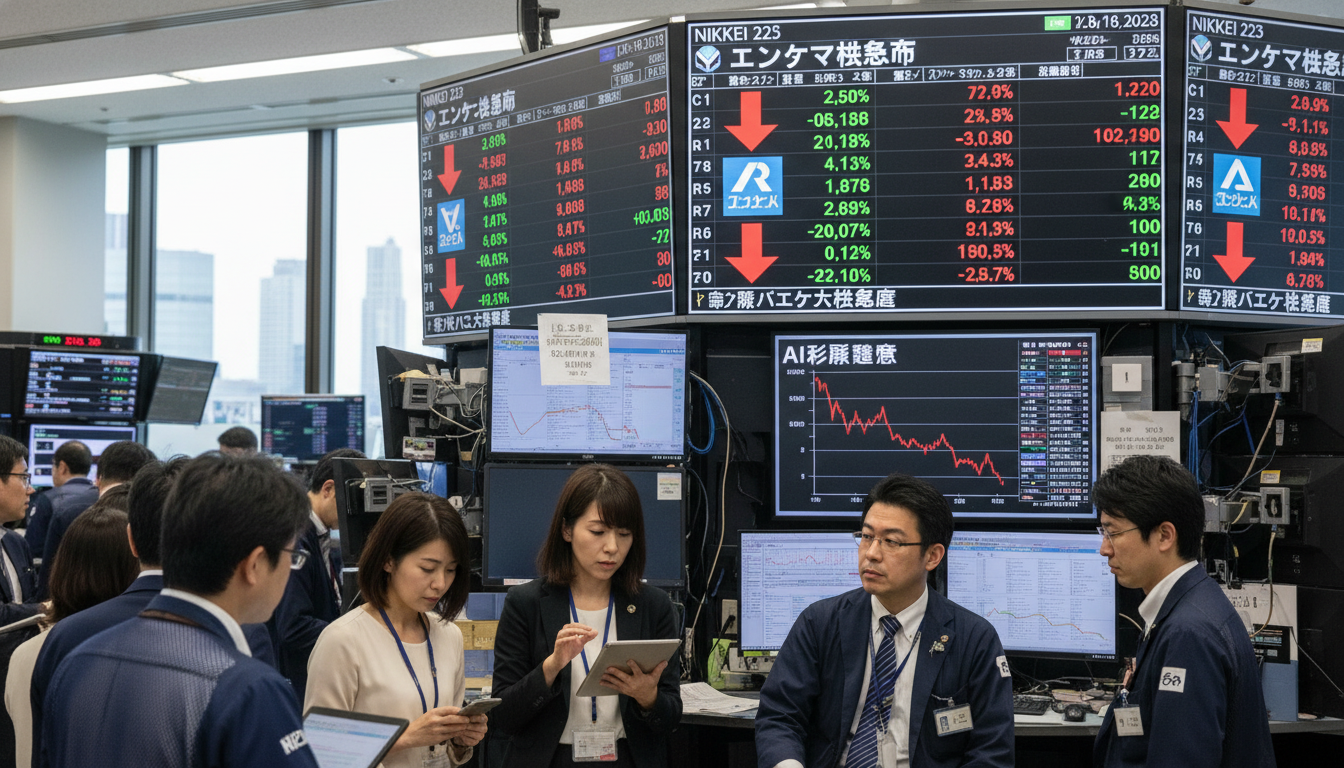
Japanese entertainment companies face valuation re-rating as AI boom cools post‑COVID surge
Japanese entertainment companies confront a sectorwide valuation re‑rating as investor optimism from the post‑COVID recovery yields to uncertainty over artificial intelligence and its implications for iconic intellectual property.
TOKYO — Shares of several leading firms slipped this week as markets recalibrated growth assumptions for Japanese entertainment companies in the face of accelerating AI adoption and unclear licensing risks. The move has prompted analysts and corporate boards to reassess revenue forecasts tied to characters, games and global merchandising.
Market reaction drives sectorwide stock declines
Trading patterns this week reflected a broad pullback in the entertainment segment, with investors reducing exposure to firms seen as most sensitive to intellectual property disruption. Market participants cited a shift from pandemic‑era recovery narratives to questions about how quickly AI will alter content production and monetization.
The sell‑off has not been limited to a single subsector; video game publishers, character licensing houses and media producers all registered increased volatility. The change in tone has accelerated conversations about long‑term multiples and the assumptions embedded in current valuations.
Uncertainty over AI’s effect on Mario, Hello Kitty and other IP
Industry observers say the core concern is not technology itself but the legal and commercial uncertainty that surrounds AI‑generated content. Companies that built global franchises around characters such as Mario and Hello Kitty face complex questions about image control, derivative works and downstream licensing income.
Those uncertainties threaten revenue streams beyond game sales, including merchandise, theme‑park tie‑ins and brand collaborations. Without clear precedents or regulatory guidance, investors are treating future royalty curves and licensing renewals as higher risk.
Nintendo, Sanrio and studios adapt strategies
Major entertainment groups are responding by tightening control over brand use and accelerating digital strategies that incorporate — but do not cede — creative ownership. Some firms are updating licensing terms, pursuing dedicated blockchain or authentication projects, and experimenting with AI tools internally to streamline production while protecting IP assets.
Executives are also diversifying income sources, emphasizing live experiences, direct‑to‑consumer platforms and new content formats to reduce reliance on single revenue lines. Those moves are aimed at reassuring investors that core brands remain monetizable even as the technological landscape evolves.
Analysts point to valuation re‑rating amid shifting growth outlook
Financial analysts say the sector is undergoing a re‑rating driven by a revised growth outlook rather than a sudden deterioration in fundamentals. Multiples that expanded during the post‑COVID recovery are now being compressed as discount rates rise and uncertainty about sustainable margins increases.
Many analysts are asking companies for clearer forward guidance, scenario analyses and more transparent disclosure around licensing exposures. The market reaction suggests investors will reward firms that can demonstrate both IP protection measures and credible pathways to monetize new AI‑enabled content.
Soft‑power export value at stake for Japan’s creative economy
Beyond balance sheets, observers warn that a prolonged downturn or mismanaged transition could affect Japan’s cultural exports and tourism appeal. Characters and franchises serve as ambassadors for Japanese culture, driving consumer interest and related industries abroad.
A weaker commercial performance could have ripple effects on ancillary sectors that benefit from popular media, including travel, retail and hospitality. Policymakers and industry groups may increasingly weigh in to support frameworks that sustain both creativity and commercial viability.
What investors will watch next in the entertainment sector
Market participants say the near‑term catalysts to watch include quarterly results, guidance on licensing revenue, and public statements about AI policies and partnerships. Legal developments — including test cases over AI‑derived works and new regulation — are likely to be key drivers of sentiment.
Investors will also monitor how individual companies allocate capital between IP protection, new content creation and technology investment. Firms that can provide quantifiable plans to defend and extend their franchises are expected to attract more patient institutional capital.
The short‑term repricing reflects a broader recalibration of expectations rather than an existential threat to Japan’s creative giants, but clarity on IP protections, licensing terms and regulatory responses will determine whether recent market moves represent a temporary correction or a longer lived structural shift.

