
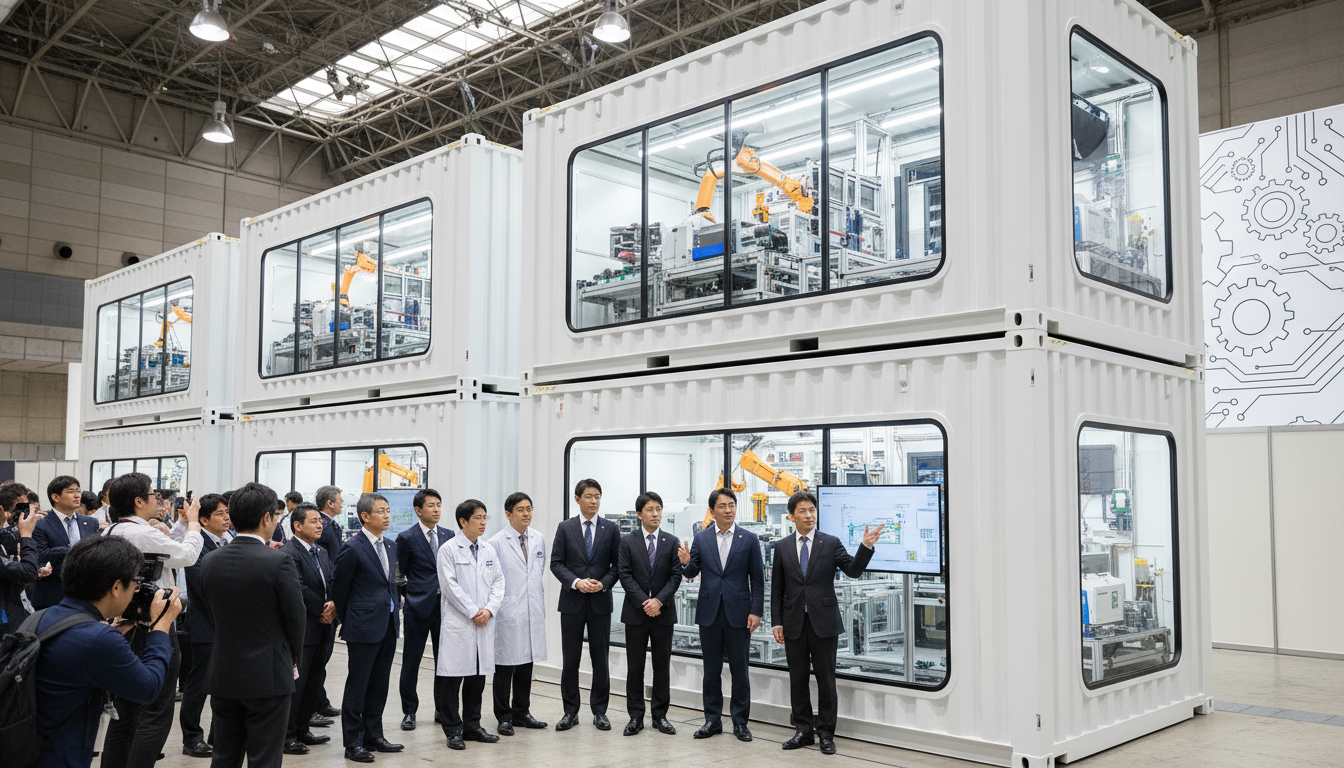
Japanese Suppliers Launch Containerized Battery Manufacturing Kits to Speed EV Production
Japanese firms unveil containerized battery manufacturing kits—modular, low-cost units that speed plant builds and can supply batteries for 50,000 EVs per year.
Japanese suppliers of battery-manufacturing equipment are rolling out a containerized battery manufacturing model designed to cut installation time and lower upfront capital costs for battery makers and automakers.
The system packages production equipment into standardized shipping containers that can be transported and assembled on site, allowing clients to scale capacity rapidly with a modular approach.
Consortium of Japanese equipment makers moves to modular delivery
Japanese manufacturers and equipment suppliers have coordinated to offer pre-configured containers that house battery production machinery and control systems.
The partners are marketing the kits as a way to respond quickly to orders and shifting demand patterns in global electric vehicle supply chains.
By delivering equipment as sealed, transportable modules, suppliers aim to simplify installation work at customer sites and reduce the need for bespoke factory construction.
How the container modules are outfitted and transported
Each container is designed to integrate key production functions such as electrode coating, cell assembly, and formation testing, along with embedded control and safety systems.
Containers are intended to be shipped by road, rail or sea and then linked at a factory site with standardized power, cooling and communications interfaces.
The modular format allows clients to add or replace functional blocks without lengthy on-site engineering, shortening commissioning times compared with traditional greenfield plants.
Assembling a factory: linking containers into a production line
The partners say a client can combine roughly 1,000 containers to create a factory capable of producing battery cells sufficient for about 50,000 electric vehicles a year.
Containers are joined in series to form production lines, and support modules for utilities and quality control are integrated to form an operational plant.
This approach aims to enable stepwise capacity expansion, where companies can scale output incrementally as demand materializes rather than committing to a single large investment.
Cost and time benefits for battery makers and automakers
The containerized battery manufacturing model reduces civil-engineering work and on-site assembly, a major portion of traditional plant lead time and cost.
Modularity also lowers the technical barrier for new entrants and regional assemblers that need closer, flexible battery supply near vehicle assembly plants.
Faster factory build-out and standardized equipment can cut time-to-market for new battery formats and chemistry variants while improving predictability of capital expenditure.
Potential market response and customer opportunities
Automakers seeking localised battery supply, contract manufacturers, and regional battery firms are likely targets for the containerized solution.
Smaller producers can adopt a phased deployment to match production with sales, while larger groups can deploy multiple clusters to diversify supply risk.
The model also offers opportunities for overseas export of Japanese equipment expertise combined with standardised engineering packages.
Logistics, standardisation and quality-control challenges
Despite advantages, the container approach requires strict standardisation of interfaces, quality assurance across modules, and robust logistics planning.
Certification and safety approvals for battery production must be secured at each site, and integrating many modules raises complexity around process control and maintenance.
Supply of critical raw materials and long lead times for some components could still constrain ramp-up, and buyers will need to weigh modular convenience against system integration risks.
The move toward containerized battery manufacturing represents a strategic effort by Japanese equipment makers to offer flexible, lower-cost routes for building battery capacity quickly.
If broadly adopted, the model could accelerate battery deployments near vehicle assembly hubs and support faster responses to shifts in EV demand, while also forcing industry players to address interoperability, certification and supply-chain resilience.

