
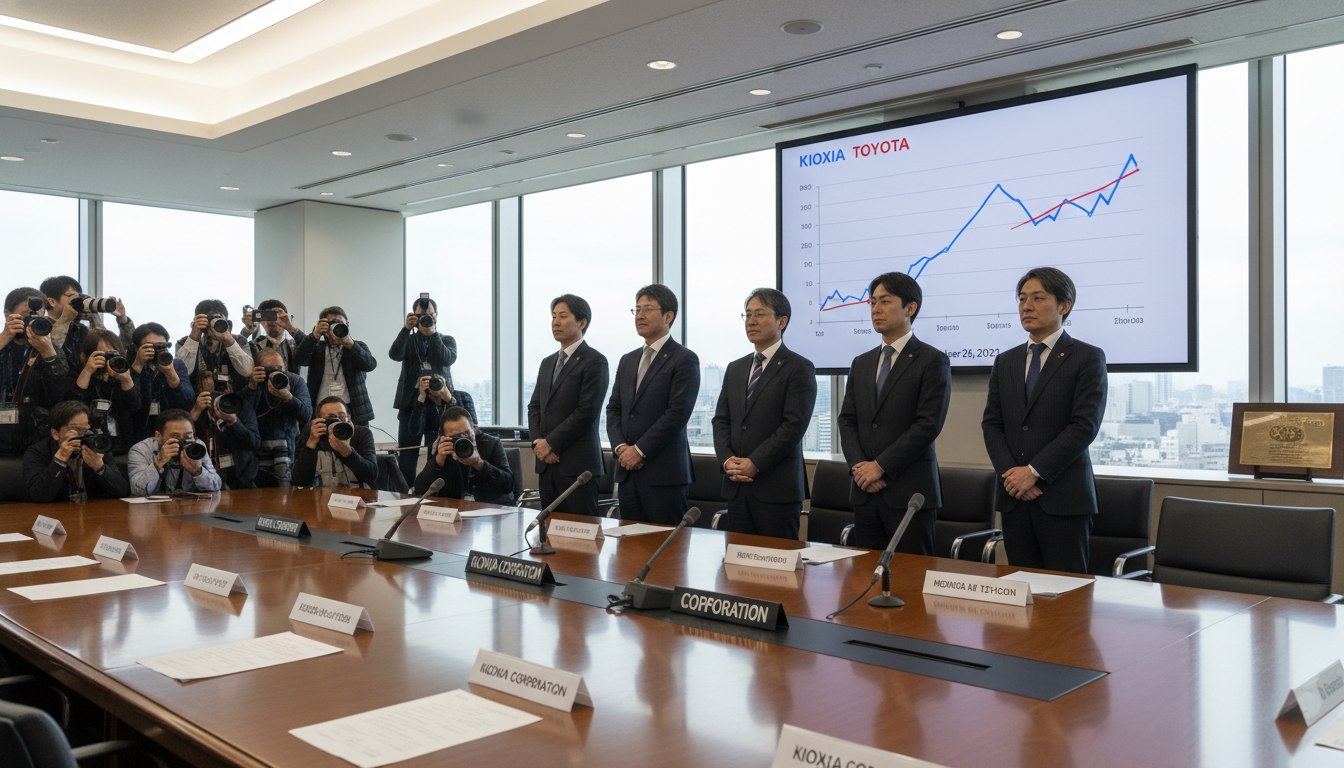
Kioxia Overtakes Toyota to Become Japan’s No.2 by Market Capitalization Amid AI Chip Boom
Kioxia surpassed Toyota in market capitalization on June 3, 2026, a milestone that highlights a rapid reordering of Japan’s biggest listed companies. The flash-memory maker’s share price surge pushed it into the number-two slot, underscoring how artificial intelligence demand is reshaping investor priorities. The move follows a strong run for Kioxia that has taken it from 169th to second by market value within a year.
Kioxia rises to No.2 by market capitalization
Kioxia’s climb to the second position occurred during trading on Wednesday, June 3, 2026, when investors bid up shares of the memory-chip specialist. Market participants pointed to heightened demand for high-performance flash storage used in AI servers and data centers as the key catalyst. The company’s rapid ascent — from well outside the top 100 a year ago to the upper echelon today — reflects a broader appetite for semiconductor assets.
Kioxia’s performance contrasts with the long-standing market dominance of traditional industrial names, and the shift has been visible across market indices. Traders noted that momentum in chip stocks has pulled forward valuations as investors reposition portfolios toward technology-linked companies. The speed of the re-ranking has prompted fresh discussion about sector leadership within Japan’s equity market.
AI demand fuels flash-memory valuations
Industry analysts say the immediate driver of Kioxia’s rally is persistent demand for NAND flash memory used in AI training and inference systems. Large language models and related workloads require vast quantities of high-speed storage, and suppliers of advanced memory have become critical links in technology supply chains. That structural demand has translated into stronger earnings expectations and higher multiples for companies in the space.
Investors have also been pricing in future capacity expansions and product upgrades that could sustain revenue growth over several years. While manufacturing memory remains capital-intensive, the potential for sustained demand has reduced the sector’s cyclical stigma in the eyes of many market players. The result is a reappraisal of how memory makers fit into Japan’s corporate landscape.
Toyota slips to third as chipmaker climbs
Toyota Motor, long a mainstay at the top of Japan’s market-cap rankings, fell to third place as Kioxia rose above it. The shift does not reflect a sudden deterioration in Toyota’s business outlook, but rather a relative revaluation that favors semiconductor exposure amid the AI cycle. Automotive groups face their own transitions — including electrification and software integration — but the market’s near-term focus has tilted toward firms tied directly to AI infrastructure.
For some investors, Toyota’s temporary demotion is a reminder of how capital markets can rapidly reassign prestige based on thematic trends. Analysts caution that leadership positions can be fluid during periods of technological disruption and that longer-term returns will depend on execution and fundamentals across industries. Market watchers will be watching both sectors for signs of durability in the new rankings.
SoftBank holds Japan’s top market-cap spot
SoftBank Group continued to sit atop Japan’s list of the largest companies by market capitalization, a position it consolidated earlier amid gains in its technology investments. The conglomerate’s stake-driven model and exposure to high-growth tech firms have underpinned its valuation in recent years. Its maintenance of the top slot underscores the prominence of investment-led business models in the current market environment.
SoftBank’s presence at number one also highlights the broader theme of financial-market recognition for technology-related assets. While other traditional sectors have not vanished from the index, the concentration of large valuations among firms with tech linkages marks a meaningful shift. Policymakers and corporate leaders have taken note of the evolving composition of Japan’s market leaders.
Investor reaction and market dynamics
Trading desks reported elevated activity in memory-chip stocks and related suppliers following Kioxia’s move up the rankings. Portfolio managers described a rotation into semiconductor names as investors sought exposure to companies positioned to benefit from AI spending. That rotation has been accompanied by increased volatility as market participants reassess risk and reward across sectors.
Some investors warned that sentiment-driven rallies can overshoot fundamentals and urged caution on valuation multiples that have expanded quickly. Others argued that the structural nature of AI demand justifies a premium for leading suppliers of advanced memory. The balance between enthusiasm for long-term secular growth and attention to near-term profit cycles will likely shape market behavior in coming months.
Implications for Japan’s corporate landscape
The reordering of market-cap rankings signals a potential long-term shift in Japan’s industrial leadership, with technology-focused firms gaining prominence over traditional manufacturers. Corporate strategy may follow suit as companies accelerate investments in semiconductors, software and AI-related capabilities. That could affect hiring, capital spending and partnerships across sectors as firms seek to remain competitive.
For policymakers, the change raises questions about industrial policy, supply-chain resilience and support for high-tech manufacturing. Strengthened valuations for chipmakers may spur renewed emphasis on domestic research and production capacity. Observers say the development could also encourage Japanese firms to more aggressively pursue global technology partnerships and commercialization of advanced chips and memory.
Kioxia’s brief elevation to second place on June 3, 2026, is a vivid illustration of how rapidly market leadership can evolve in the era of AI, and it leaves investors, companies and policymakers reassessing priorities as the technology-driven cycle unfolds.

