
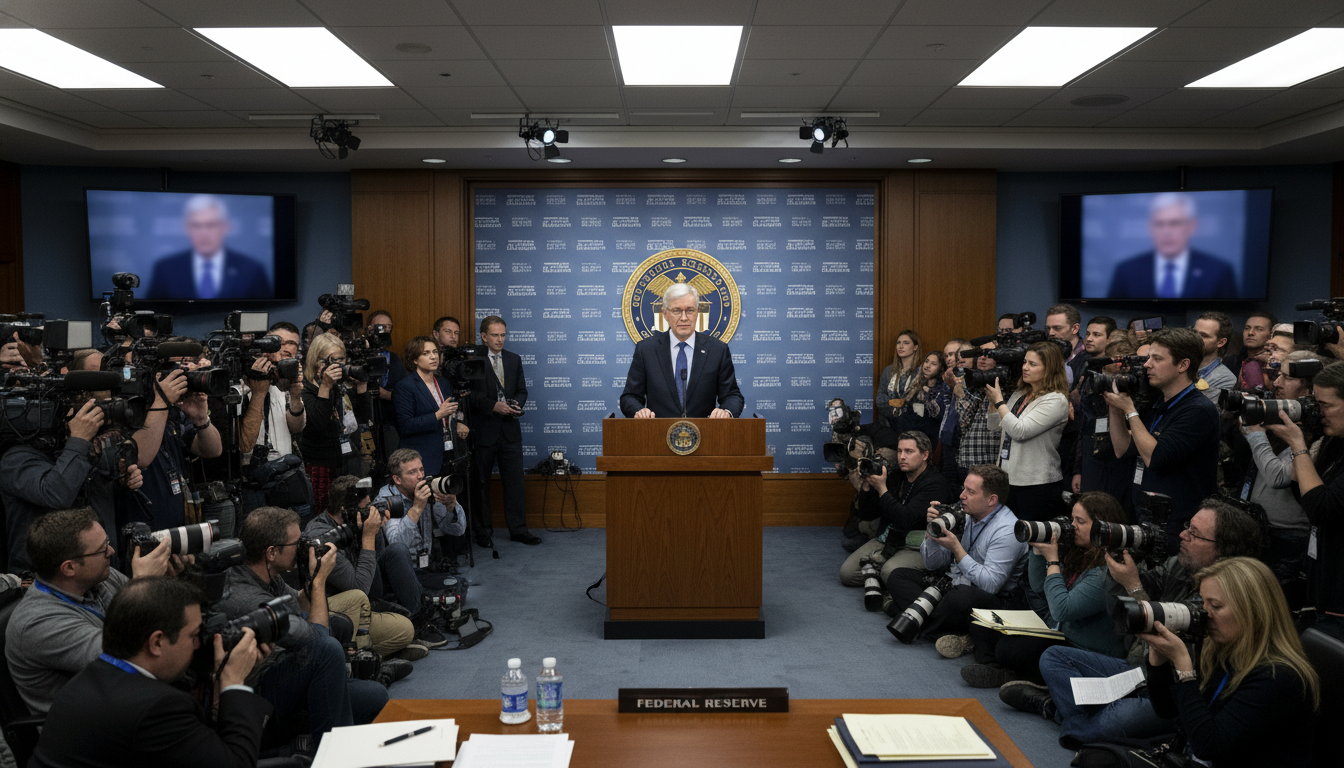
Jerome Powell Faces Likely Final Fed News Conference Amid DOJ Probe and White House Pressure
Federal Reserve Chair Jerome Powell will address what many view as his likely final Fed news conference amid a Justice Department probe into renovation costs and sustained pressure from the White House.
Powell to Address Pressures at Likely Final Conference
Jerome Powell, the Federal Reserve chair, is preparing to speak publicly after months of intense scrutiny from the Trump administration and critics on Capitol Hill. The remarks come as markets and policymakers watch for both his tone and any sign of compromise on monetary policy. Powell has been a steady presence at the central bank, and this news conference is being framed by many observers as a culminating moment in his tenure.
His public remarks will be read for signals about the Fed’s independence and the outlook for interest rates, issues that have been central to recent tensions with the White House. Powell’s careful approach to language has defined his leadership style, and officials expect him to reiterate the central bank’s commitment to its dual mandate.
Justice Department Opens Inquiry Over Building Renovations
In a statement earlier this year, Powell disclosed that the Justice Department had opened an unprecedented investigation touching the Fed and himself, centered on cost overruns for renovation projects. The inquiry has raised fresh questions about the boundary between federal oversight and political influence when the subject involves the central bank. While Powell described the probe in measured terms, it has become a focal point for critics who argue it could be used to exert pressure on the Fed.
Officials at the Fed have maintained that routine audits and reviews are part of normal operations, but they also stress that a criminal investigation is different in scale and implication. The announcement of the DOJ inquiry prompted immediate headlines and prompted lawmakers from both parties to press for clarity on the scope and rationale of the investigation.
White House Pressure and Public Exchanges with Trump
President Donald Trump’s public criticisms of the Fed and Powell have been unusually direct and personal, involving repeated calls for lower interest rates and occasional invective. Those exchanges intensified a broader political debate over the appropriate relationship between the White House and the Federal Reserve. Powell’s stance has been depicted by supporters as a defense of institutional independence in the face of partisan pressure.
The back-and-forth has at times involved sharp rhetoric, but also policy disagreement that touches on fundamental economic priorities such as inflation control and employment. Observers say the dispute illustrates how central banking has become an increasingly politicized arena, particularly in a highly polarized national environment.
Market Reaction and Monetary Policy Implications
Financial markets have monitored the conflict closely, interpreting public pressure on the Fed as a potential risk to predictable policy making. Investors and economists will look to Powell’s remarks for guidance about whether rate decisions were influenced by external political forces. The Fed’s recent rate decisions and forward guidance have been watched for signs of either independence or capitulation.
Analysts caution that any perception of political interference could heighten market volatility and undermine confidence in the central bank’s ability to manage inflation and employment. Powell’s task is therefore to reassure markets by offering clear, data-driven explanations of policy while avoiding language that might inflame political tensions.
Congressional Oversight and Institutional Safeguards
Lawmakers have responded to the unfolding controversy by calling for oversight hearings and greater transparency around the DOJ inquiry and Fed governance. Both Republican and Democratic members of Congress have emphasized the need to protect the Federal Reserve’s operational autonomy while also ensuring accountability. Committee chairs have signaled they will press Fed officials for testimony to clarify the facts behind the renovation cost questions.
Policy experts note that institutional safeguards—legal protections, internal audits, and congressional oversight—exist to mediate such disputes, but their effectiveness depends on adherence to norms and the rule of law. The current episode is likely to prompt renewed debate about whether additional statutory protections or disclosures are necessary to shield monetary policymaking from political pressure.
Assessing Powell’s Potential Legacy as Fed Chair
Jerome Powell’s tenure will be judged on a combination of economic outcomes and his stewardship of the Fed’s institutional independence. Supporters credit him with navigating a complex economic landscape while emphasizing data-driven policy, even as critics fault him for decisions they view as insufficiently responsive to growth concerns. The present controversy over the DOJ inquiry and public attacks adds a political dimension to how history will remember his leadership.
Observers say Powell’s legacy will hinge on whether he is perceived to have preserved the Fed’s credibility and whether monetary policy under his watch succeeded in balancing inflation control with labor market objectives. As he prepares to face reporters, the stakes are not merely personal but institutional, with implications for the central bank’s role in the U.S. economy.
Jerome Powell’s public remarks will therefore be parsed for both substance and symbolism, as policymakers, markets and the public seek clarity on the Fed’s direction and resilience in the face of sustained political pressure.

