
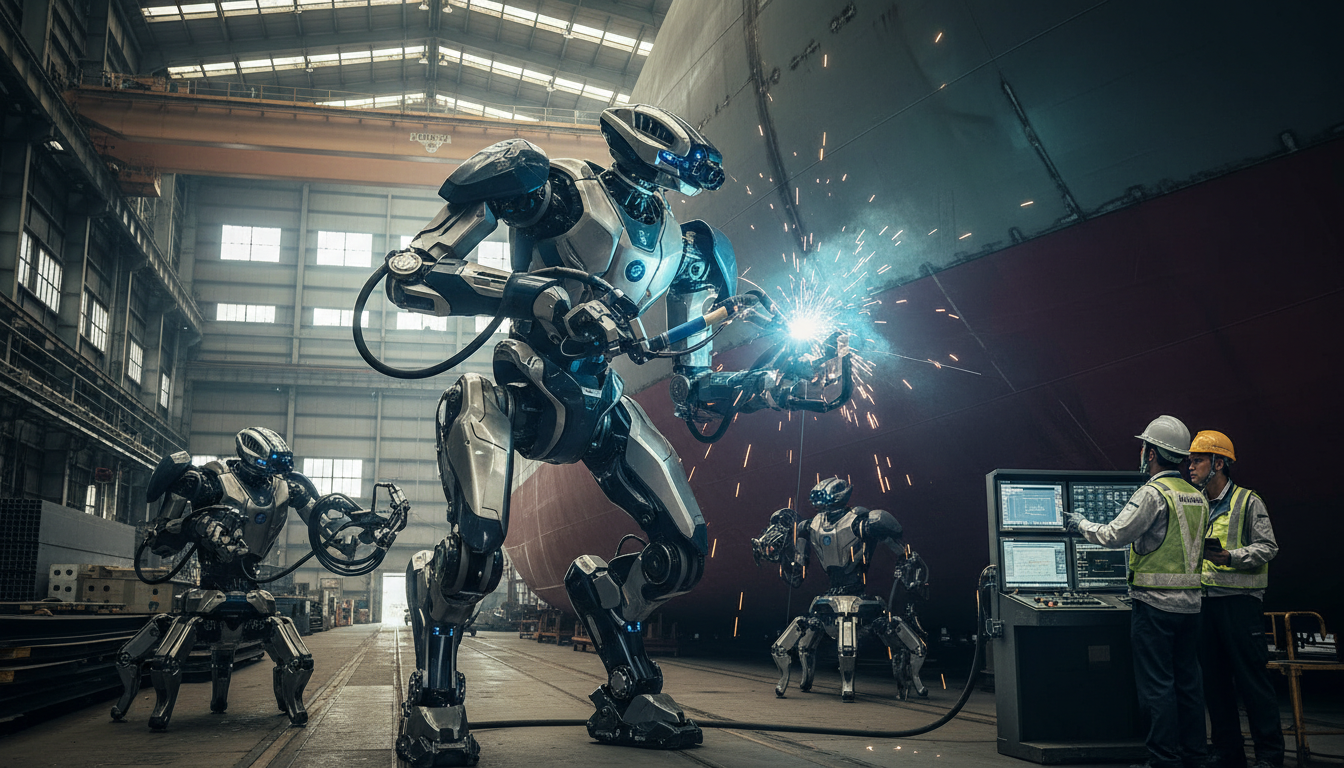
Kawasaki Heavy’s AI shipbuilding robot aims to double welding productivity
Kawasaki Heavy unveils an AI-equipped shipbuilding robot to double welding productivity and ease worker shortages using technology from its Corleo quadruped.
Kawasaki Heavy Industries is developing an AI-equipped shipbuilding robot intended to roughly double welding productivity on shipyards, the company said, as it seeks to ease a growing shortage of skilled technicians. The project adapts technologies from Kawasaki’s Corleo quadrupedal robot to operate in the confined, hazardous workspaces typical of ship construction. Company officials present the effort as a move to improve safety, reduce manual strain and raise output without abandoning human oversight. The shipbuilding robot will focus on repetitive, precision welding tasks that currently consume a large share of technicians’ time.
Kawasaki frames the project as a productivity and safety initiative
Kawasaki Heavy positions the shipbuilding robot as both a productivity tool and a safety improvement for shipyards, where heavy manual labour and complex welding are routine. The firm says the AI-driven system is being designed to carry out continuous welding work with consistent quality, potentially shortening schedules and reducing rework. Management has highlighted that automating high-volume welding could allow human workers to shift toward inspection, supervision and higher-skilled tasks. The company emphasizes the robot is intended to augment the workforce rather than act as a wholesale replacement.
Corleo quadruped technology adapted for shipyards
Engineers are drawing on mobility, perception and balance systems developed for Kawasaki’s Corleo quadrupedal robot when tailoring the shipbuilding machine to the shipyard environment. Those technologies help the platform navigate irregular surfaces and reach awkward positions that are typical inside hulls and superstructures. By transferring algorithms for terrain assessment and dynamic stabilization, Kawasaki aims to enable the shipbuilding robot to operate close to parts and fixtures without frequent repositioning. The reuse of proven components shortens development time and reduces the engineering risk associated with introducing robotics to heavy-assembly lines.
Expected gains in welding output and workforce effects
Kawasaki projects that automating specific welding operations could roughly double throughput for targeted tasks, a level of improvement that would alter labour allocation on complex projects. Higher, steadier welding output also has implications for delivery schedules and cost management across shipbuilding programs. Shipyards facing aging workforces and recruitment challenges may find the technology a practical substitute for scarce skilled labor in the short term. Industry observers note that productivity gains will depend on integrating the robot into existing production flows and on training staff to oversee and maintain the new systems.
Design considerations and operational features under development
Developers say the shipbuilding robot will combine AI-driven path planning with sensors that monitor weld quality and detect obstacles in real time. The platform is being engineered to work alongside scaffolding and human teams, with safety interlocks and remote-control options for supervisors. Attention to modular hardware and software is intended to allow adaptation across vessel types and varying welding standards. Kawasaki’s approach includes iterative testing in controlled environments to refine reliability before live-yard deployment.
Testing, rollout plans and industry implications
Kawasaki plans staged trials to validate performance under conditions that mimic active shipyards, including tests of endurance, repeatability and quality control. If field trials confirm the company’s expectations, the robot could be offered to shipbuilders as part of a broader automation package that addresses both labor shortages and tighter delivery windows. Shipyards that adopt the technology may need to adjust work processes, invest in staff retraining and update safety protocols to accommodate mixed human–robot operations. The move adds to a broader trend in heavy industry toward targeted automation aimed at raising output while managing labour constraints.
The shipbuilding robot project marks a notable step for Kawasaki Heavy Industries in bringing AI and advanced mobility into traditional heavy-manufacturing sectors. By adapting technology from a quadrupedal research platform, the company is attempting to bridge lab prototypes and practical yard applications, with a focus on welding tasks that could yield immediate productivity and safety benefits.

