
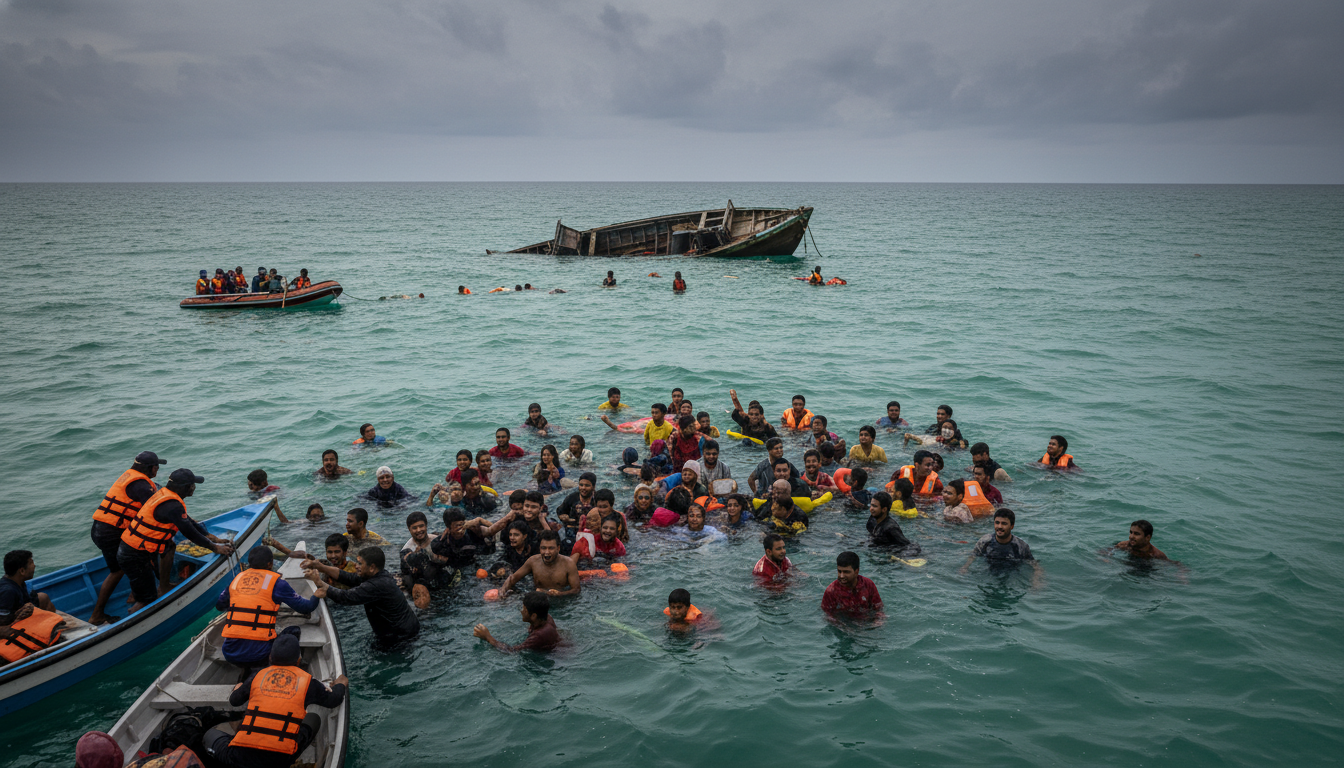
Rohingya boat capsizes en route to Malaysia, nine rescued and dozens feared lost
Rough seas off Cox’s Bazar caused a Rohingya boat capsizes around April 9, leaving nine people rescued by the Bangladesh Coast Guard and many others missing.
Boat overturns during journey from Bangladesh to Malaysia
An overcrowded vessel carrying around 250 Rohingya refugees capsized in rough weather and is believed to have sunk in the Andaman Sea around April 9. The Bangladesh Coast Guard recovered nine survivors after responding to reports of a distressed boat, but the majority of those on board remain unaccounted for. The incident occurred as the boat left from the vicinity of Cox’s Bazar, a coastal district that hosts large Rohingya displacement camps and is a frequent departure point for irregular maritime journeys.
Rescue teams described chaotic scenes on arrival and said survivors were taken to shore for treatment and questioning. Authorities have warned that casualty figures may rise as search operations continue and more debris or bodies are found in the area.
Search and rescue operations under way in the Andaman Sea
Bangladesh Coast Guard vessels and local maritime patrols conducted search-and-rescue sweeps after receiving distress signals and witness reports. Searchers have combed a stretch of the Andaman Sea near the Naf River mouth, where currents and winds can change rapidly and complicate recovery efforts. Local fishermen and naval assets assisted in the initial response, sharing information about lifeboats, floating debris, and the possible direction of drift.
Officials cautioned that strong currents and poor visibility have hampered the search and that the probability of finding large numbers of survivors decreases with each passing day. Families of those believed to be on the boat have gathered in Cox’s Bazar, seeking news from authorities and relief groups working at landing points.
Drivers of the sea crossings from Cox’s Bazar to Malaysia
The decision by Rohingya and other displaced people to attempt perilous sea voyages is driven by multiple factors, including deteriorating living conditions in and around Cox’s Bazar camps. Overcrowding, limited access to formal employment, and restrictions on movement have pushed some to seek livelihoods abroad despite the risks. Smugglers and traffickers often exploit these vulnerabilities, offering passage on unseaworthy vessels for substantial fees.
Observers say the Bangladesh-Malaysia route remains attractive because Malaysia is seen as a destination with established Rohingya communities and potential work opportunities. However, the sea journey is fraught with cost, deception, and life-threatening danger, and this latest capsizing is part of a continuing pattern of maritime tragedies in the Bay of Bengal and Andaman Sea.
Humanitarian and local responses in Cox’s Bazar
Local humanitarian organizations and camp-based leaders have mobilized to support families and coordinate with authorities after the capsizing. Medical teams prepared to treat hypothermia, dehydration, and injuries among the rescued, while psychosocial workers offered initial counseling to relatives and survivors. Aid agencies have also urged authorities to increase communication and transparency about search efforts and casualty figures to reduce distress among communities waiting for news.
Relatives have appealed for DNA testing and identification procedures to be put in place promptly should recovered bodies be brought ashore. Humanitarian actors stressed the need for systematic family tracing and for survivors to receive immediate protection and legal counseling, given the cross-border nature of the incident.
Regional migration dangers and calls for coordinated action
The capsizing has drawn renewed attention to the regional dynamics that fuel maritime migration and the need for coordinated responses across Bangladesh, Myanmar, Malaysia, and international partners. Advocacy groups and regional observers have called for stepped-up action against smuggling networks, improved rescue capacity, and safer, legal pathways for refugees and migrants. They argue that stronger regional cooperation could reduce reliance on dangerous sea routes and save lives.
Authorities and aid organizations face long-standing challenges in balancing border security, humanitarian protection, and the need to dismantle trafficking operations. Experts say that without parallel measures to address root causes, such as camp conditions and statelessness among Rohingya, maritime departures are likely to continue.
Survivors and families await fuller information as the Bangladesh Coast Guard continues its operations, while humanitarian agencies press for rapid support and transparent reporting. The scale of the human toll from the April 9 capsizing remains uncertain, and authorities have appealed for anyone with information about boat movements or smuggling networks to come forward to aid the ongoing search and investigation.

