
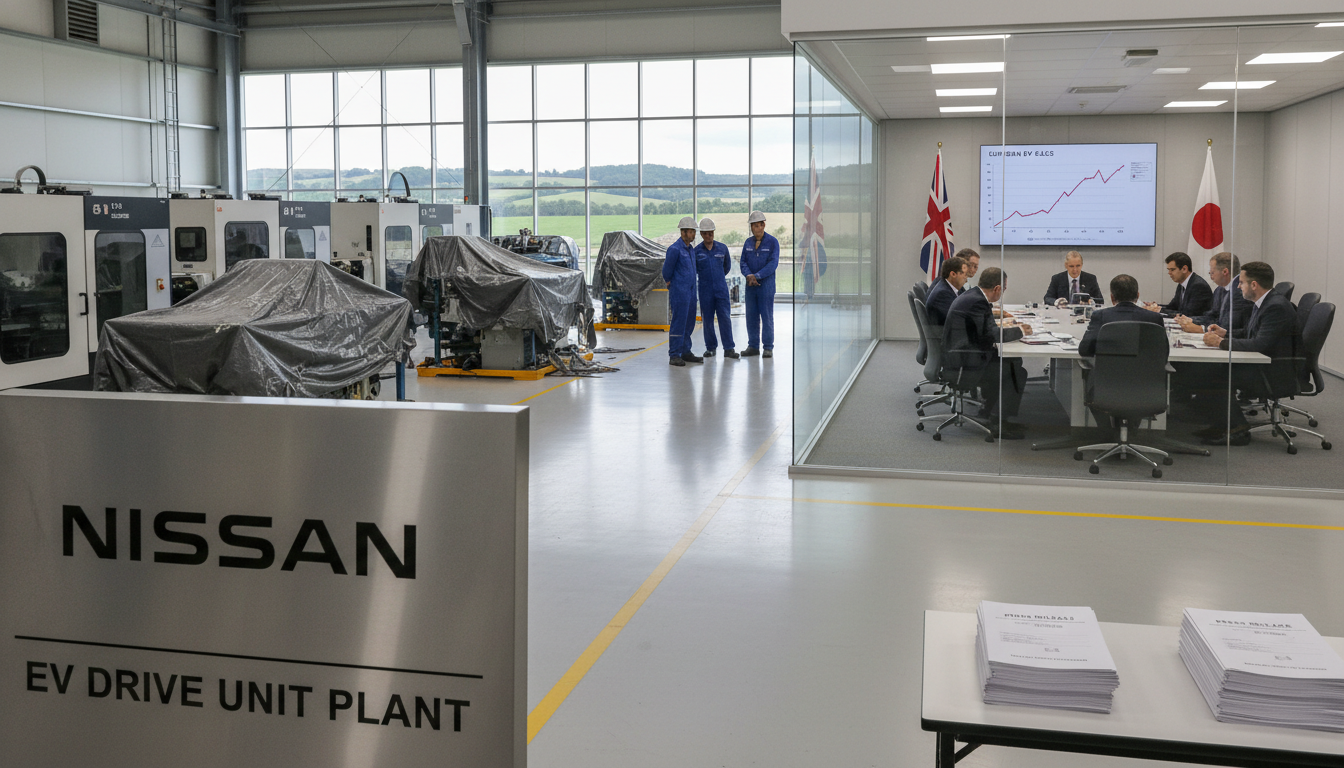
Nissan scraps UK EV drive unit plan after weak European sales
Nissan abandons plans to build EV drive units in the UK, scaling back investment after weak European electric vehicle sales and shifting its global production strategy amid market headwinds.
Nissan ends UK EV drive unit project
Nissan has decided to abandon its plan to manufacture electric vehicle (EV) drive units in the United Kingdom, citing disappointing sales of key EV models in Europe and the need to reassess capital allocation. The company said the move reflects lower-than-expected demand for its recent EV offerings and a strategic shift to concentrate production where returns are stronger.
The decision marks a retreat from an earlier commitment to bolster local EV component manufacturing in the UK market. Nissan characterized the change as a reorientation of investment priorities rather than a withdrawal from the broader European market, but did confirm the specific UK drive-unit project will not proceed.
Reasons behind the retreat
Company officials pointed to sluggish consumer uptake and an increasingly competitive landscape for electric cars in Europe as primary drivers of the decision. Nissan’s management indicated that scaling back this specific investment allows the automaker to preserve resources for platforms and regions showing more immediate growth potential.
Analysts note that carmakers are under pressure to balance heavy EV capital spending with profitability goals amid uneven demand. Nissan’s move follows similar recalibrations by several global manufacturers as they adapt rollout plans to real-world sales patterns and supply-chain costs.
Implications for supply chain and suppliers
The halted project will have immediate implications for suppliers and engineering partners originally lined up to produce e-axles and other drive components in the UK. Companies contracted to supply parts, tooling and assembly services are likely to see order volumes reduced or delayed as Nissan reassigns work or seeks alternate sourcing strategies elsewhere.
Supply-chain experts say the decision could accelerate consolidation among smaller suppliers that had positioned themselves to support the UK manufacturing hub. Those firms may pursue new contracts in other regions or diversify product lines to offset the lost business tied to the shelved drive-unit venture.
Market performance of Nissan’s EV models in Europe
Nissan attributed the change to weak sales of its latest electric models in Europe, where buyers have a growing array of choices across price points and brands. Market analysts describe Europe as a crucial but intensely competitive battleground for EVs, where consumer preferences and incentives vary widely across countries.
The automaker’s performance in Europe has been mixed, with demand fluctuating by model and market segment. Nissan’s reassessment underscores how performance in individual regional markets can materially alter long-term manufacturing plans for next-generation components.
Strategic shift in global EV production
By canceling the UK drive-unit plan, Nissan is signaling a broader recalibration of its global EV production footprint. The company is prioritizing flexibility, reserving capacity to expand or contract manufacturing in response to shifting demand and to target investments where margins and volumes better justify capital deployment.
Executives have emphasized the need to align production with demonstrable market traction and to protect cash flow while pursuing electrification. The move is consistent with a trend among automakers to adopt more modular approaches to EV architecture and to concentrate specialized component production in a smaller number of strategic locations.
Workforce and regional economic effects
Although Nissan framed the decision as a targeted change rather than a comprehensive pullback from Europe, the cancellation of the drive-unit plan is likely to have localized effects on jobs and investment projections tied to the project. Local authorities and business groups that had anticipated supplier jobs and capital spending in support of the factory will need to reassess economic forecasts.
Officials in affected communities may seek assurances about alternative investment commitments from Nissan or other automotive firms to mitigate the impact. For workers and suppliers, the immediate priorities will be securing continuity of contracts and exploring redeployment or retraining options where feasible.
The company’s move to abandon the UK EV drive unit project and scale back investment after weak European sales reflects the hard choices automakers face as they navigate an uneven transition to electrification. As Nissan reallocates resources, industry observers will watch closely to see where the automaker concentrates its next round of EV component production and how competitors respond to the changing market dynamics.

