
Takaichi Government Shifts to "Fiscal Sustainability" in Cabinet-Approved Basic Policy
Japan’s new Basic Policy pivots from rigid fiscal consolidation to a multi‑year focus on fiscal sustainability, signaling a major change in budget strategy under Prime Minister Sanae Takaichi.
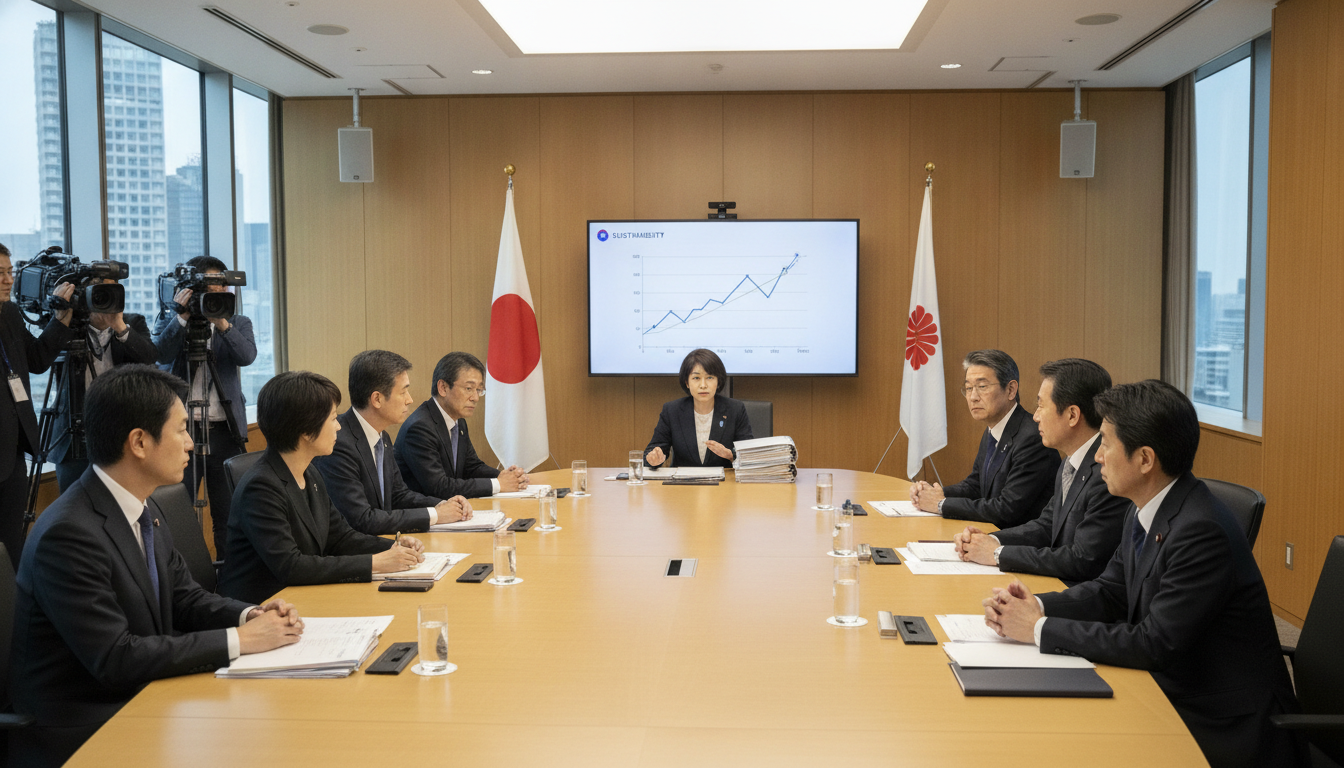
The Cabinet on July 21 approved the latest Basic Policy on Economic and Fiscal Management and Reform, replacing language that historically emphasized "fiscal consolidation" with a framework that prioritizes fiscal sustainability measured over multiple years rather than single‑year balance targets. (kantei.go.jp)
Policy Shift Announced at Cabinet Meeting
The government framed the decision as part of a broader effort to combine growth promotion with sustainable public finances, describing the approach as “responsible proactive fiscal policy.”
Officials said the move seeks to enhance predictability for private investment while preserving the state’s ability to fund strategic spending. (kantei.go.jp)
Removal of ‘Fiscal Consolidation’ from the Basic Policy
Since the Basic Policy’s inception in 2001, successive documents had explicitly cited fiscal consolidation as a central objective, a formulation that guided budget discipline for more than two decades.
The Ministry of Finance and Cabinet documents note that the earlier explicit call for annual fiscal consolidation targets has now been omitted from the July decision, marking a clear rhetorical and practical departure. (mof.go.jp)
Adopting a Multi‑Year View of Fiscal Health
Under the revised wording, the government will assess public finances on a multi‑year basis and set “core targets” to ensure that fiscal balances do not deteriorate over the medium term.
The Basic Policy emphasizes monitoring trajectories of debt and deficits across several fiscal years instead of insisting on single‑year primary surpluses. (www5.cao.go.jp)
Government Rationale: Growth, Investment and Predictability
Prime Minister Takaichi and senior ministers argue the change is intended to unlock higher private investment and to allow targeted, long‑term spending on infrastructure, technology and strategic industries.
Officials have highlighted measures such as a separate “investment frame” intended to distinguish growth‑oriented, predictable spending from ordinary annual expenditures. (kantei.go.jp)
Market and International Reaction
International institutions and market analysts have urged caution, stressing that credibility matters for sovereign risk and borrowing costs.
The OECD and IMF have both underscored the importance of a clear, credible medium‑term consolidation plan even as fiscal policy supports growth, warning that ambiguity could raise uncertainty about Japan’s long‑run debt trajectory. (oecd.org)
Political and Administrative Implications
The policy change reflects the Takaichi administration’s broader emphasis on “responsible activism” in fiscal affairs, balancing investment with declared sustainability goals.
Domestically, the shift will reshuffle budget prioritization in the Finance Ministry, Cabinet Secretariat and line ministries as they translate multi‑year targets into annual budget guidance and evaluation metrics. (www5.cao.go.jp)
Financial markets and rating agencies will watch the operational details closely, including how the government defines the new “core targets,” the composition of the investment frame, and the safeguards that will prevent open‑ended deficit increases.
Analysts note that the policy’s success depends on concrete rules for fiscal governance, transparent monitoring, and credible medium‑term plans that combine revenue and expenditure measures to place public debt on a sustainable path. (oecd.org)
Observers say the change could give the government more flexibility to respond to shocks or to pursue strategic investments, but they caution that flexibility without clear guardrails risks eroding market confidence.
How the administration reconciles near‑term stimulus or investment with long‑term debt management will determine whether the new emphasis on fiscal sustainability is judged responsible by investors and international institutions. (elibrary.imf.org)
The Cabinet decision marks a notable turning point in Japan’s fiscal lexicon and strategic approach, shifting the official emphasis from an annual consolidation imperative to a broader, multi‑year stewardship of public finances.
Implementation, transparency and measurable targets will shape whether the change strengthens Japan’s growth prospects while maintaining the fiscal credibility international partners and markets expect.

