
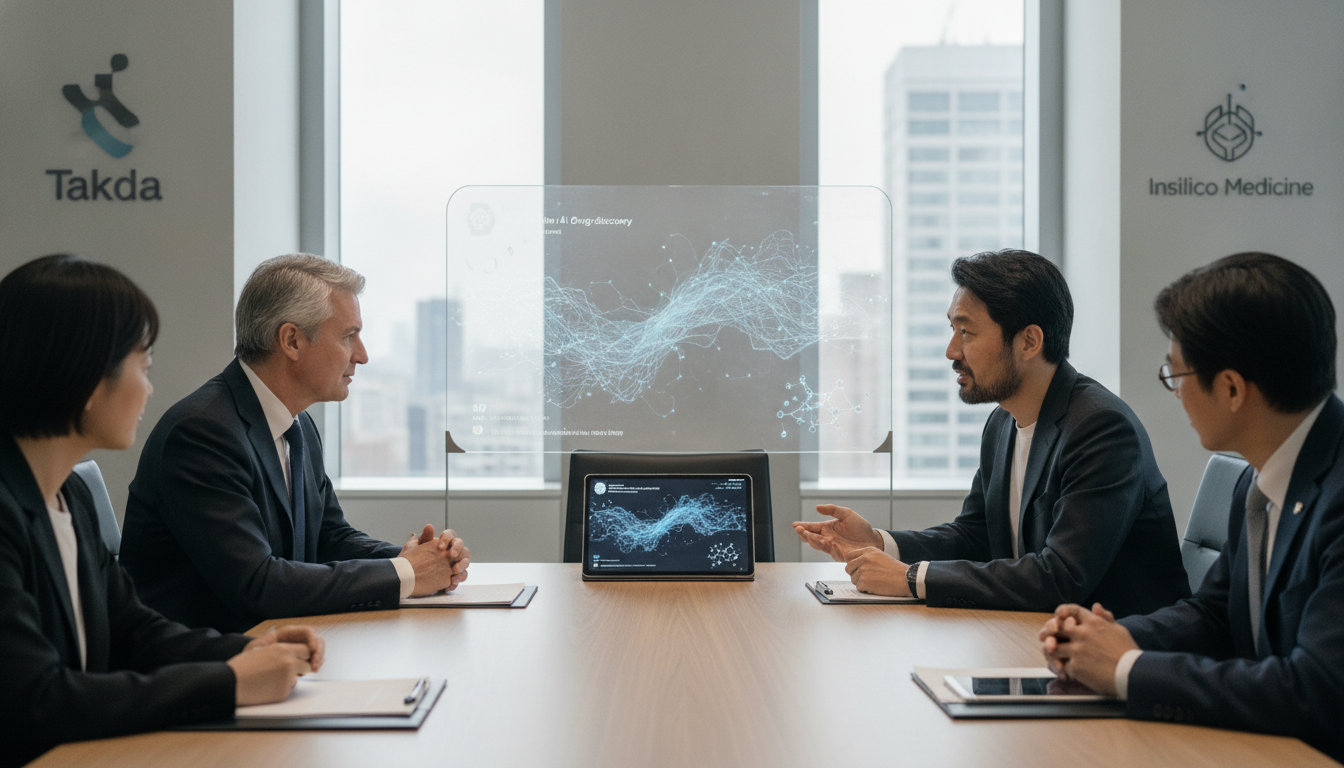
Takeda signs deal with Insilico to deploy generative AI for drug development
Takeda will use Insilico Medicine’s generative AI to accelerate drug discovery, marking a high-profile move into generative AI drug development for the Japanese drugmaker.
Japanese pharmaceutical giant Takeda Pharmaceutical Company has reached an agreement with Hong Kong-based Insilico Medicine to use the biotech firm’s generative AI platform in early-stage drug discovery. The deal gives Takeda access to Insilico’s computational tools for identifying candidate molecules and streamlining target selection, a step the company says aims to shorten timelines in generative AI drug development.
Deal structure and immediate scope
The agreement grants Takeda access to Insilico’s proprietary generative models and data analytics tools to support target identification and molecular design. Specific financial terms and exclusivity provisions were not disclosed by either party, though the partnership is described as a licensing and collaboration arrangement rather than an outright acquisition.
Initial work is expected to focus on preclinical candidate identification and hit-to-lead optimisation, with both companies citing the potential to accelerate programs that would traditionally require years of laboratory screening. The arrangement reflects a growing pattern of biopharma firms licensing algorithmic platforms rather than building them in-house.
How generative AI is applied in discovery
Generative AI platforms can propose novel chemical structures, predict their likely biological activity, and estimate key properties such as solubility and metabolic stability. By iterating computational models against biological datasets, these systems aim to prioritise molecules with higher probability of success before laboratory synthesis and testing.
Beyond molecule generation, the technology supports virtual screening at a scale and speed unattainable with conventional methods, reducing the number of physical experiments needed. Integrating AI outputs with traditional medicinal chemistry workflows remains critical, and companies typically validate computational hits through a sequence of laboratory assays.
Strategic rationale for Takeda
For Takeda, the collaboration is both a technological and strategic move to deepen its discovery toolkit amid rising R&D costs. The company has signalled a desire to diversify its discovery approaches and to accelerate late-stage value creation, especially in therapeutic areas where small molecules and biologics coexist.
Partnering with a specialised AI developer allows Takeda to leverage external expertise while focusing internal resources on translational and clinical development. The deal also positions Takeda to respond more quickly to competitive pressures from biotech companies that have embraced computational design.
Insilico’s platform and capabilities
Insilico Medicine, headquartered in Hong Kong, is known for applying deep learning to molecular design and target prediction. Its platform combines generative algorithms with predictive models trained on chemical and biological data to propose candidate structures and prioritize targets for experimental follow-up.
The company has promoted its ability to shorten discovery cycles and to suggest chemically diverse solutions that might be overlooked by conventional approaches. Under the Takeda agreement, Insilico will provide platform access, support model tuning to Takeda’s datasets, and collaborate on joint validation studies.
Industry context and cross-border licensing trends
The Takeda-Insilico deal is part of a broader uptick in cross-border licensing and collaboration between established pharmaceutical firms and AI-driven biotech companies. Asian and North American AI startups have increasingly attracted partnerships as drugmakers seek to de-risk early discovery and reduce cost burdens.
Such agreements also highlight regulatory and intellectual property questions that arise when algorithm-generated molecules form the basis of a candidate. Companies typically establish detailed data-use, ownership and inventorship frameworks to govern downstream development and potential commercialization.
Potential milestones and uncertainties
Planned milestones commonly include computational validation, synthesis of nominated candidates, in vitro pharmacology, and in vivo proof-of-concept studies. Success at each stage remains uncertain, and history shows that computational hits often require extensive optimisation to become viable drug candidates.
Both firms emphasise that generative AI is a tool to enhance, not replace, laboratory science and clinical judgment. Observers note that timelines for tangible clinical outcomes from such collaborations usually span several years, contingent on preclinical performance and regulatory pathways.
As Takeda integrates Insilico’s models into its discovery pipeline, the collaboration will be watched as an indicator of how major pharmaceutical companies operationalise generative AI in research. The partnership underscores growing confidence in computational methods while recognising the practical and regulatory steps required to translate algorithmic predictions into medicines for patients.

