
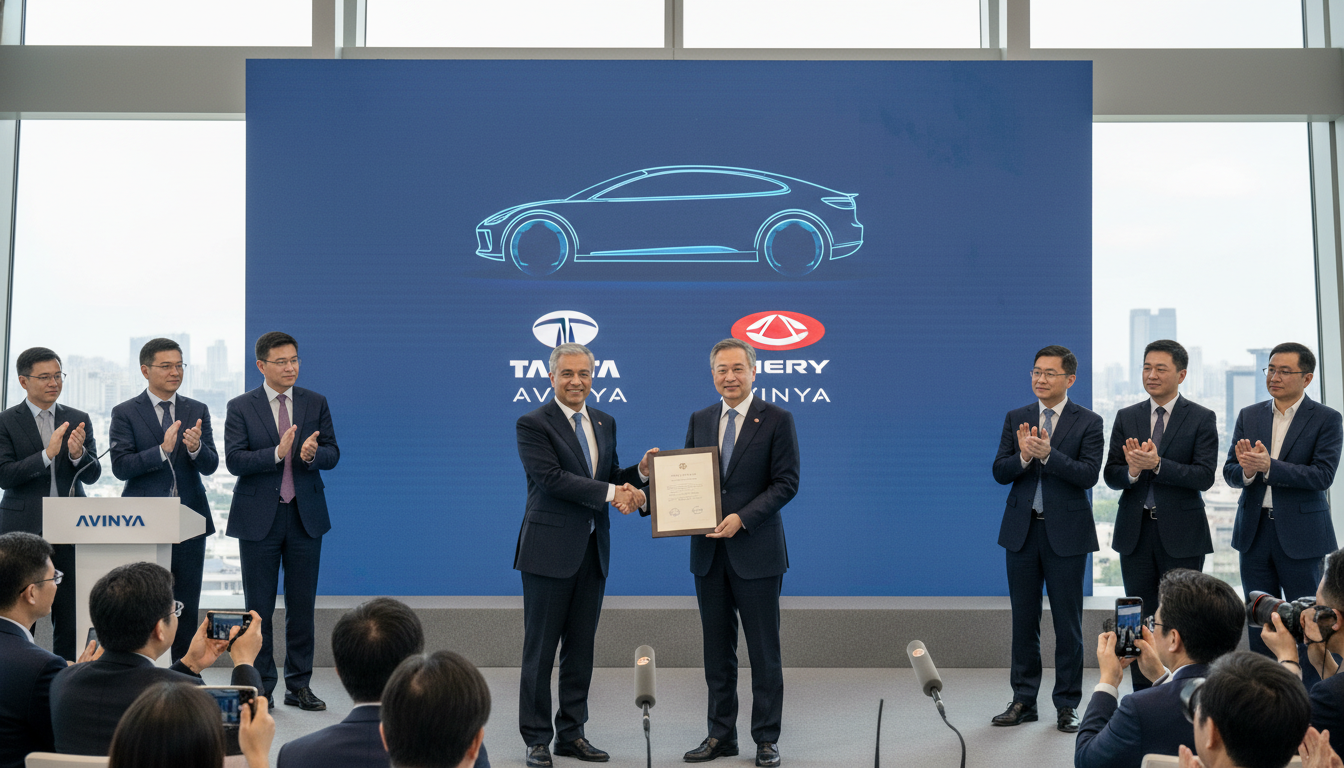
Tata Avinya EV to Use Chery Technology as Platform Partnership Expands
Tata Motors will base some Tata Avinya EV models on a Jaguar Land Rover–Chery platform to speed EV launches while weighing geopolitical and supply-chain risks.
BENGALURU — Tata Motors has announced plans to incorporate technology from China’s Chery into its Tata Avinya EV range, marking a notable step in the company’s effort to accelerate electric vehicle development. The move, which includes using a platform being jointly developed by Jaguar Land Rover and Chery for certain Avinya models, reflects a broader trend among Indian automakers to adopt proven Chinese EV solutions. Company officials say the approach aims to shorten development cycles and bring new models to market faster, while prompting fresh scrutiny of strategic, regulatory and supply-chain implications.
Details of the Avinya platform arrangement
Tata said that some vehicles within the Avinya family will be built on a scalable platform co-developed by Jaguar Land Rover, a Tata subsidiary, and Chery. That platform will provide a shared engineering base for multiple models, allowing the company to adapt body styles and features while retaining core battery, motor and electronic architectures. Using an established modular platform can reduce duplicated engineering effort and lower unit development costs, which Tata views as important for competing in the fast-evolving EV market.
Why Tata is accelerating EV development
Executives at Tata and other Indian manufacturers are under pressure to bring competitively priced EVs to market before consumer demand consolidates around rivals. Relying on tested technology from overseas partners can cut lead times measured in years, rather than months, and can reduce the risk of software and hardware integration issues that often delay launches. For Tata, the Avinya programme is positioned as a strategic priority: faster rollouts will support dealer readiness, battery supply deals and post-sale service networks needed for mass adoption.
Industry-wide trend toward Chinese tech adoption
Across India’s auto sector, established and emerging players are increasingly looking to Chinese suppliers and joint ventures for batteries, power electronics and complete vehicle platforms. Chinese firms have invested heavily in battery chemistry, electric drive systems and vehicle software, creating a pool of ready-made components and design blueprints that can be adapted to local markets. Automakers see such collaboration as a pragmatic way to compress the product development timeline and to access cost-effective electric-drive solutions without building every capability in-house.
Geopolitical and regulatory considerations
The decision to use technology with roots in China also heightens geopolitical and regulatory sensitivity. India and China have experienced periodic diplomatic tensions, and defence as well as trade officials have in the past scrutinised critical technology flows. For automakers, that reality translates into potential hurdles ranging from heightened compliance checks to public and political scrutiny over reliance on foreign components. Regulators may also demand transparency on technology transfer terms, data security arrangements and local content plans as part of broader industrial policy objectives.
Supply-chain and competitive implications
Adopting a shared platform can ease procurement and standardise parts, but it also concentrates supplier dependency, particularly for battery cells, powertrains and software stacks. For Tata, managing suppliers and ensuring diversified sources will be critical to avoid bottlenecks and to protect margin stability. Competitors in India are likely to respond by accelerating their own partnerships or by doubling down on in-house platform development, raising the possibility of faster product cycles and intensifying price competition in the mainstream EV segment.
Market response and consumer expectations
Consumers will judge Tata Avinya EVs on range, price, feature set and after-sales support as much as on their engineering pedigree. A platform derived from a joint Jaguar Land Rover–Chery effort could bring advanced features and better economies of scale that translate into more competitive retail pricing. Yet brand-sensitive buyers may weigh the origin of technology when assessing durability, safety credentials and long-term serviceability, making effective communication about testing, certification and warranty terms essential for market acceptance.
Implications for Jaguar Land Rover and partnerships
The platform collaboration underscores Jaguar Land Rover’s evolving role within Tata’s broader group strategy, as it participates in developing shared architectures that can serve multiple brands and markets. For JLR, leveraging external partnerships can spread development costs and accelerate the introduction of electrified models that meet diverse safety and regulatory standards. The arrangement also signals to partners and suppliers that platform-based strategies remain central to how automakers aim to scale EV production efficiently.
As Tata moves ahead with the Avinya programme, stakeholders will watch how the company balances speed to market with the need for supply resilience and regulatory compliance. The use of a Jaguar Land Rover–Chery platform for some Tata Avinya EV models may deliver measurable time and cost advantages, but it will also require careful management of trade-offs related to geopolitics, local manufacturing priorities and consumer acceptance. Ultimately, execution on testing, sourcing and after-sales assurance will determine whether the strategy translates into sustainable market gains.

