
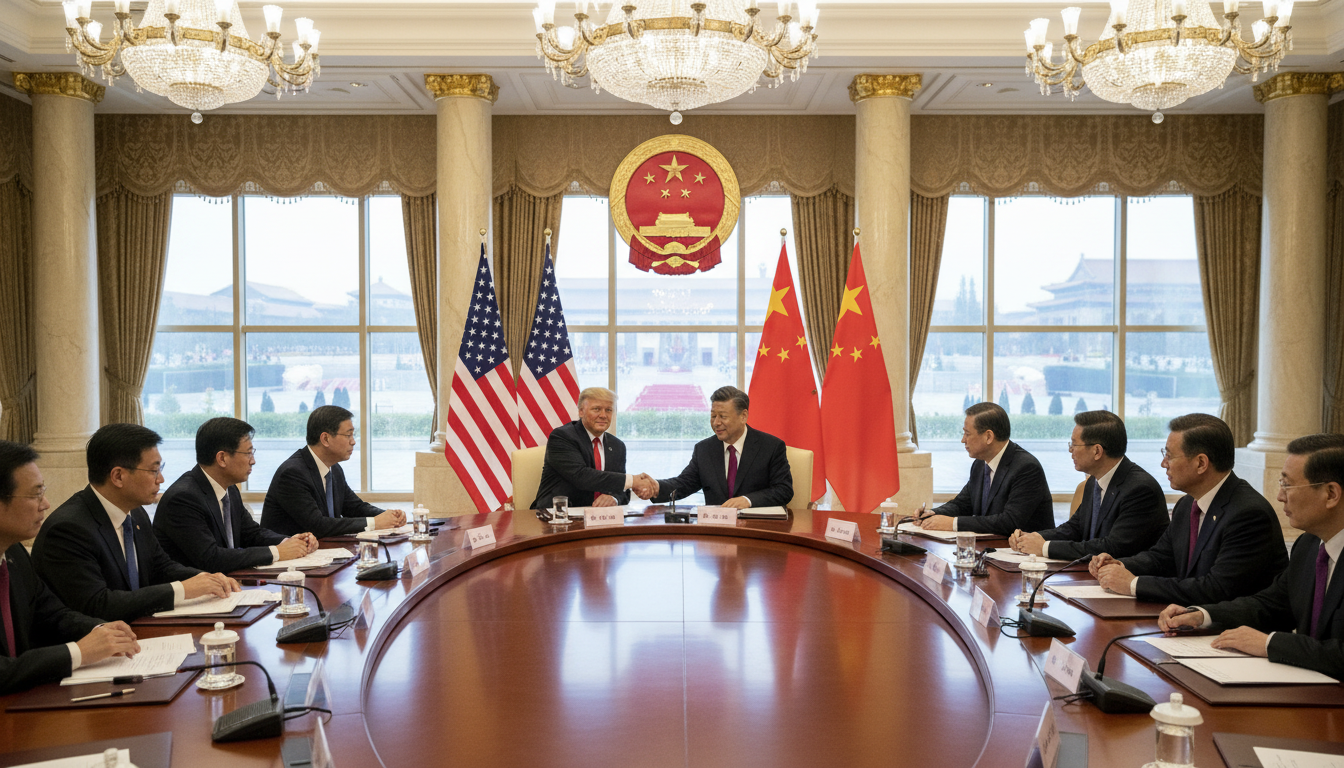
Trump-Xi Summit: Trump Arrives in Beijing for High-Stakes Talks on Trade, Technology and Taiwan
Trump-Xi Summit in Beijing on May 13, 2026: leaders discuss trade, technology and Taiwan as the US and China seek managed competition amid global uncertainty.
President Donald Trump arrived in Beijing on Wednesday evening for the Trump-Xi Summit, his first presidential visit to China in nearly a decade. The talks with Chinese President Xi Jinping are expected to focus on trade, advanced technology, Taiwan and broader geopolitical tensions. U.S. and Chinese officials have framed the meetings as an effort to stabilize competition and manage bilateral risks.
Trump’s Arrival and Opening Encounters
The president’s arrival marked a high-profile restart of direct engagement between the two capitals after years of strained ties. Protocol in Beijing emphasized formal greetings and a program of bilateral and working-level sessions designed for substantive negotiations. Observers noted the optics of the meeting will be closely watched by markets and regional partners.
White House and Chinese staff arranged a sequence of private talks followed by public remarks, underscoring both the confidentiality and the performative elements of the summit. Security, logistics and clear signaling were prioritized to reduce the risk of miscommunication during sensitive exchanges.
Trade and Tariffs Center Stage
Trade remains a central pillar of the agenda, with both sides under pressure to show progress on tariffs, market access and supply-chain resilience. U.S. officials pressed for commitments on agriculture, IP protections and the easing of measures that U.S. businesses cite as barriers to fair competition. Beijing has signaled interest in addressing some market-access issues while protecting strategic industries.
Economic advisers reported that negotiators will seek limited, verifiable outcomes rather than a comprehensive overhaul, aiming for steps that can lower tensions without conceding core strategic interests. Any agreement will be evaluated for its practical enforceability and its impact on industrial policy.
Technology and Strategic Supply Chains
Technology competition ranks high among the most sensitive topics at the Trump-Xi Summit, especially in semiconductors, telecommunications and artificial intelligence. Washington has stressed national-security reviews and export controls as tools to protect critical technologies. Beijing continues to invest heavily in domestic capabilities while resisting measures that would freeze its access to global innovation.
Both sides are expected to discuss mechanisms to reduce the risk of inadvertent disruption to commercial supply chains, with industry representatives advocating clearer, narrower rules. The outcome could shape investment flows and joint research arrangements in sectors deemed vital to economic competitiveness.
Taiwan and Regional Security Discussions
Taiwan is a likely focal point of the security dialogue, with the leaders confronting the risk of escalation in the Taiwan Strait. U.S. officials have reiterated long-standing commitments to peace and stability, while Chinese statements emphasize sovereignty concerns and opposition to external interference. How the two leaders frame their approach to crisis management will be closely monitored by Asian capitals.
Analysts say the summit offers an opportunity to reaffirm crisis-communication channels and to discuss confidence-building measures, though substantive policy shifts on Taiwan are unlikely to be announced publicly. Any private understandings reached could nonetheless affect military postures and regional diplomacy.
Diplomatic Tone and Global Context
The summit unfolds amid a volatile global landscape, with conflicts and economic shocks complicating bilateral choices. Both administrations appear to prefer a controlled reset that mitigates immediate risks while preserving strategic competition. Public messaging will aim to balance domestic political audiences and international expectations.
Diplomats and foreign-policy experts are watching whether the leaders can translate broad statements into durable practices, such as crisis hotlines, trade enforcement mechanisms, or joint statements on norms for emerging technologies. The tone of the meetings may determine whether tensions ease or shift to new arenas.
Possible Outcomes and Next Steps
Observers expect a mix of symbolic commitments and targeted agreements, rather than sweeping breakthroughs, from the Trump-Xi Summit. Short-term deliverables could include industry-specific pledges, clearer export-control processes and renewed dialogues on climate, health or economic coordination. Both capitals will likely highlight any areas of progress to domestic audiences.
Follow-up will be important: working groups, verification steps and timelines will determine whether commitments are implemented. Markets and governments across the region will assess the summit’s implications for trade flows, investment decisions and security planning.
The Trump-Xi Summit carries significance beyond bilateral ties, with outcomes likely to influence global economic stability and regional security calculations in East Asia.

