
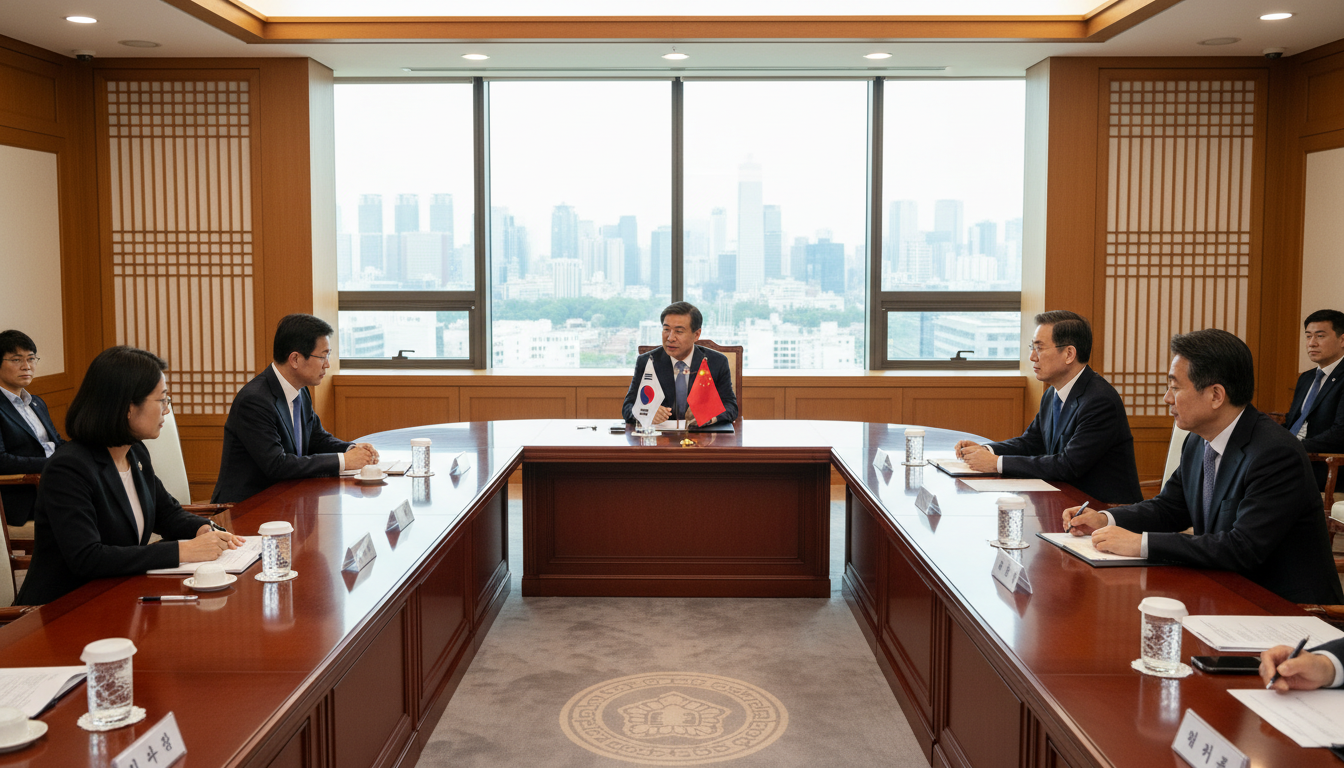
U.S. and China Hold High-Stakes Trade Talks in Seoul Ahead of Xi–Trump Summit
U.S. and Chinese trade delegations met in Seoul on May 13, 2026 to prepare for the Xi–Trump summit, seeking to steady a volatile trade war while major policy gaps remain unresolved.
Seoul meeting sets stage for summit
U.S. and Chinese trade officials convened in South Korea on May 13, 2026 in last-minute discussions designed to reduce friction ahead of a planned meeting between President Xi Jinping and President Donald Trump. Delegates described the talks as an effort to stabilize an escalating trade war, even as negotiators acknowledged deep and widening differences on core issues.
The talks took place amid a flurry of diplomatic activity in Seoul and Incheon, where senior U.S. Treasury and trade officials held bilateral meetings with South Korean counterparts. Officials said the goal was pragmatic: secure limited agreements and avoid headline-grabbing surprises before leaders meet.
U.S. delegation and Scott Bessent’s role
U.S. Treasury Secretary Scott Bessent arrived in Incheon ahead of bilateral consultations and engaged with South Korean President Lee Jae Myung and other officials. Bessent’s itinerary included talks intended to coordinate allied positions and to brief partners on U.S. priorities for the upcoming China summit.
U.S. sources indicated Bessent’s presence aimed to underline Washington’s focus on financial stability and to reassure regional allies that any U.S.-China agreements would account for broader economic risks. Delegation members emphasized the need to balance tariff pressures with systemic issues such as technology controls and subsidy practices.
Chinese delegation objectives and messaging
China’s team, led by Vice Premier He Lifeng, emphasized a desire to manage tensions and seek “stability” in economic relations with the United States. Chinese officials stressed that any progress should respect China’s policy prerogatives on industrial planning and technology development.
Beijing’s negotiators reportedly sought language that would avoid unilateral restrictions while opening limited channels for cooperation on trade facilitation and supply chain resilience. Observers noted Beijing’s parallel effort to reassure regional partners and markets that talks would not produce abrupt policy shifts.
Areas of contention remain wide
Despite an atmosphere of cautious diplomacy, negotiators acknowledged persistent and widening gaps over tariffs, export controls and state support for strategic industries. U.S. representatives continued to press for enforceable commitments on market access and curbs on industrial subsidies that Washington sees as distortive.
China pushed back on demands it views as infringing on sovereignty or core economic strategies, while both sides flagged concerns over enforcement mechanisms and verification. Analysts warned that without concrete, verifiable steps, rhetoric of stabilization could prove fragile once leaders return home.
Regional implications and South Korea’s role
South Korea hosted the talks in part to play a mediating role and to protect its economy from collateral damage in the U.S.–China rivalry. President Lee’s engagements with visiting officials underscored Seoul’s interest in ensuring predictable trade and investment conditions for Korean firms exposed to both markets.
Seoul’s diplomacy also reflected broader regional anxieties about decoupling and supply-chain fragmentation. South Korean business groups welcomed any progress that lowers the risk of abrupt tariff escalations or restrictive export measures affecting semiconductors and other key industries.
Markets and business responses ahead of summit
Global markets reacted to the Seoul talks with cautious optimism, pricing in a reduced chance of immediate escalation but remaining sensitive to headline risks. Traders and corporate risk managers said any summit language lacking detail or enforcement could still leave volatility elevated.
Multinational companies in technology and manufacturing stressed their need for long-term clarity on trade rules, investment screening and export controls. Corporate representatives urged negotiators to prioritize mechanisms that would give firms predictable operating environments across the region.
The delegations in Seoul framed the meetings as preparatory, not conclusive, noting that the Xi–Trump summit would ultimately determine the diplomatic and policy momentum. Officials left open the possibility of incremental, sector-specific agreements but warned that large-scale compromises would be difficult without sustained follow-up.
U.S. and Chinese officials said they would reconvene as necessary to refine proposals before the leaders’ talks, while South Korea indicated it would remain engaged to help bridge technical differences where possible. The outcome of the summit on May 13, 2026 and any subsequent commitments will be closely watched by governments and businesses seeking relief from the ongoing trade war.

