
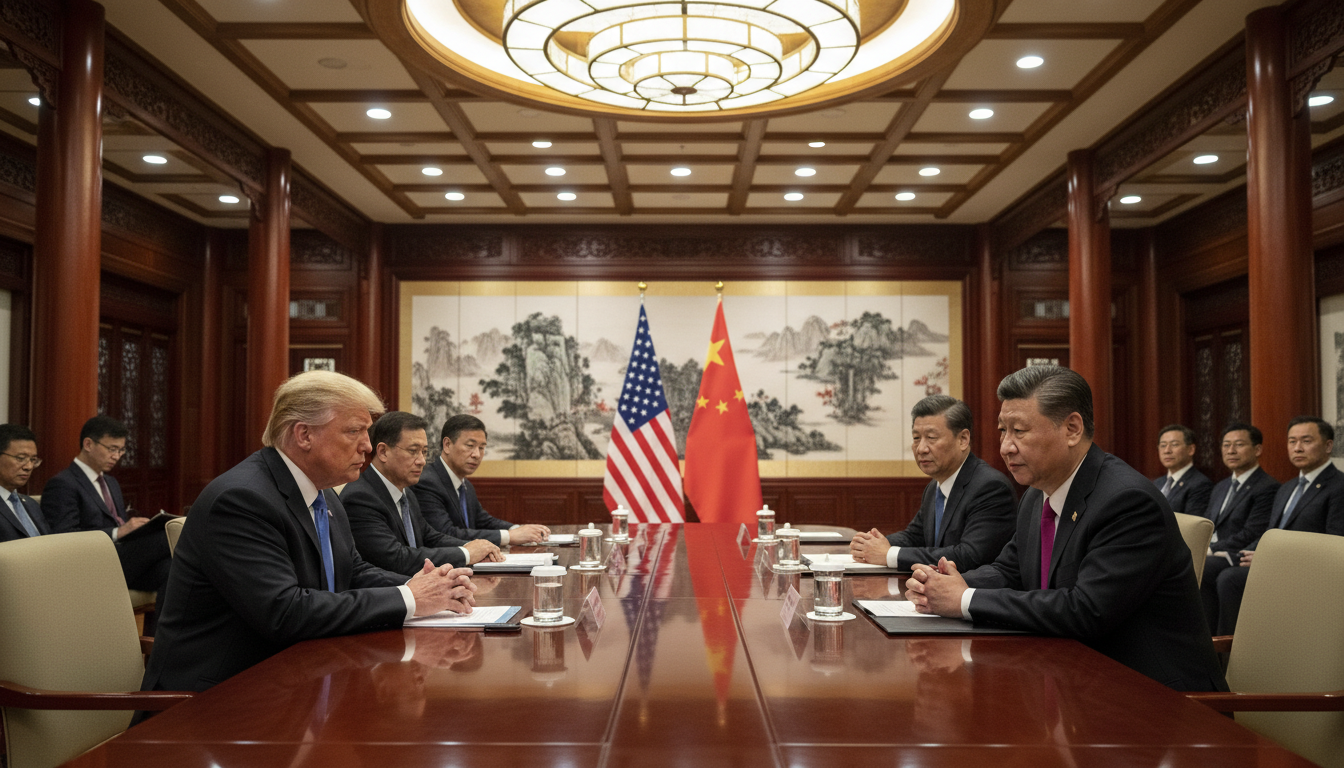
Trump-Xi summit in Beijing seeks to steady U.S.-China ties amid persistent divisions
Trump-Xi summit in Beijing on May 14, 2026: leaders sought to steady U.S.-China ties amid policy differences, with economic and security impacts for the region.
The Trump-Xi summit in Beijing on May 14, 2026 opened with warm public gestures as U.S. President Donald Trump called Chinese President Xi Jinping a "great leader" while both sides framed the meeting as an effort to stabilize bilateral relations. The encounter was pitched as a reset to prevent further deterioration, even as officials acknowledged substantial gaps on economic and strategic issues. The summit’s optics — a handshake and televised opening — were intended to reassure markets and regional partners that dialogue will continue.
Trump’s remarks and meeting optics
The opening exchange emphasized personal rapport and a desire to manage tensions rather than erase them. President Trump’s compliment of President Xi and the leaders’ public handshake were carefully staged to signal a working relationship at the top level. Diplomatic aides framed the moment as an effort to build trust while keeping expectations modest on immediate policy changes.
Officials sought to project calm even as both delegations prepared for detailed, and likely contentious, discussions. Large entourages and bilateral teams were visible throughout the palace compound, underscoring the high-stakes nature of the talks. Observers noted that ceremonial warmth does not always translate into policy convergence.
Agenda focused on trade, technology and regional security
Delegates said the summit agenda centered on trade disputes, technology controls, and strategic security challenges in the Indo-Pacific. Both sides were reported to have placed particular priority on whether to rein in measures that have disrupted supply chains and corporate planning in recent years. Talks also covered export controls and investment screening, areas that have proven difficult to reconcile.
Security issues such as maritime tensions and deterrence in the Taiwan Strait were discussed in guarded terms, according to sources familiar with the meeting. Each side reiterated foundational positions while exploring whether mechanisms could be formed to reduce the risk of miscalculation. No immediate, sweeping agreements were announced at the close of the leaders’ remarks.
Points of friction remained visible during talks
Despite conciliatory language, fundamental differences emerged across several policy fronts. Delegates and analysts highlighted diverging views on human rights, industrial policy, and the appropriate scope of trade remedies. These disagreements underscore why experts caution that stabilization may be incremental rather than transformational.
Technology rivalry proved especially thorny, as measures to safeguard advanced semiconductors and AI-related hardware were central to the U.S. negotiating posture. China, in turn, emphasized the importance of safeguarding its industrial ambitions and resisting what it called discriminatory practices. These competing priorities suggest durable competition even as diplomatic channels expand.
Economic and regional implications, including for Japan
Markets and businesses in Asia watched the summit closely, assessing potential changes to tariffs, investment flows, and supply-chain reconfiguration. Tokyo and other regional capitals have strong interest in any U.S.-China understanding that might ease trade frictions or clarify export-control regimes. Japanese manufacturers, in particular, could see relief if clearer rules reduce sudden disruptions to critical component shipments.
Analysts cautioned that a modest diplomatic thaw would not immediately reverse years of strategic decoupling in key sectors. Companies reliant on semiconductor materials, rare-earth elements, and high-value manufacturing will continue to plan for diversification. Governments across the region may welcome reduced tensions while preparing for a long-term competitive landscape.
Diplomatic signals, follow-up steps and international reaction
Following the leaders’ meeting, both Washington and Beijing signalled intentions to keep negotiation channels open, with mentions of ministerial-level working groups and follow-up consultations. The summit produced pledges to deepen dialogue, although officials stopped short of naming binding timelines or specific deliverables. Diplomatic aides said technical teams would meet in coming weeks to flesh out next steps.
Responses from other capitals were measured, with regional partners emphasizing the value of stable U.S.-China ties for economic and security planning. Tokyo described the summit as a necessary opportunity for communication, while urging transparency and coordination on regional issues. International institutions and markets will monitor whether words are matched by concrete policy shifts.
The summit underscored the complexity of U.S.-China relations: leaders can reduce short-term uncertainty through high-level meetings, but structural divergence on technology, trade and strategic influence remains. As officials move to detailed discussions, analysts expect progress to be incremental and punctuated by episodes of rivalry. The summit in Beijing provided a public signal that both sides prefer managed competition to open confrontation, but the ultimate trajectory of the relationship will be decided in subsequent rounds of bargaining and implementation.

