
Tyndall Rebuild Highlights Military Base Resilience Amid Pentagon Climate Policy Shift
Tyndall Air Force Base rebuild spotlights military base resilience as the Pentagon alters climate policy, prioritizing readiness while cutting climate research.
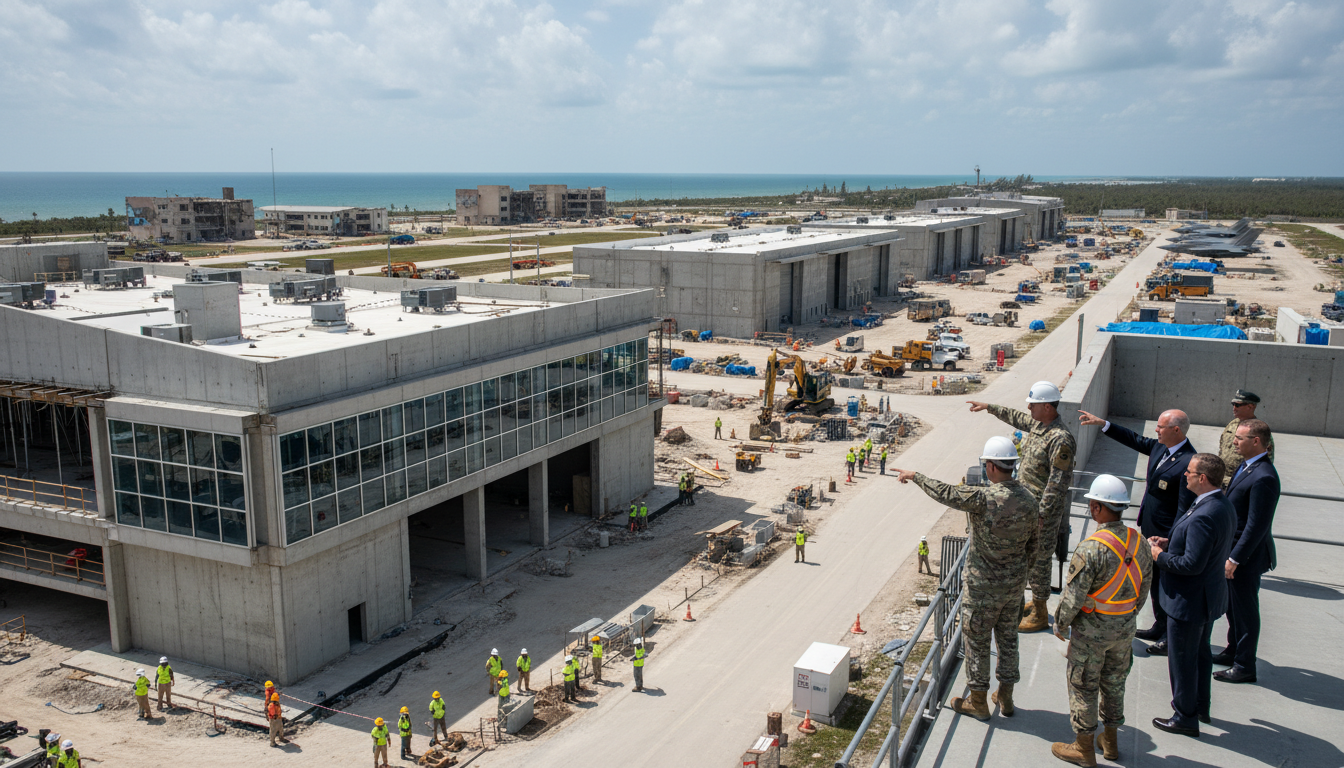
The reconstruction of Tyndall Air Force Base in Florida has emerged as a high-profile example of military base resilience as the U.S. Defense Department adapts installations to rising seas, stronger storms and other climate-driven hazards. The project, prompted by the catastrophic impact of Hurricane Michael in 2018, combines elevated construction, hardened roofs and coastal protections intended to preserve mission capability over coming decades. At the same time, recent Pentagon policy changes and the cancellation of climate-related studies have complicated how the department frames and funds such work.
Tyndall Rebuild Aims for 75-Year Sea-Level Resilience
Rebuilding at Tyndall has focused on long-term durability, with new facilities raised more than a foot above current grade to allow for projected sea-level rise over 75 years. Roofs and structural systems are being engineered to withstand winds up to roughly 266 kilometers per hour, while engineered oyster reefs and other natural defenses are planned to dissipate wave energy along vulnerable shorelines. Col. Robert Bartlow, who leads the recovery effort, has said the installation will be largely complete within a schedule that keeps flying operations active during construction.
Damage from Hurricane Michael and the Case for Hardening
When Hurricane Michael struck in 2018 it inflicted nearly $5 billion in damage at Tyndall, destroying hangars, damaging F-22 fighters and generating hundreds of thousands of cubic yards of debris. That scale of loss is now a touchstone for planners across the services, who point to rising repair costs and mission interruptions as a rationale for bigger, more resilient investments. Military engineers report that extreme weather events have become both more frequent and more damaging, prompting a re-evaluation of siting, design standards and long-term maintenance plans.
Resiliency Projects Underway at Multiple Installations
Tyndall is not unique: the U.S. military has undertaken flood walls, runway elevating, and wildfire mitigation projects at sites ranging from the Naval Academy in Maryland to airfields in Virginia and bases in Hawaii. Recent years have seen bases on Guam damaged by typhoons, heavy rains closing roads and landslides blocking key access for installations in California and New York. Service leaders describe these efforts in terms of operational readiness and the ability to launch and sustain missions after disasters, language that anchors infrastructure investments to strategic priorities.
Policy Shift at the Pentagon and the Hegseth Directive
The infrastructure push has coincided with a policy reorientation at the top of the Pentagon, where senior leadership has ordered the removal of climate language from certain strategic documents and halted a slate of climate-related studies. A 2025 memorandum directed that references to “climate” be excised from mission statements and barred environmental initiatives from a long-range planning program, while officials say weather-related risk assessments and resilience improvements may still proceed. The change in emphasis has prompted concern among analysts that research and forecasting capacity will decline even as physical hardening continues.
Funding Constraints, Research Cuts and Strategic Vulnerabilities
Budget pressures and shifting priorities present a dual challenge: many installations are underfunded for regular needs, and resources earmarked for fortification can be diverted toward contingency operations. Independent reviews have found the military has not consistently tracked disaster costs and has sometimes failed to incorporate future climate projections into facility designs. Experts warn that canceled studies and reduced funding for meteorological and environmental science could hollow out predictive capabilities that inform operational planning, leaving bases more exposed to surprise weather impacts and adversary exploitation.
Operational Trade-Offs and Technological Shifts
Beyond bricks and seawalls, the services have explored technological adjustments intended to lower logistical vulnerability, from hybrid-power combat vehicles to quieter, less fuel-dependent systems. Those programs have faced funding reductions even as the logic for electrified or hybrid platforms — reduced supply-line burdens and enhanced stealth — remains operationally persuasive. The tension between immediate readiness demands and longer-term investments in emissions reduction and research underscores a broader debate about how the military balances short-term mission needs with strategic resiliency investments.
Despite the policy and budget shifts, installation commanders and engineers emphasize pragmatism: their priority is keeping bases mission-capable under increasingly volatile conditions. The Tyndall rebuild shows the scale and ambition of that work, but also highlights unresolved questions about funding, data and institutional commitment to the science that informs design. As the department pursues hardening projects under a new rhetorical framework, officials and analysts alike say the outcome will depend on whether physical resilience can be sustained without the research and forecasting tools that have historically guided long-term planning.

