
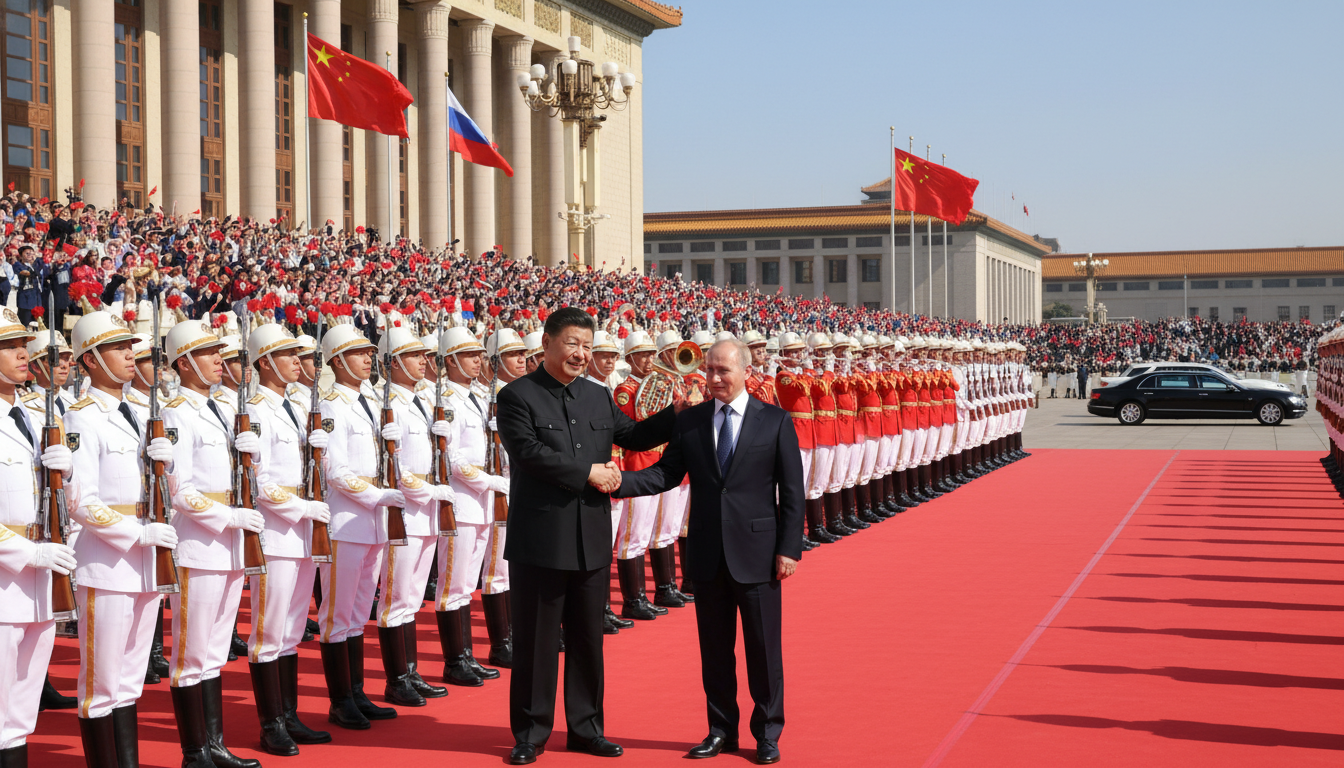
Putin’s Beijing Visit: Xi Jinping Hosts Lavish Welcome as Leaders Prepare Joint Statement
Putin’s Beijing visit on May 19–20, 2026 saw Xi Jinping stage a lavish welcome as the two leaders prepare a joint statement and sign bilateral accords.
Chinese President Xi Jinping on May 20 welcomed Russian President Vladimir Putin with a formal inspection of an honour guard at the Great Hall of the People, marking a two-day state visit intended to cement bilateral ties. The visit follows U.S. President Donald Trump’s recent trip to Beijing, and Chinese officials described the programme as aimed at strengthening comprehensive partnership and strategic cooperation. (apnews.com)
State Reception Echoes Recent U.S. Visit
The ceremonial elements of Mr. Putin’s arrival — a red-carpet reception, an honour guard and official photographs outside the Great Hall — closely resembled the pageantry extended to President Trump less than a week earlier. Observers noted the similar choreography of public diplomacy as Beijing signalled its capacity to receive rival global powers with equal pomp. (thedailybeast.com)
Agreement on a Joint Statement and Documents
The Kremlin and Chinese authorities said the talks would conclude with a high-level joint statement and a package of intergovernmental agreements, covering cooperation across multiple sectors. Moscow issued an advance notice that the visit, held at Xi’s invitation, would include formal signings intended to mark the 25th anniversary of the 2001 Treaty of Good-Neighborliness and Friendly Cooperation. (bloomberg.com)
Economic Ties and Energy Trade Highlighted
Economic and energy cooperation featured prominently on the agenda, with Russian officials pointing to growing exports to China and intensified commercial contact in recent months. Russian sources and independent reporting have highlighted a notable rise in oil shipments to China in early 2026, underscoring Beijing’s importance as a market for Russian hydrocarbons. (themoscowtimes.com)
Diplomatic Balancing After the Trump Summit
Analysts said Beijing’s near-concurrent hosting of the U.S. and Russian leaders reflects a deliberate diplomatic balancing act: deepening ties with Moscow while managing a relationship with Washington that Chinese leaders describe as important to global stability. Senior Beijing officials framed both visits as part of a broader effort to stabilise major-power relations amid regional tensions and economic uncertainty. (washingtonpost.com)
Symbolism and Soft Power in the Capital
The visits have been accompanied by visible displays around Tiananmen and in official venues, and Chinese state media emphasised ceremonies that project Beijing as a central diplomatic hub. The inclusion of youth delegations, cultural events and the opening of the Russia–China Years of Education programme were presented as softer, long-term investments in bilateral relations. (bernama.com)
The two leaders’ meetings over May 19–20 will be closely scrutinised for concrete deliverables on trade, energy and security cooperation, as well as any language in the joint statement that signals Beijing’s stance on regional crises. Officials in both capitals said the visit was designed to reaffirm strategic ties while allowing China space to manage relations with other major powers. (bloomberg.com)
As the delegations move to finalise documents and public statements, diplomats and analysts will be watching whether the accords signed in Beijing translate into measurable shifts in commerce or strategy across Asia and Europe. The outcomes of this short but high-profile visit are likely to shape perceptions of China’s role as a convening power during a period of heightened geopolitical competition.

