
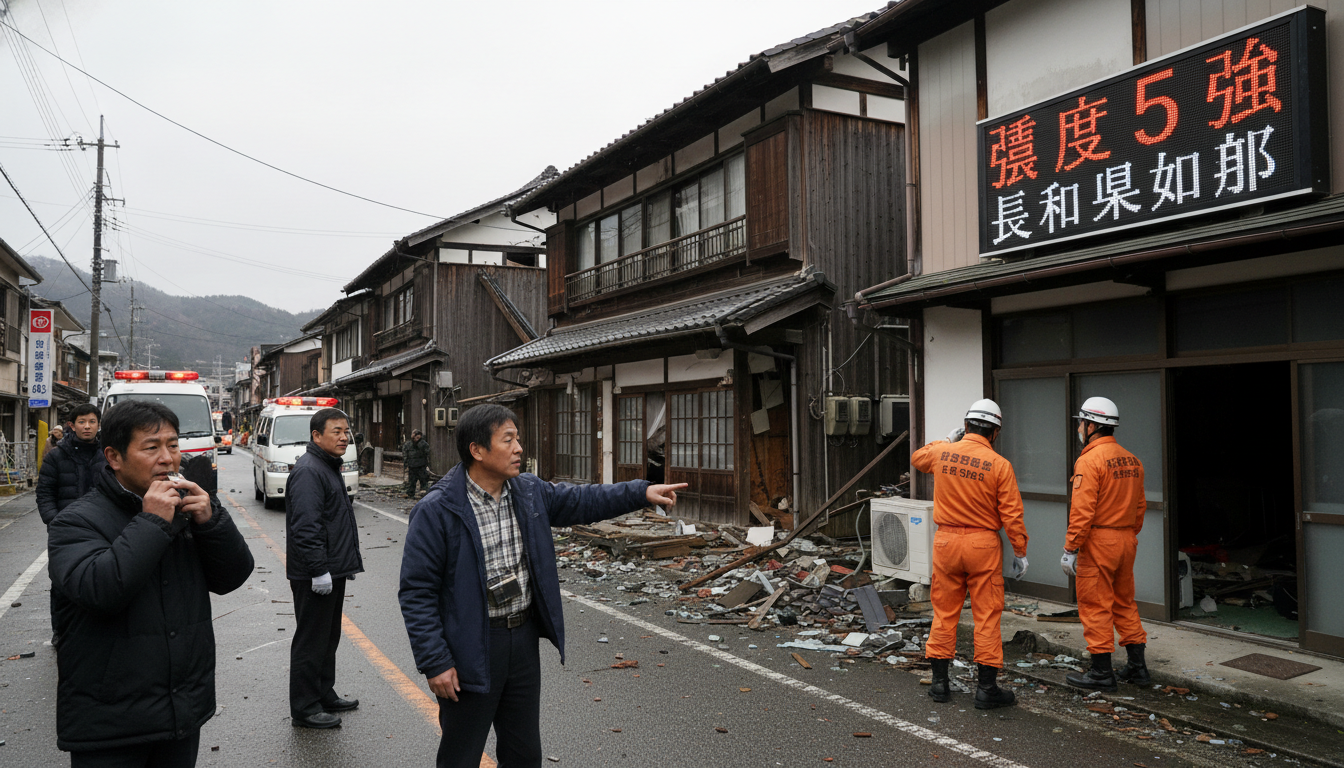
Nagano earthquake: Magnitude 5.0 strikes northern Nagano, upper 5 intensity recorded in Omachi
Magnitude 5.0 Nagano earthquake struck northern Nagano Prefecture at 13:20 JST on April 18, 2026; upper-5 intensity in Omachi and no tsunami risk, JMA says.
A magnitude 5.0 Nagano earthquake struck northern Nagano Prefecture at 1:20 p.m. on Saturday, April 18, 2026, according to the Japan Meteorological Agency (JMA). The agency reported the quake’s epicenter in the prefecture’s northern area at a depth of approximately 10 kilometers. Early intensity readings showed an upper-5 on the JMA shindo scale in the city of Omachi and a lower-5 in Nagano city. Authorities noted there was no tsunami risk associated with the event.
Epicenter location and seismic measurements
The JMA located the epicenter in northern Nagano Prefecture and estimated the focal depth at about 10 kilometers. A magnitude of 5.0 was assigned after routine analysis of seismic wave data recorded by regional monitoring stations. Such a shallow depth typically amplifies surface shaking, accounting for the relatively high shindo readings in nearby municipalities. Meteorological agency bulletins were issued promptly with technical details and safety advice.
Intensity distribution across affected cities
Intensity measurements varied across the region, with the city of Omachi receiving an upper-5 on the shindo scale and Nagano city registering a lower-5. The village of Ogawa experienced an intensity of 4, while Matsumoto recorded an intensity of 3. These gradations reflect local ground conditions, building types and proximity to the epicenter, which influence how strongly shaking is felt. Local authorities urged residents in higher-intensity zones to check for hazards such as fallen objects and structural damage.
Tsunami and wider hazard assessments
The JMA confirmed there was no tsunami risk following the quake, noting that the epicenter was inland and the magnitude and depth did not meet tsunami-generation thresholds. Emergency management offices advised the public to follow official channels for any updates or changes. Besides tsunami, officials highlighted secondary hazards such as aftershocks, landslides in mountainous areas and gas leaks, advising residents to remain vigilant. Municipalities in steep or previously unstable zones were asked to monitor slopes and riverbanks for signs of movement.
Immediate response and reporting of damage
As of the latest initial reports, officials had not confirmed any injuries or major infrastructure failures linked to the tremor. Local fire departments and municipal disaster-response teams conducted rapid assessments, checking schools, hospitals and public facilities for damage. Where needed, crews were placed on standby to respond to reports of fallen furniture, cracked walls or utility disruptions. Residents were encouraged to report damage and to avoid entering visibly compromised structures until inspections were completed.
Transport and public service checks
Rail operators and road management agencies carried out precautionary inspections after the quake, temporarily slowing or suspending services in some areas to ensure safety. Initial checks focused on rail tracks, bridges and tunnels that could be affected by ground shaking. Utility companies also inspected lines for gas and electrical faults and advised households to shut off gas if leaks were suspected. Commuters were asked to confirm service statuses with transport providers before travel into and out of the affected municipalities.
Preparedness guidance from local governments
Municipal authorities in Nagano Prefecture reiterated standard earthquake preparedness steps, including securing heavy furniture, preparing emergency kits and confirming evacuation routes. Residents were asked to keep a battery-powered radio or charged mobile device to receive official notices and to avoid congesting emergency lines with non-urgent inquiries. Schools and workplaces were instructed to account for people on-site and to follow emergency protocols until inspections cleared buildings for use. Local offices provided information centers for residents seeking advice or reporting damage.
Seismic activity in Nagano Prefecture has been recurrent given the region’s complex tectonics, which include active fault lines and mountainous geology that can intensify shaking. While many quakes in the area are moderate and cause limited damage, even mid-range events can trigger landslides or damage older structures. Experts often remind residents that preparedness and timely reporting significantly reduce risk and speed recovery.
Authorities continue to monitor seismic activity and will issue updates if aftershocks or new assessments indicate changing conditions. Residents in Omachi, Nagano city, Ogawa village and surrounding areas should follow official guidance, check homes and utilities for damage, and report any urgent concerns to local emergency services.

