
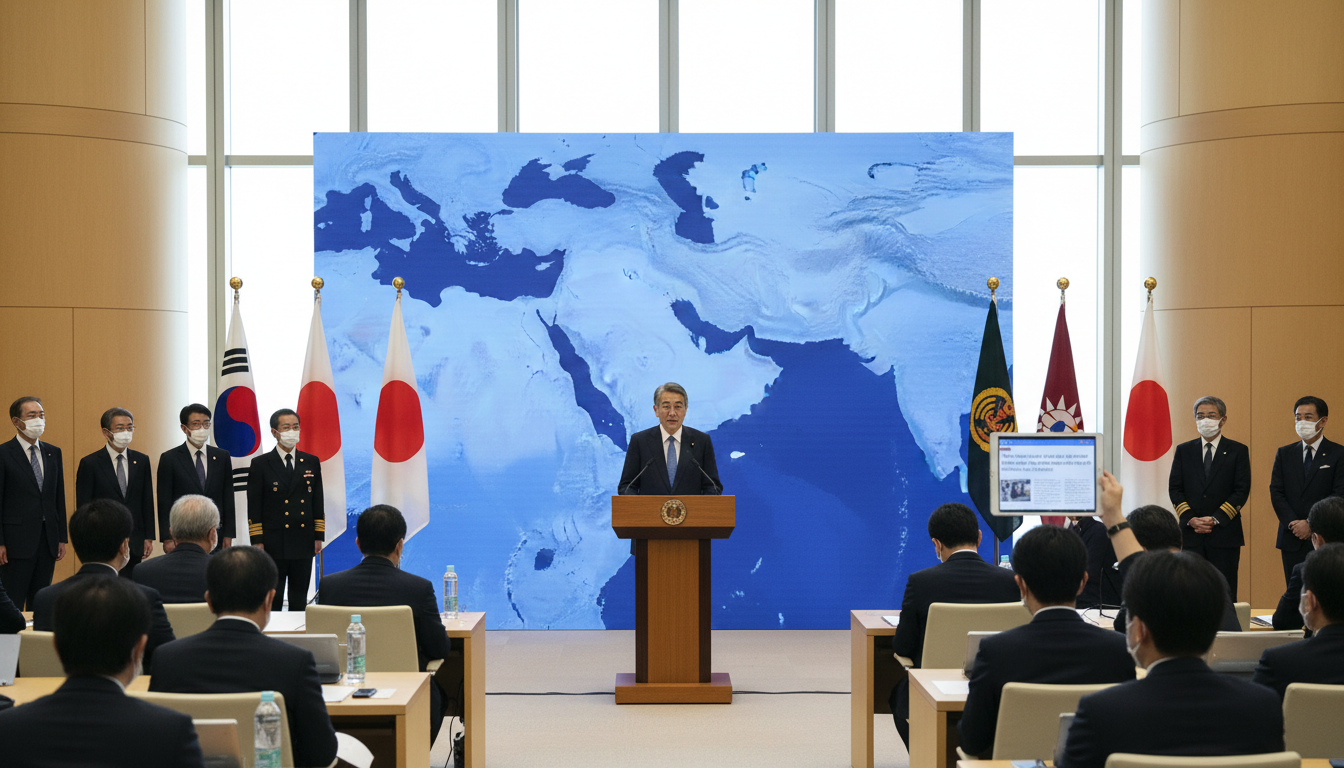
Japan pledges “all possible measures” to restore safety in the Strait of Hormuz
Japan pledges to act with international partners to restore safety and freedom of navigation in the Strait of Hormuz after a multinational security meeting in Europe.
Japan’s prime minister said Tokyo will take “all possible measures” to help restore stability in the Strait of Hormuz and to protect the freedom of navigation for commercial and national vessels. The pledge came during a high-level meeting convened by Britain and France that drew roughly 50 countries and international organizations to coordinate responses. Officials described the gathering as focused on practical steps such as mine clearance and measures to safeguard crews and ships operating in and near the critical waterway.
Japan Pledges ‘All Possible Measures’ to Secure the Strait of Hormuz
Prime Minister Sanae Takaichi told world leaders that Japan would work closely with relevant countries and international organizations to address threats in the strait. She said the safety of vessels and crew members currently held in the Gulf remained an urgent priority for Tokyo. The prime minister also expressed support for mediation efforts and said Japan welcomed ongoing diplomatic talks between the United States and Iran.
Takaichi framed Japan’s commitment as both immediate and conditional on international cooperation, indicating Tokyo would act “within its capacity” alongside partner states. Government officials said that this approach aims to balance operational support with diplomatic initiatives so as not to escalate tensions. The statement underscored Japan’s strategic interest in keeping the Strait of Hormuz open for commerce and energy shipments.
Multinational Meeting Hosted by Britain and France Draws Broad Support
The meeting, hosted by Britain and France, brought together governments from Asia, the Middle East and Europe along with regional and global institutions. Delegations included representatives from China, South Korea and a range of Middle Eastern nations, reflecting the geographic breadth of states with stakes in the waterway. Participants sought to synchronize efforts and outline immediate and medium-term responses to threats affecting shipping.
Organizers said the talks produced a commitment to rapid planning and coordination, with an emphasis on operational readiness. Attendees discussed information-sharing mechanisms, common rules of engagement and the allocation of technical resources for maritime safety. Several countries signaled readiness to contribute to practical activities such as mine removal and vessel escorts if conditions allow.
Mine Removal and Navigation Safety Prioritized by Participants
One of the central outcomes of the talks was an agreement to accelerate planning for mine-clearance operations and other actions to ensure safe navigation through the Strait of Hormuz. Delegates underscored the need to remove unexploded ordnance and improvised devices that have impeded commercial traffic. The technical challenge of mine removal was described as significant, requiring specialized vessels and trained teams.
Officials said plans will consider both near-term clearance operations and longer-term measures to enhance maritime resilience. Proposals under review include coordinated patrols, route surveys and the deployment of remote-sensing equipment to identify hazards. The aim is to restore confidence among ship operators and insurers so that commercial traffic can resume with reduced risk.
United Kingdom to Lead Multinational Naval Mission, Says Starmer
British Prime Minister Keir Starmer announced that Britain and France would lead a multinational mission to protect freedom of navigation once operational conditions allow. He said more than ten countries had pledged to cooperate with the initiative, signaling a broad interest in a coordinated security presence. The mission is intended to provide protective escorts and deterrence for commercial shipping through vulnerable areas.
Details on command arrangements, rules of engagement and timelines were left to follow-up planning groups established during the meeting. Officials cautioned that the mission’s deployment would depend on risk assessments, legal clearances and the consent of coastal states. The announcement aimed to reassure traders and governments that a collective security option is being prepared if diplomatic avenues do not sufficiently reduce threats.
Tokyo Welcomes U.S.-Iran Talks and Regional Mediation Efforts
Japan publicly welcomed reported talks between the United States and Iran and said dialogue offered a positive pathway toward de-escalation. Tokyo also voiced support for mediation by relevant countries, reflecting a preference for diplomatic resolution alongside operational measures. Government spokespeople framed diplomacy and targeted security actions as complementary tools to protect maritime commerce.
Japanese officials emphasized the importance of aligning diplomatic momentum with practical safety measures at sea, so that any agreements ashore translate into secure shipping lanes. They noted that protecting seafarers and commercially vital routes requires both political commitments and on-the-ground capabilities. Tokyo signaled readiness to contribute to multilateral responses while continuing consultations with regional partners.
Momentum for Ceasefires and Commercial Sailing Cited by Delegates
Delegates said recent developments, including agreements on ceasefires in nearby conflicts, had created an opening for renewed commercial traffic through the Strait of Hormuz. Iranian officials were reported to state that Hormuz was open to commercial shipping following related ceasefire steps elsewhere in the region. Meeting participants said that such statements must be corroborated by verified, on-the-water conditions before traffic is fully restored.
The group agreed to prepare contingency plans for a range of scenarios, from immediate mine-clearance needs to the staged resumption of normal shipping lanes. Officials stressed that restoring stable, predictably safe passage will take coordinated technical work and sustained diplomatic engagement. The decisions aim to reduce uncertainty for shipowners, freight operators and energy markets.
Japan will continue to press for close cooperation with allies and regional actors to achieve durable security in the Strait of Hormuz, officials said. Further operational details and timelines are expected as working groups translate the meeting’s commitments into actionable plans. The international community will monitor developments at sea and in diplomacy to determine when and how multinational measures should be deployed.

