
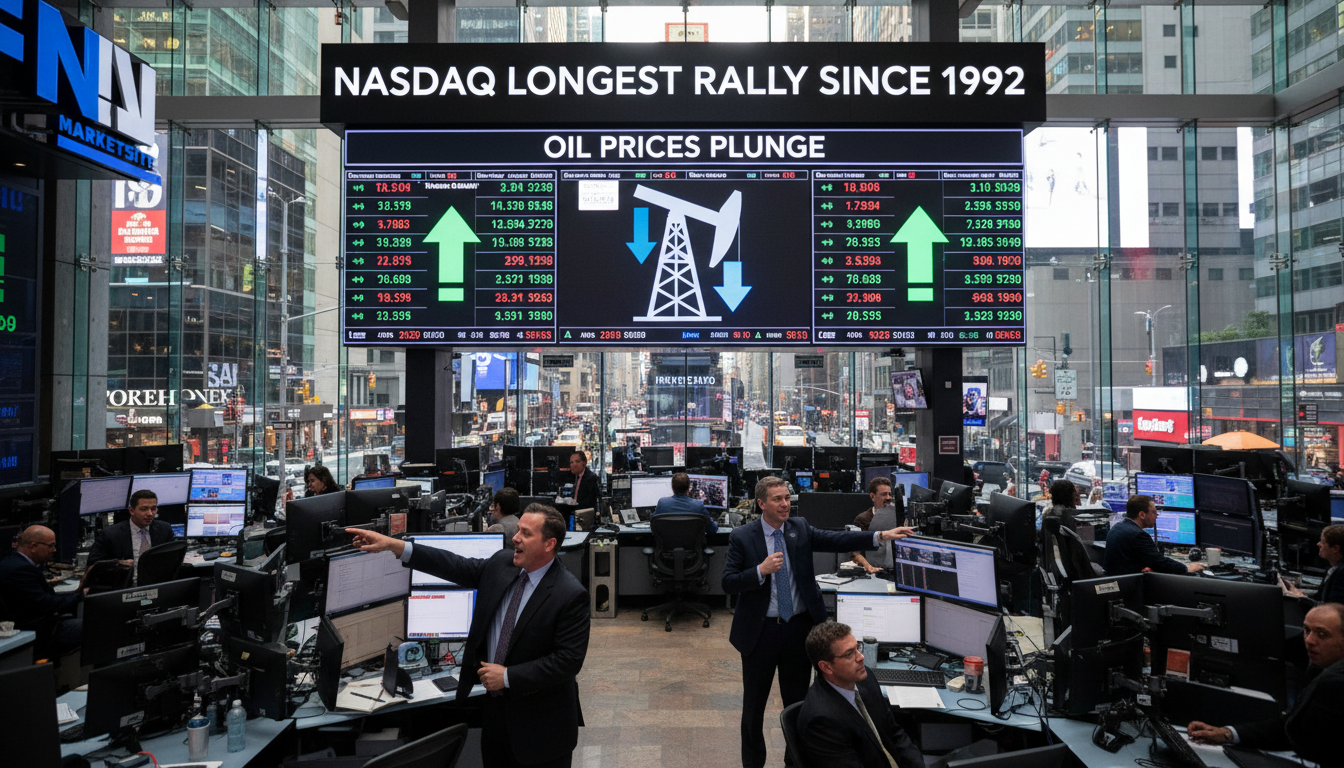
Crude oil futures plunge as Strait of Hormuz reopening eases supply fears and lifts US stocks
Crude oil futures fell sharply after Iran declared the Strait of Hormuz open following a ceasefire, easing supply concerns as US stocks and the Nasdaq advanced.
NEW YORK — Crude oil futures plunged Friday after Iranian Foreign Minister Abbas Araghchi said passage for all commercial vessels through the Strait of Hormuz was "completely open" following a ceasefire agreement between Israel and Iran-backed Hezbollah. The announcement undercut premium pricing tied to a potential Middle East supply shock and triggered a rapid shift in investor positioning. At the same time, US equity markets moved higher, with the Nasdaq extending what market commentators described as its longest consecutive rally since 1992.
U.S. equities rally amid improved risk appetite
Investors shifted toward risk assets as oil prices eased, lifting major U.S. indexes. The move reflected renewed confidence that a key shipping chokepoint would remain accessible to global trade, reducing immediate concerns about crude supply disruptions.
Market participants noted that the easing in oil-related risk gave traders latitude to increase exposure to growth-oriented stocks. Traders also cited a broader pick-up in risk appetite after days of geopolitical uncertainty.
Iranic announcement and ceasefire terms
Iranian Foreign Minister Abbas Araghchi’s statement framed the reopening as a direct result of a negotiated ceasefire involving Israel and Iran-backed Hezbollah. Officials emphasized the temporary nature of the arrangement while urging continued monitoring of compliance.
The declaration on maritime access reduced the perception of an imminent, large-scale oil supply interruption through the Strait of Hormuz. Shipping firms, insurers and regional authorities will be watching for operational follow-through and any localized incidents that could reverse the improvement.
Immediate effects on crude oil futures and benchmarks
Crude oil futures experienced sharp declines as the market digested lower near-term supply risk. Traders liquidated protection and rolled positions as the premium for geopolitical risk subsided.
Energy desks reported higher volumes in both light sweet crude and Brent-related contracts as participants recalibrated short-term hedges. Commodity strategists cautioned that while the downward move was material, volatility could return quickly if the ceasefire falters or new tensions emerge.
Investor caution despite improved outlook
Despite the rally in equities and falling oil prices, many investors retained a cautious posture. Analysts and fund managers said the regional situation remains fluid and that a durable easing of risk would require sustained, verifiable calm.
Some institutional players described the market response as a partial re-pricing rather than a full resolution of geopolitical uncertainty. Money managers signaled they would continue to watch shipping traffic, diplomatic statements and on-the-ground developments before committing to longer-term shifts in allocation.
Shipping and supply chains to be closely monitored
The Strait of Hormuz is a critical artery for global energy flows, and its operational status directly influences shipping costs and crude trade patterns. Even with an official opening, practical conditions such as insurance rates and convoy arrangements could lag behind diplomatic pronouncements.
Logistics firms and oil companies will likely track vessel transit times and marine insurance premiums for signs that the market’s confidence is translating into resumed, unencumbered trade. Any episodic incidents could prompt rapid reversals in both freight and oil price dynamics.
Outlook for markets and potential triggers for renewed volatility
Market strategists said the near-term outlook hinges on the durability of the ceasefire and the behavior of regional actors. A sustained calm could produce further downward pressure on oil and support continued equity gains, while any breakdown would likely push prices higher and spark risk-off moves in stocks.
Economic data, central bank communications and corporate earnings flows were also cited as key variables that could amplify or dampen current price moves. Traders will balance geopolitical developments with macroeconomic indicators as they size positions heading into coming sessions.
Short-term market reactions reflected a collective judgment that immediate supply risks had eased, but the underlying geopolitical backdrop remains capable of producing sudden changes in direction. Observers stress that market participants should expect intermittent bouts of volatility until a longer-term political resolution or a reliably maintained calm is evident.

