
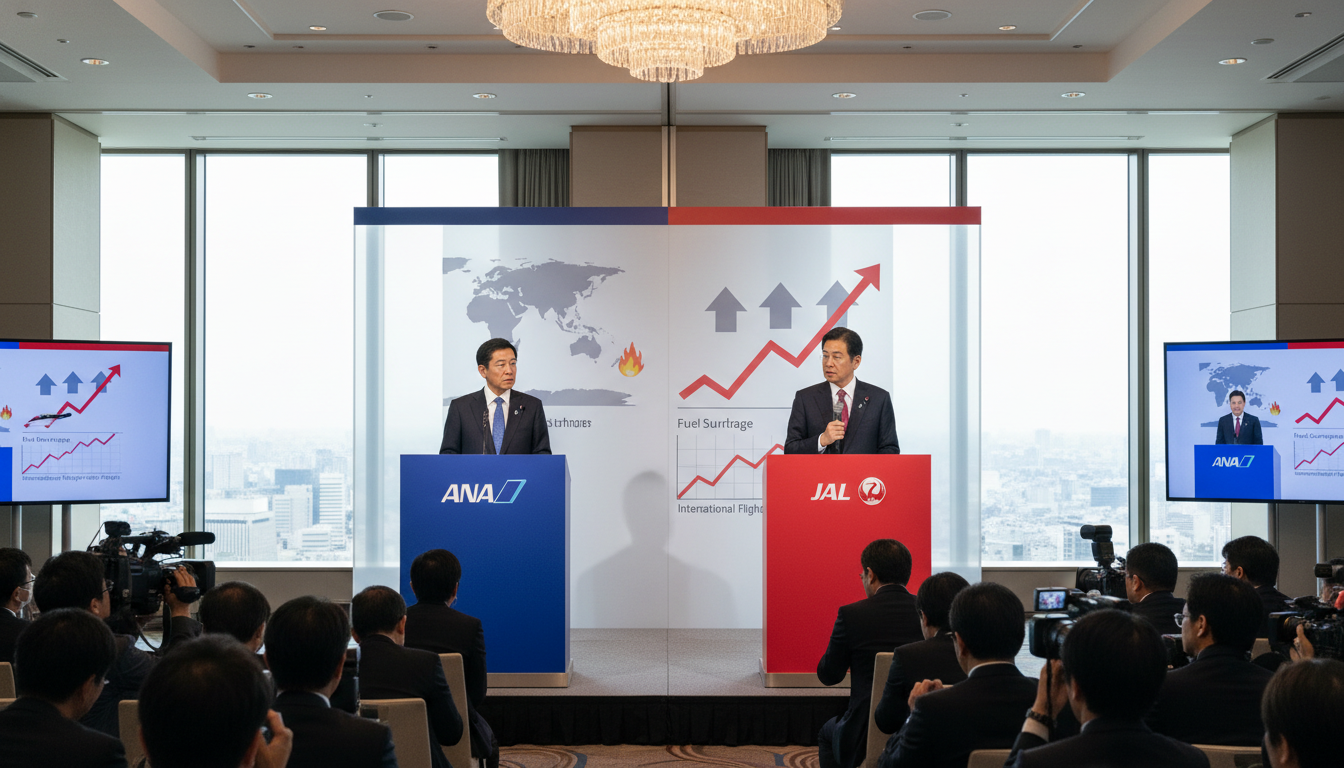
ANA, JAL Announce Advance Fuel Surcharge Hikes on International Flights
Japan’s two largest carriers, ANA and JAL, raised international fuel surcharges on April 20, 2026, citing surging kerosene prices tied to Middle East tensions. The fuel surcharge increase affects ticketing for May–June and may rise further if prices stay elevated.
Advance increase announced by ANA and JAL
On April 20, 2026, All Nippon Airways (ANA) Holdings and Japan Airlines (JAL) said they would raise international fuel surcharges earlier than planned, citing continued uncertainty over the Iran situation and rising jet fuel costs. The increase applies to tickets issued for travel in May and June, and both carriers warned that additional hikes could follow if the market remains volatile. The announcement reflects growing pressure on carriers to pass higher fuel costs to passengers while balancing demand recovery for international travel.
Scale of the surcharge increases by route
The new levels represent roughly a 1.5–2.0 times increase compared with the previous bands, with the largest jumps on long-haul routes. For Japan–Korea flights, ANA’s surcharge rises from ¥3,300 to ¥6,700, while JAL’s moves from ¥3,000 to ¥6,500. On North America and Europe routes—where surcharges are already highest—ANA’s band increases from ¥31,900 to ¥56,000 and JAL’s from ¥29,000 to ¥56,000. Carriers emphasized that amounts vary by fare class and ticketing date, but said the revised schedule will apply uniformly to international bookings issued in the designated May–June window.
Method used to calculate the fuel surcharge
ANA and JAL calculate fuel surcharges using a common market benchmark: the average price of jet fuel (kerosene) traded on the Singapore market combined with average foreign-exchange rates, lagged by two months. Each airline then maps that combined figure against its internal surcharge table to determine the passenger levy. The two-month averaging is intended to smooth short-term volatility, but sustained price moves can push calculated levels beyond existing table ranges, forcing carriers to revise their bands when necessary.
Kerosene prices, table caps and the adjustment
Airline officials said kerosene prices rose faster than crude oil in recent months, pushing the two-month average above the previous surcharge table cap. For the February–March period, the kerosene benchmark averaged about ¥23,076 per barrel—exceeding the airlines’ prior table ceiling of ¥21,000 per barrel. To accommodate that shift, both carriers amended their surcharge tables, raising the upper limit to just under ¥24,000 per barrel. Authorities also noted that national crisis-mitigation subsidies for fuel costs influenced the carriers’ decision to set published surcharges lower than the raw formula would have produced for this round.
Potential for further increases and market implications
Industry observers say the adjustment signals a higher baseline for international fares until geopolitical tensions ease and kerosene prices retreat. If Iran-related supply risks persist or if crude markets remain tight, airlines could trigger additional surcharge increases at future review points. Higher fuel surcharges will add to the cost burden for leisure and business travelers alike and could dampen volume on price-sensitive routes, particularly for discretionary travel.
Operational and financial impact on carriers
Airlines operate on thin margins for international long-haul services, and fuel is a major cost component. By partially passing rising fuel costs to passengers through surcharges, carriers aim to protect operating profit without immediately raising base fares. Nevertheless, cabin load factors, yield management and route deployment may be adjusted if demand weakens as a result. Carriers also monitor currency movements and hedging positions that affect their net fuel exposure, but the immediate effect of the announced surcharge hike will be visible in ticket prices and booking notices over the coming weeks.
Higher surcharges may also affect ancillary revenue strategies and corporate travel budgets, prompting some firms to review travel policies or opt for fewer trips where feasible.
Guidance for travelers and travel agents
Passengers with upcoming international travel plans should check ticketing dates and fare rules carefully, since the revised fuel surcharge applies to tickets issued for the affected period. Travel agencies and corporate travel managers are advised to confirm total fare breakdowns and consider rebooking windows or refundable fare options if uncertainty remains. For customers who purchased tickets before the announcement, airlines’ published terms determine whether the change affects existing reservations; travelers seeking clarification should contact carriers or their travel agents directly.
The fuel surcharge hike announced by ANA and JAL on April 20, 2026, underscores how geopolitical developments and commodity markets can quickly influence airfares, and travelers and industry stakeholders can expect continued sensitivity to jet fuel price movements in the months ahead.

