
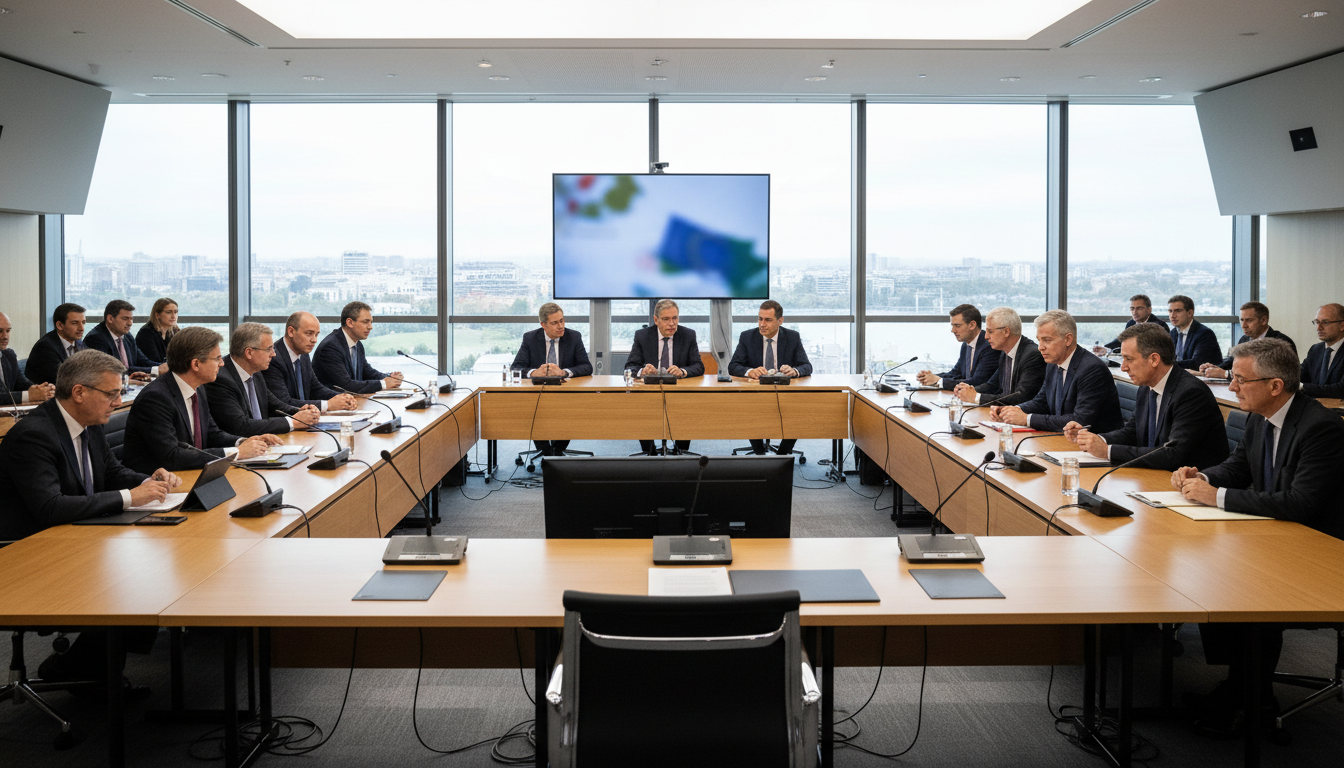
EU ministers fail to back suspension of EU-Israel association agreement
EU ministers failed to secure a majority to suspend the EU-Israel association agreement after Spain and Ireland pressed for action over settlements, Gaza and a new law.
The European Union’s foreign ministers met in Luxembourg on Tuesday and were unable to agree on suspending the EU-Israel association agreement, a pact that has governed relations between the bloc and Israel since it came into force in 2000. Spain and Ireland led calls for either full or partial suspension amid mounting concern over West Bank settlements, the humanitarian situation in the Gaza Strip and the adoption of a new law described by some ministers as deeply troubling. EU foreign policy chief Kaja Kallas said the ministers had debated the issue but that there was not sufficient support to proceed with suspension, while underscoring that discussions on the relationship with Israel would continue.
Member states split over suspension bid
A substantial divide emerged among member capitals as ministers arrived in Luxembourg, with a number urging immediate punitive measures and others advocating caution. Those backing suspension argued the association agreement must reflect EU values on human rights and international law, citing settlement expansion and civilian suffering in Gaza. Opponents warned that unilateral move could close diplomatic channels and complicate security and cooperation across multiple areas governed by the pact.
Spain and Ireland lead the push in public
Spain’s Foreign Minister Jose Manuel Albares framed the debate in stark terms, telling reporters that “today, Europe’s credibility is at stake” and calling for an open discussion on suspending the agreement. Ireland, long active on Middle East human rights issues, joined Madrid in advocating for measures targeting the legal framework that underpins bilateral cooperation. The public push by these two governments heightened pressure on the rest of the EU to clarify whether political red lines would translate into concrete policy shifts.
Kallas: no majority but continued dialogue promised
After the session, Kaja Kallas said ministers had explored options but lacked the political consensus required for suspension of the EU-Israel association agreement. She emphasized that the debate would not end in Luxembourg and that the bloc would continue to reassess its relationship with Israel in light of developments on the ground. Kallas’s statement signaled that while immediate punitive action was off the table, the issue will remain on the EU foreign-policy agenda and could resurface as facts change.
Concerns cited: settlements, Gaza and a new law
Ministers who sought action pointed to three main concerns: settlement activity in the West Bank, the deteriorating humanitarian situation in the Gaza Strip, and the adoption of a new law that critics say raises fundamental rights questions. Those concerns were presented as interconnected, with ministers arguing that continued implementation of the association agreement without response could be seen as tacit acceptance. Proponents of restraint countered that targeted measures — rather than a blanket suspension affecting trade and cooperation — would better serve both principled and practical objectives.
Practical and political implications of suspension
Suspending the EU-Israel association agreement would carry complex legal and economic consequences, touching trade arrangements, scientific cooperation and political dialogue established under the pact. Several member states cited the risk of unintended fallout for civilians and regional stability if broad sanctions disrupted cooperation in areas like humanitarian assistance or research. At the same time, proponents argued that calibrated steps — such as restricting certain forms of preferential treatment — could signal that the EU’s commitments to international law are enforceable without severing all ties.
Next steps and likely scenarios for EU policy
With no majority in Luxembourg, EU officials expect the debate to continue in working groups and upcoming ministerial meetings where legal options and targeted responses will be spelled out in detail. Diplomats said discussions are likely to focus on measures that can command broader support, including selective sanctions, trade carve-outs, or enhanced monitoring of compliance with human-rights conditions under the agreement. Any concrete proposals will require intensive legal scrutiny and political bargaining among member states before ministers can agree on a course of action.
The Luxembourg meeting underlined the tensions within the EU between defending core principles and preserving engagement channels with a key partner. While Spain and Ireland have escalated pressure and kept the issue in the public eye, a consensus on suspending the EU-Israel association agreement remains elusive. Ministers left the session with a clear understanding that the relationship will be subject to ongoing review and that future developments on the ground could shift the calculus in Brussels.

