
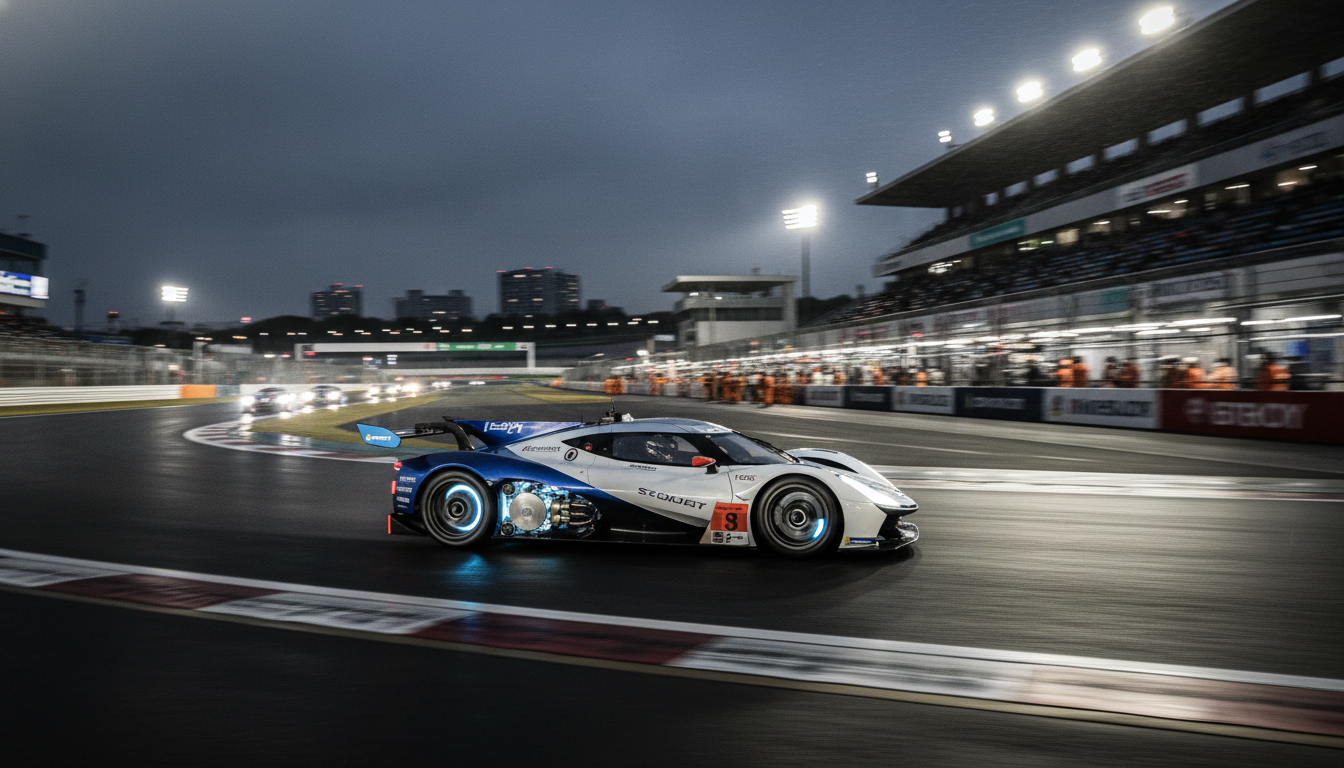
Toyota hydrogen car with superconducting motor to contest 24-hour endurance race in Shizuoka
Toyota fields a hydrogen car combining a superconducting motor and liquid hydrogen fuel in a 24-hour endurance race, aiming for a world-first finish.
Toyota will race a Toyota hydrogen car equipped with a superconducting motor and liquid hydrogen fuel at a 24-hour endurance contest beginning Saturday afternoon, June 6, 2026, in Shizuoka prefecture. The company says the entry will set a world first if it completes the full 24 hours, marking a milestone in hydrogen combustion and electric-drive experimentation. The vehicle blends a traditional hydrogen-fueled engine concept with a high-efficiency superconducting motor to test durability under prolonged competitive conditions.
Race entry and world-first claim
Toyota announced the entry of the hydrogen car into the 24-hour endurance race as a demonstration of the technology’s viability under sustained stress.
If the vehicle finishes the event it would be the first hydrogen-engine model paired with a superconducting motor to complete an extended endurance contest, according to Toyota.
The bid reflects Toyota’s dual-path strategy on decarbonizing transport, pursuing both fuel-cell electrification and hydrogen combustion pathways.
Company engineers will monitor performance metrics throughout the race to assess real-world durability and efficiency under continuous operation.
Technical setup of the competing vehicle
The car combines liquid hydrogen as the energy carrier with a superconducting electric motor designed to reduce electrical losses.
Toyota describes the setup as an integration of a hydrogen-fueled power source and superconducting motor technology to improve overall drivetrain efficiency.
Superconducting motors, which operate with minimal electrical resistance at very low temperatures, can offer high torque density and reduced weight compared with conventional motors.
In this application, the motor is paired with a liquid hydrogen system that Toyota has modified for race conditions, focusing on safety, refueling logistics, and thermal management.
Race logistics and location details
The 24-hour contest is staged in central Japan’s Shizuoka prefecture, starting Saturday afternoon, June 6, 2026.
Teams will run through day and night, subjecting vehicles to continuous laps and pit-stop cycles that simulate extended real-world operation.
Organizers require strict safety protocols for hydrogen handling and for vehicles using experimental propulsion systems.
Toyota’s pit crew will perform scheduled refueling stops for liquid hydrogen and carry out checks on the superconducting motor cooling systems between stints.
Safety protocols and hydrogen handling
Handling liquid hydrogen in a race environment demands specialized procedures for storage, transfer, and emergency response.
Toyota has adapted its refueling equipment and trained staff to meet the race’s regulatory requirements and to minimize risks during quick pit operations.
Race marshals and technical inspectors will oversee compliance with fuel-system safeguards and thermal insulation standards.
The company says redundant monitoring and fail-safe systems are in place to detect leaks, overpressure, or temperature excursions before they escalate.
Industry context and strategic significance
Toyota’s entry follows years of research into multiple hydrogen pathways, including fuel-cell electric vehicles and hydrogen internal combustion testing.
A successful 24-hour run would give the automaker empirical data under sustained load and could influence how hydrogen technologies are viewed for commercial and motorsport use.
Industry analysts say that demonstrations in endurance motorsport provide visibility and a rigorous proving ground for emerging propulsion systems.
Real-world results from extended races can help automakers refine designs, validate supply-chain logistics for alternative fuels, and address public perceptions about safety and reliability.
Potential impacts on future vehicle development
Should the Toyota hydrogen car finish the endurance contest, the results could accelerate engineering work on superconducting motors and liquid-hydrogen handling.
Data on thermal behavior, component wear, and energy throughput during continuous operation will guide next-stage prototypes and potential pilot programs.
Manufacturers and suppliers may use the findings to weigh the merits of adding superconducting components to electrified drivetrains or of expanding hydrogen refueling infrastructure.
The demonstration also offers regulators and race organizers practical insights into standardizing protocols for hydrogen-fueled competition vehicles.
The Toyota hydrogen car’s appearance at the Shizuoka endurance race represents a deliberate test of an unconventional powertrain under extreme conditions. Teams, engineers, and observers will watch lap times, pit efficiency, and system reliability as metrics that could shape hydrogen strategies in the auto industry.

