
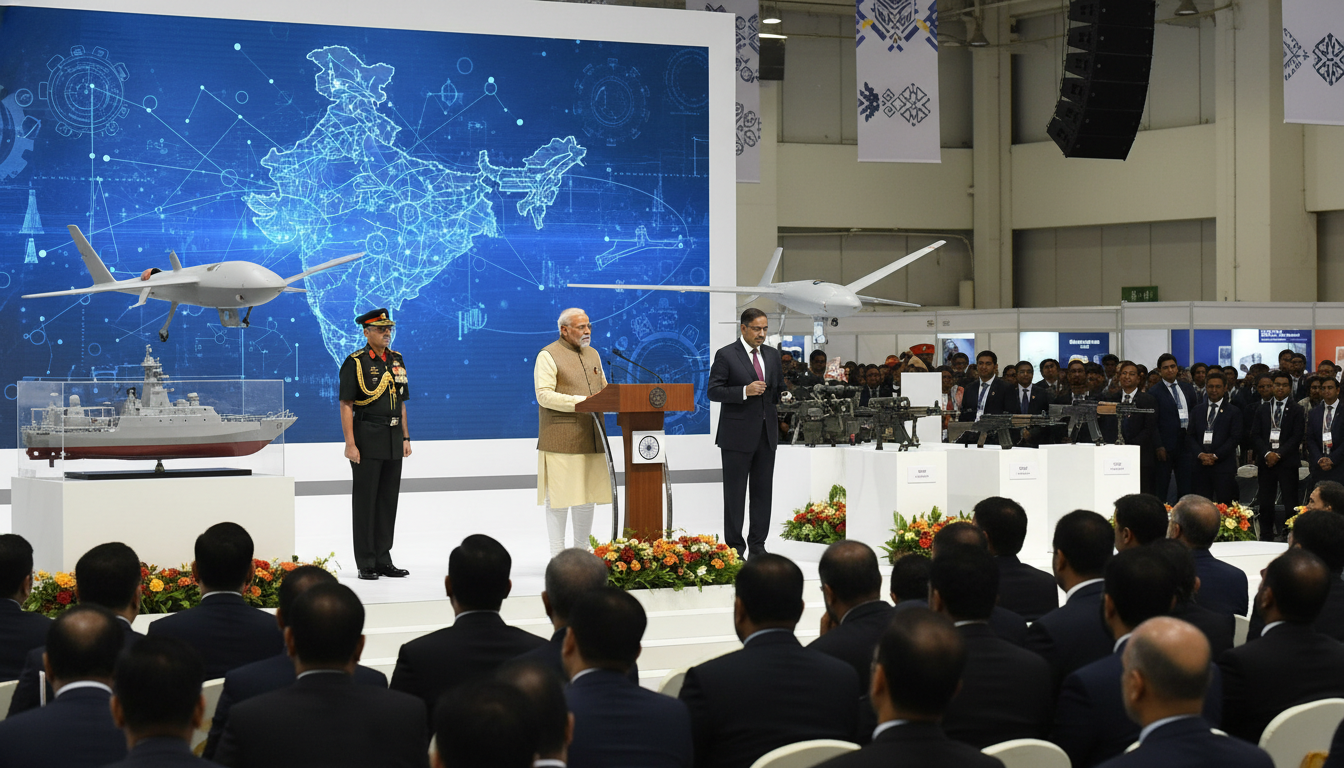
India military buildup accelerates as INS Vikrant and all‑alignment diplomacy drive defense indigenization
India’s military buildup centers on the domestically built carrier INS Vikrant, reflecting New Delhi’s push for defense self‑reliance and a strategic "all‑alignment" foreign policy. This shift combines naval modernization with diplomatic balancing among the United States, Russia and regional partners. The effort seeks to reduce long-standing dependence on foreign suppliers and to expand India’s role as an arms producer and exporter.
INS Vikrant signals naval modernization
The INS Vikrant, India’s first home‑designed aircraft carrier, has become a visible emblem of the country’s naval ambitions. Commissioned in 2022 and deployed off the eastern port of Visakhapatnam, the carrier demonstrates New Delhi’s capacity to design and outfit a large warship domestically.
The vessel’s design and operations are being presented by Indian officials as evidence of greater operational independence. Navy sources say the ship’s modularity and high share of indigenous parts allow quicker upgrades without reliance on external approvals.
International Fleet Review highlights partnerships and tensions
India hosted an International Fleet Review in February that brought together roughly 20 foreign vessels from friendly navies across Asia and beyond. Japanese, South Korean and Southeast Asian ships participated, underscoring New Delhi’s intent to bolster maritime cooperation while maintaining diplomatic flexibility.
Not all outcomes were celebratory: the subsequent sinking of the Iranian frigate IRIS Dena while returning from the review created a delicate diplomatic moment for India. The incident illustrated the risks inherent in convening a diverse set of partners amid intensifying regional conflicts.
Balancing relations with the United States, Iran and Russia
New Delhi’s diplomatic posture aims to preserve relationships with the United States and Iran simultaneously, a balancing act officials describe as central to their “all‑alignment” approach. Following recent hostilities in the Middle East, India has publicly called for restraint and abstained from overtly siding with either camp while taking steps to protect its strategic and commercial interests.
At the same time, India has maintained robust defense ties with Russia, which helped build much of its Cold War‑era military capability. Indian officials and military leaders argue that sustained engagement with Moscow remains essential to sustaining forces and acquiring key platforms.
From nonalignment to all‑alignment: historical roots
India’s current stance grew out of the nonalignment doctrine it championed after independence, which sought to avoid entanglement in great‑power blocs. That posture shifted after the 1962 war with China, when New Delhi accepted substantial military assistance from the Soviet Union to bolster defenses.
The collapse of the Soviet Union and changing global alignments prompted New Delhi to evolve toward a more flexible “all‑alignment” strategy. Rather than formal alliances, the policy emphasizes multi‑directional engagement, allowing India to deepen ties with Western democracies while continuing relationships with other global actors.
Defense indigenization and export ambitions
Alongside diplomatic recalibration, India is accelerating efforts to manufacture weapons and platforms at home and to build a defense industrial base capable of exporting equipment. The Vikrant’s high indigenous content is cited by officials as a template for reducing reliance on foreign suppliers and for nurturing domestic firms.
New Delhi is also signaling an interest in developing export markets for armaments, pitching indigenous systems to partners across Asia, Africa and the Middle East. Success will depend on meeting quality, cost and interoperability benchmarks that global customers demand.
India faces structural and strategic challenges as it pursues these objectives. Deepening defense ties with Moscow, reluctance to broaden the military remit of partnerships such as the Quad, and regional sensitivities complicate efforts to present a unified security posture.
India’s military buildup, exemplified by the INS Vikrant and the broader indigenization drive, is reshaping South Asian defense dynamics. As New Delhi navigates competing pressures from major powers and regional contingencies, its blend of naval modernization and all‑alignment diplomacy will be a key determinant of stability and influence in the years ahead.

