
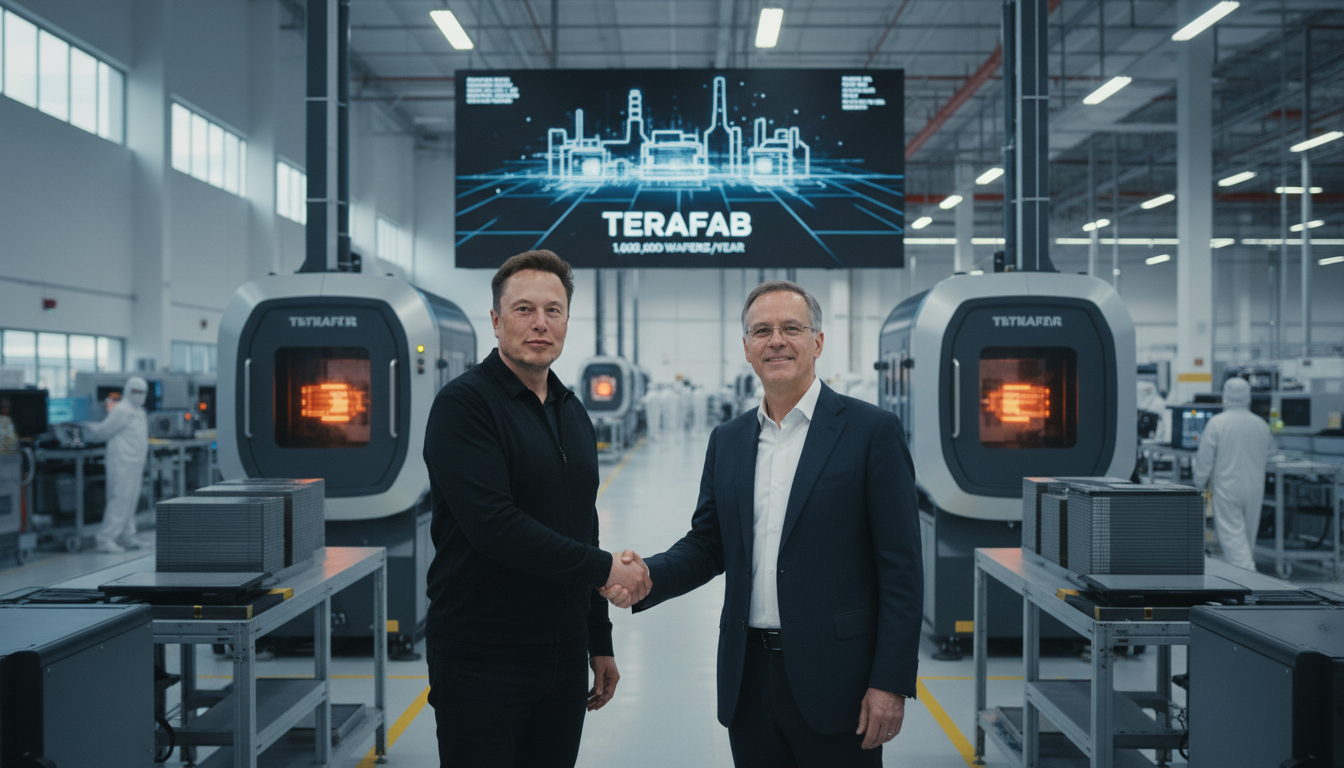
Musk Names Intel Manufacturing Partner for Terafab, Aiming for 1 Million Wafers Monthly
Elon Musk said Intel will be the manufacturing partner for Terafab, a Musk-led JV aiming to produce 1 million wafers monthly to secure advanced chips.
Tesla founder and CEO Elon Musk announced on a recent Tesla earnings call that a joint venture of Musk-led companies intends to use Intel’s advanced chipmaking technology for the Terafab project.
The facility is being pitched as a large-scale effort to produce as many as one million wafers per month, a figure Musk specified during the briefing.
The move signals a significant shift in the supply-chain strategy for Musk’s ecosystem, which has faced tightness in advanced semiconductor supply in recent years.
Musk Announces Intel Partnership for Terafab
Elon Musk told investors that Intel will serve as the manufacturing partner for the Terafab initiative during the company’s earnings call.
He described the arrangement as part of a broader joint venture involving his companies that aims to bring high-volume chip production to the United States.
Musk framed the partnership as leveraging Intel’s process know-how to accelerate the venture’s ability to produce advanced wafers at scale.
Terafab’s Target: One Million Wafers per Month
The Terafab project has set an ambitious output target of one million wafers each month, a scale that would put it among the largest wafer-capacity proposals in recent U.S. chipmaking plans.
Such production volumes are typically measured in 300mm wafers capable of serving demanding applications in automotive, AI and data-center chips.
If achieved, the capacity would represent a major addition to U.S. manufacturing supply and would mark a new phase in how vertically integrated technology groups secure critical components.
Strategic Motives Behind the Chip Push
Musk and his companies have faced supply constraints for specialized chips used in electric vehicles, artificial intelligence and other advanced systems.
Building a domestic, large-scale wafer source is intended to reduce reliance on external foundries and to align chip design with in-house manufacturing roadmaps.
The Terafab plan also reflects a broader industry trend where device makers and software firms seek closer control over chip supply to meet performance and security requirements.
Implications for Tesla and Other Musk Ventures
A high-volume, in-house source of advanced wafers could provide Tesla and affiliated companies with priority access to custom process nodes.
Securing tailored chip production could accelerate development cycles for vehicle control units, neural network accelerators and data-center processors.
Musk’s announcement suggests the project is being positioned to service multiple parts of his corporate ecosystem rather than a single product line.
Intel’s Role and Technical Considerations
Intel’s selection as the manufacturing partner signals reliance on a well-established U.S. chipmaking supplier for process technology and factory design.
The collaboration would pair Intel’s expertise with the joint venture’s capital and demand signals, but detailed technology transfer, equipment procurement and process-node choices were not disclosed during the call.
Scaling to one million wafers per month requires substantial clean-room capacity, advanced lithography and a multi-year build-out, underscoring persistent technical and logistical hurdles.
Regulatory and Market Reaction Expected
A project of this size will likely face intense scrutiny from regulators, suppliers and potential customers as details are finalized.
Permitting, export controls and incentives for domestic semiconductor investment are factors that could shape the timeline and footprint of Terafab.
Market participants will also watch how existing foundries and chip-equipment suppliers respond to a large, vertically integrated entrant into advanced wafer production.
The announcement places Terafab squarely at the intersection of industrial policy and corporate strategy, reflecting both commercial ambitions and broader concerns about supply-chain resilience.
Stakeholders will be watching for further specifics from Musk and participating firms on site selection, financing, technology nodes and expected production start dates.
Until those operational details are published, the Terafab plan remains a high-profile pledge that could reshape chip sourcing for Musk’s businesses and influence the U.S. semiconductor landscape.

