
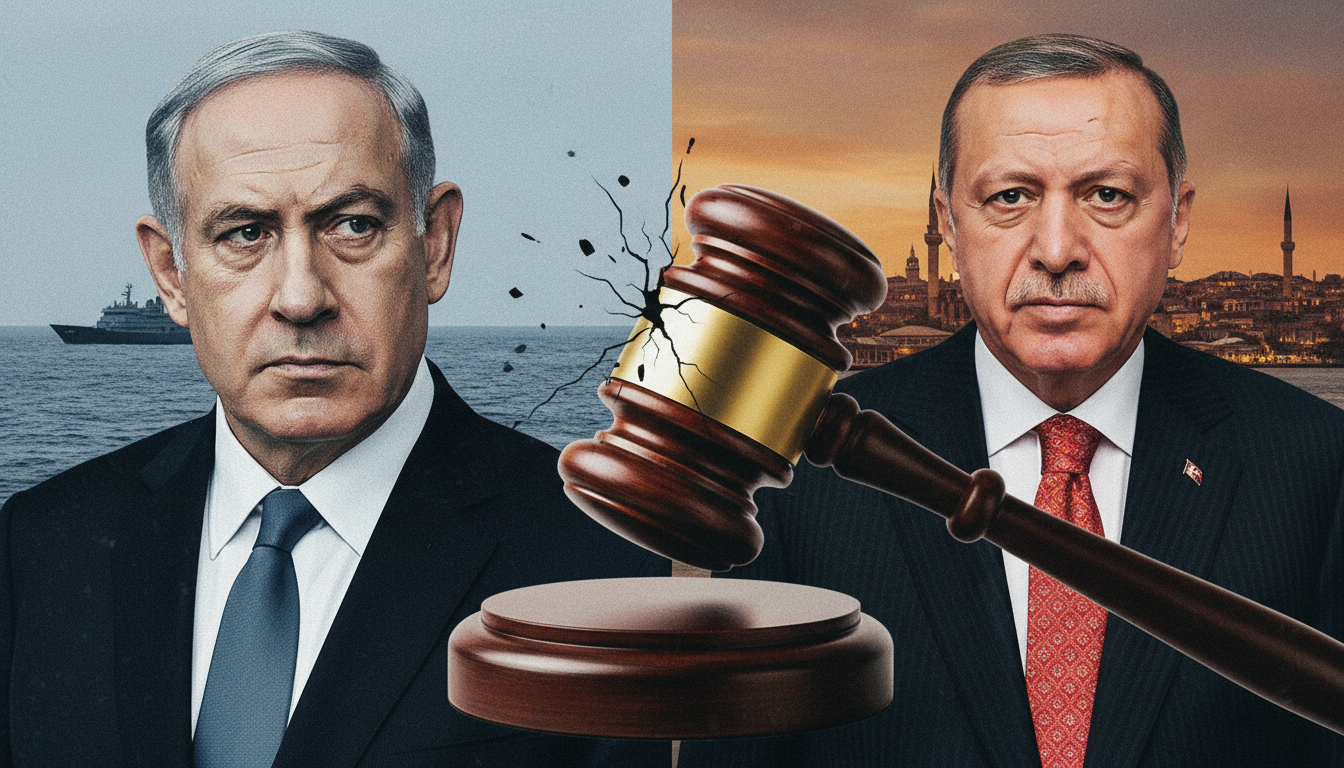
Turkey-Israel tensions escalate after Istanbul prosecutor charges Netanyahu over Global Sumud Flotilla
Turkey-Israel tensions surge after Istanbul charges Netanyahu over the Global Sumud Flotilla; energy, airspace and trade links face possible disruption.
The long-simmering Turkey-Israel tensions flared this week after the Istanbul Chief Public Prosecutor’s office filed criminal charges against 35 people, including Israeli Prime Minister Benjamin Netanyahu, over last year’s attack on the Global Sumud Flotilla in international waters.
Mr. Netanyahu responded publicly on X by accusing President Recep Tayyip Erdoğan of massacring Kurds, escalating a spat that analysts say is partly driven by domestic politics ahead of Israel’s election.
The row comes against a backdrop of a Turkish trade embargo imposed in May 2024, deeper regional rivalries and growing concern in both capitals about how far rhetoric may translate into tangible policy measures.
Prosecutor files charges over Global Sumud Flotilla
The Istanbul prosecutor’s indictment alleges responsibility for the flotilla attack and seeks lengthy prison terms for several named individuals, including Israel’s prime minister.
Turkish officials framed the move as a legal response to an incident in international waters, while Israeli spokespeople called the charges politically motivated and warned of diplomatic consequences.
Escalation in public rhetoric from Israeli leaders
Prime Minister Netanyahu’s post and former premier Naftali Bennett’s subsequent remarks pushed the dispute into a sharper phase of public confrontation.
Mr. Bennett publicly described Turkey as “the new Iran” and suggested that Israel would not remain passive, a comment that adds to fears of possible retaliatory language or measures.
Energy leverage and the Baku–Tbilisi–Ceyhan pipeline
Observers have repeatedly pointed to Ankara’s potential to disrupt oil flows transiting the Baku–Tbilisi–Ceyhan pipeline as a form of leverage.
Some reports indicate Azerbaijani crude reaching markets has been important to Israel’s energy mix, and any interruption could cause short-term price and supply disruptions even if Israel could seek alternative sources.
Airspace closures and commercial flight disruptions
A likely near-term punitive option would be closure of Turkish airspace to Israeli civilian flights, a step that would lengthen routes and raise costs for airlines.
Rerouting could increase fuel use, crew time and ticket prices, although airlines and governments have alternative corridors available and airlines would work quickly to mitigate operational impact.
Trade, tourism and economic ties after the embargo
Bilateral trade between Turkey and Israel has diminished since the May 2024 embargo, but goods and services continue to move through third-country arrangements.
Tourism flows also showed resilience, with Israeli arrivals to Turkey rising again in 2025, though analysts say those numbers are unlikely to give Ankara decisive leverage over Israel’s broader economy.
Regional alignments and deterrence calculations
Beyond immediate economic and logistical pressures, Ankara appears to be calibrating a broader strategy of diplomatic and security realignment.
Turkey’s role in NATO, ties with Russia and Ukraine, and outreach to states such as Saudi Arabia, Egypt and Pakistan give Ankara multiple channels to offset potential fallout from direct confrontation with Israel.
The complex web of alliances reduces the chances of an all-consuming bilateral rupture, analysts say, but does not eliminate the risk of episodic escalations.
The dispute also intersects with wider disagreements over Israel’s war in Gaza and shifting alliances in the eastern Mediterranean, where rival energy projects and military partnerships have already reshaped calculations.
Both governments have the capacity to inflict targeted pain — through energy routes, airspace controls and political isolation — but both also face costs from a prolonged rupture, limiting how far either is likely to push in the short term.
For now, diplomatic channels remain open and third-party mediators have signalled an interest in de‑escalation, though officials in Ankara and Jerusalem showed little public appetite for immediate compromise.
As the political calendar advances, particularly with Israeli domestic politics in play, the dispute will be closely watched for signs that rhetoric might give way to concrete measures affecting energy supplies, air travel and trade patterns.
Time will determine whether the current exchange of accusations becomes a sustained strategic rift or a temporary cycle of escalation and restraint in a volatile regional landscape.

