
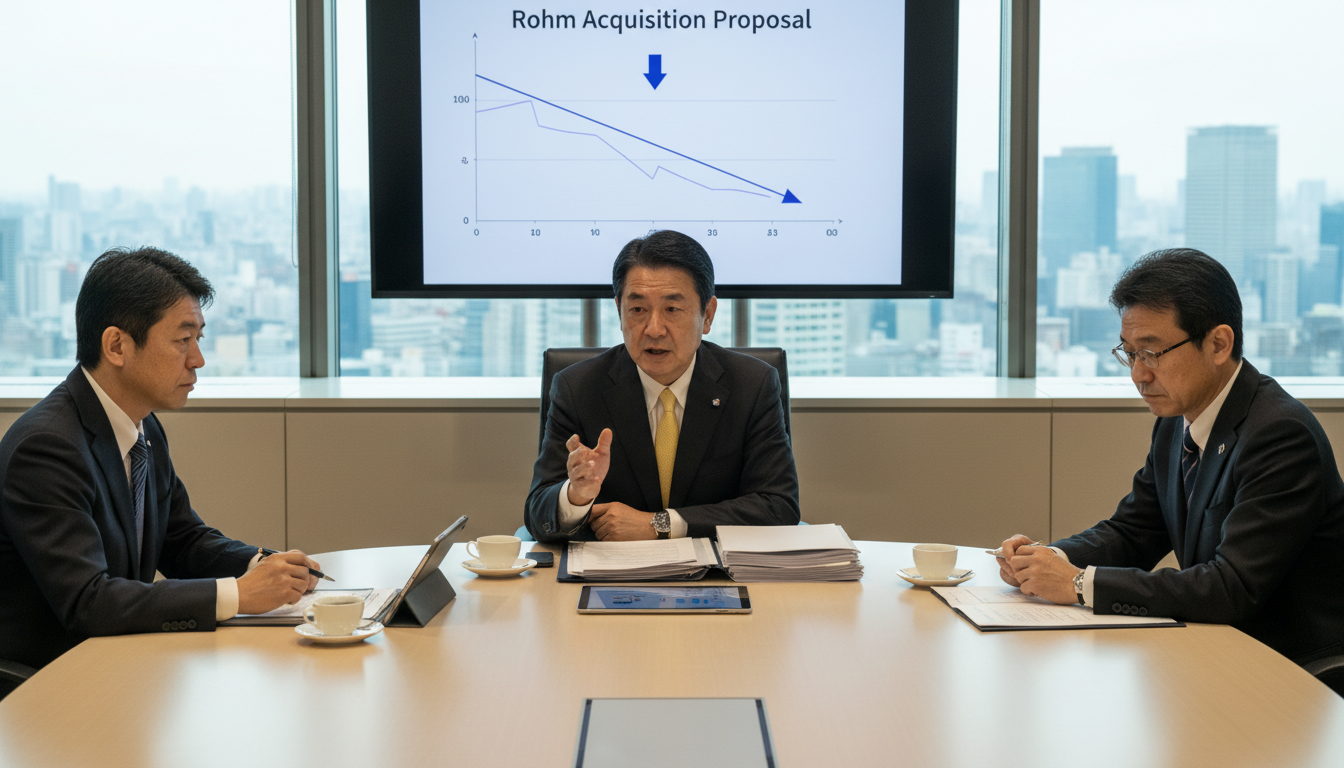
Denso May Withdraw Acquisition Proposal for Rohm as Three-Way Semiconductor Talks Advance
Denso may withdraw its acquisition proposal for Rohm as Rohm pursues semiconductor integration talks with Toshiba and Mitsubishi Electric now.
Denso’s potential decision to pull back from the Denso acquisition of Rohm marks a major development in Japan’s power semiconductor sector, industry sources said. The auto parts supplier, which sits within the Toyota Motor group, is reportedly struggling to secure Rohm’s support for its takeover offer. If Denso withdraws, consolidation in the domestic power semiconductor market appears likely to proceed through business-integration discussions centered on Rohm, Toshiba and Mitsubishi Electric. The move highlights strategic tensions between automotive-focused buyers and chipmakers seeking broader end-markets.
Denso Weighs Withdrawal of Rohm Offer
Denso initiated the acquisition proposal earlier this year as it seeks to bolster its chip capabilities amid long-term expectations for electric vehicle demand. Insiders say the company viewed Rohm’s power semiconductor portfolio as complementary to in-vehicle systems and a growth driver for the Toyota group’s electrification strategy.
But sources indicate Denso has encountered resistance from Rohm’s board and stakeholders, complicating negotiations. The lack of traction has prompted internal deliberations at Denso over whether to continue pursuing the acquisition or to formally withdraw the proposal.
Rohm Formed Special Committee to Review Offer
After the bid surfaced in early March, Rohm established a special committee to examine the merits and risks of the proposal, the company disclosed at the time. That committee’s mandate has included assessing strategic fit, valuation, governance implications and potential effects on Rohm’s non-automotive businesses.
People familiar with the matter say the committee’s deliberations have given Rohm’s management and directors ample opportunity to weigh alternatives. The existence of the committee has also signaled to other industry players that Rohm is exploring options beyond a single buyer.
Rohm Pursues Integration Talks with Toshiba and Mitsubishi Electric
On March 27, Rohm announced a basic agreement to begin talks on integrating its semiconductor operations with Toshiba and Mitsubishi Electric. Executives and analysts view those discussions as a pivot toward a domestic consolidation strategy aimed at creating a larger, more competitive power semiconductor group.
Such a three-way integration would seek to pool technology, manufacturing capacity and customer networks to better compete internationally. The talks are described by participants as preliminary, with detailed scope, timelines and governance arrangements yet to be agreed.
Concerns Over Automotive Focus Under Toyota Group
Some Rohm insiders have expressed concern that an acquisition by a Toyota-affiliated firm could narrow the company’s strategic focus toward automotive chips. Power semiconductors serve a wide range of end-markets, including home appliances, industrial machinery and energy systems, and preserving that diversification is a stated priority for several Rohm executives.
Those apprehensions have made certain shareholders cautious about any transaction that might reorient Rohm’s R&D and production toward vehicles alone. The tension between specialization for automotive demand and maintaining broad market exposure is a core issue shaping Rohm’s response to acquisition interest.
Market Pressures from Chinese and Global Competitors
Industry participants note that each Japanese power semiconductor maker is relatively small on a global scale, amplifying the urgency of consolidation. Chinese manufacturers and other global competitors have been expanding production and technological capability, intensifying pressure on domestic firms to scale up.
A larger, consolidated Japanese player could better allocate capital to next-generation wafer fabs and R&D for silicon carbide and other advanced materials. Observers say the stakes are high because power semiconductors are critical components for EVs and wider electrification trends worldwide.
Uncertainty Over Leadership and Integration Structure
Despite the momentum toward talks, the shape of any integration among Rohm, Toshiba and Mitsubishi Electric is unclear. Questions remain about which company would take the lead, how equity and board representation would be allocated, and whether the integration would take the form of a joint venture, asset transfers, or full-scale merger.
Executives engaged in preliminary discussions emphasize the need to reconcile differing corporate cultures, product portfolios and customer strategies. Until those governance and operational questions are resolved, participants expect negotiations to continue in a confidential and measured manner.
The outcome of Denso’s internal deliberations and Rohm’s parallel talks with Toshiba and Mitsubishi Electric will be closely watched by customers, investors and government officials. Any shift in ownership or a three-way integration could reshape Japan’s semiconductor landscape and affect supply chains for the automotive and industrial sectors.

