
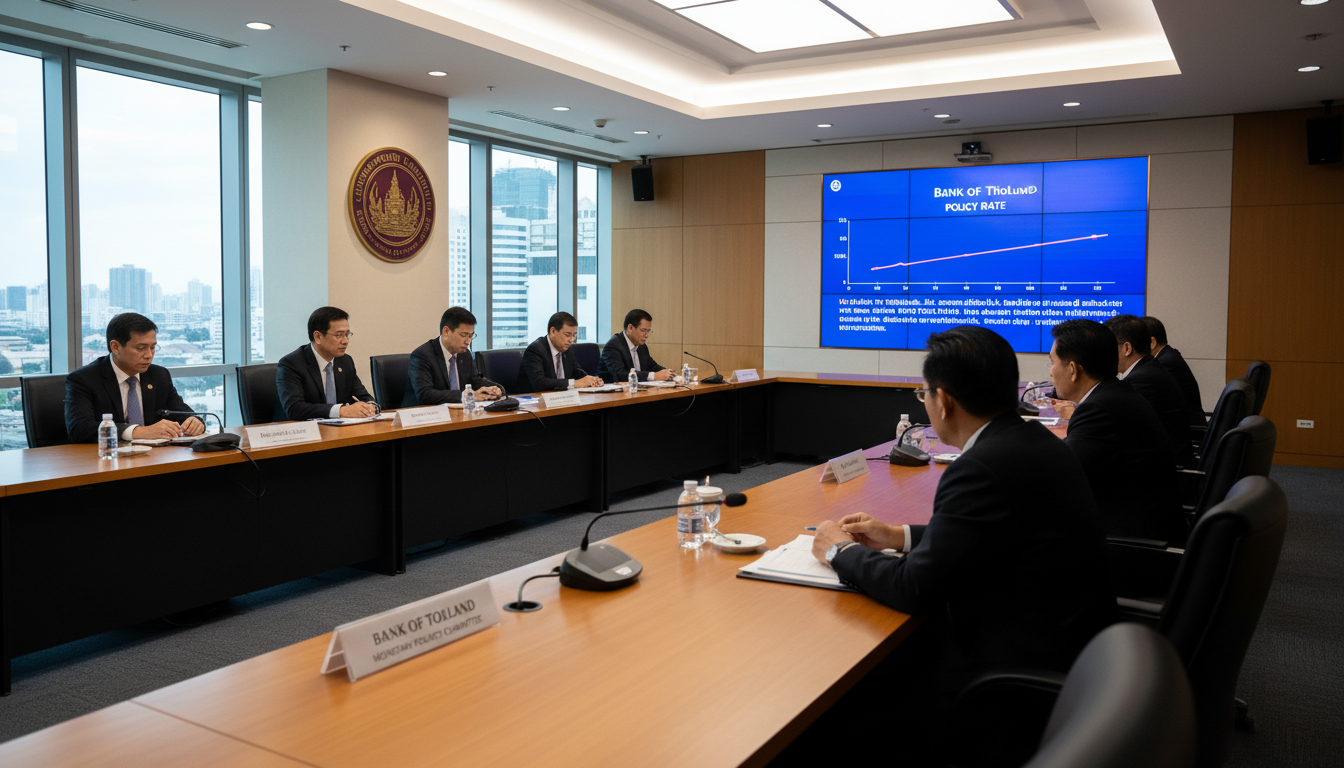
Bank of Thailand Keeps Policy Rate at 1%, Signals Room for Future Cuts
Bank of Thailand left its policy rate at 1% on April 28, citing Middle East tensions and domestic headwinds while signalling the possibility of future rate cuts to support growth.
Thailand’s central bank held its policy rate at 1% on April 28, keeping monetary settings unchanged amid rising international uncertainty and a fragile domestic recovery. The Bank of Thailand said it would monitor global developments — notably tensions in the Middle East — while retaining flexibility to ease policy if downside risks strengthen. Economists had broadly expected the decision and emphasised that the stance reflects a balance between inflation control and support for growth.
Bank of Thailand keeps policy rate at 1%
The decision to keep the policy rate unchanged comes as the Bank of Thailand evaluates several competing pressures on the economy. Core inflation has moderated from recent peaks, but price pressures and demand patterns remain uneven across sectors. By holding rates at 1%, the central bank has left room to adjust policy direction depending on how external shocks and domestic data evolve.
The Bank framed the move as cautious and conditional rather than definitive, underscoring that any future easing would depend on clearer evidence of persistent slack and disinflation. Market participants interpreted the statement as an explicit signal that cuts are on the table if the outlook deteriorates.
Central bank cites global and Middle East risks
Officials highlighted rising geopolitical tensions tied to the U.S.-Iran confrontation as a key source of uncertainty for Thailand’s outlook. Heightened conflict risks can lift oil prices and weigh on trade and investor sentiment, complicating the central bank’s policy calculus. The Bank of Thailand said it was watching energy markets closely because any sustained rise in fuel costs could feed into domestic inflation and consumption patterns.
Beyond the Middle East, the central bank noted that global growth softness and tighter financial conditions in some economies could reduce external demand for Thai exports. With tourism recovery still vulnerable to swings in global travel and sentiment, officials framed international risks as an important reason for maintaining policy flexibility.
Domestic inflation, growth and tourism dynamics
Inflation in Thailand has cooled compared with previous months, but core measures have not yet returned comfortably within target ranges in all categories. Household spending and investment have improved since the pandemic, yet growth momentum is uneven and concentrated in services tied to tourism. The Bank of Thailand pointed to lingering downside risks to activity that could justify a more accommodative stance if conditions fail to strengthen.
Tourism — a key driver of Thailand’s recovery — has supported jobs and consumption but remains sensitive to external shocks and seasonal patterns. Slower-than-expected recovery in certain markets or renewed travel disruptions could dampen receipts and tilt the economy toward below-potential growth. Policymakers said they would weigh such developments against inflation trajectories when setting policy.
Market and currency reaction
Financial markets responded to the central bank’s message with modest adjustments rather than dramatic moves, reflecting that the decision matched broad expectations. Short-term government bond yields and money market rates showed limited volatility after the announcement, while analysts reassessed timing for any potential rate reductions. The Thai baht experienced slight swings as investors balanced safe-haven flows against regional capital dynamics.
Local banks and corporate borrowers welcomed the prospect of eventual easing, noting that lower policy rates would reduce borrowing costs and support credit growth. At the same time, market analysts cautioned that any rate cuts would be contingent on clearer signs of weakening demand and sustained disinflation, keeping immediate market pricing cautious.
Monetary policy outlook and potential cuts
The Bank of Thailand signalled that future cuts remain possible should downside risks materialise and inflationary pressures subside. Policymakers indicated they would use data-dependent judgement, prioritising both price stability and a sustainable recovery in employment and output. Analysts now see a window in which one or more rate cuts could be deployed later in the year if global tensions ease and domestic demand shows signs of prolonged softness.
The central bank’s guidance aims to anchor expectations while preserving flexibility, a strategy designed to avoid abrupt shocks to markets and households. Any reduction in the policy rate would be calibrated and contingent on incoming economic indicators, particularly on core inflation trends, export performance and tourist receipts.
Thailand’s economy remains sensitive to external shocks, and the Bank of Thailand’s stance reflects a cautious approach to navigating that vulnerability. The decision to hold at 1% keeps monetary policy accommodative relative to many peers while signalling readiness to act if downside scenarios strengthen.

